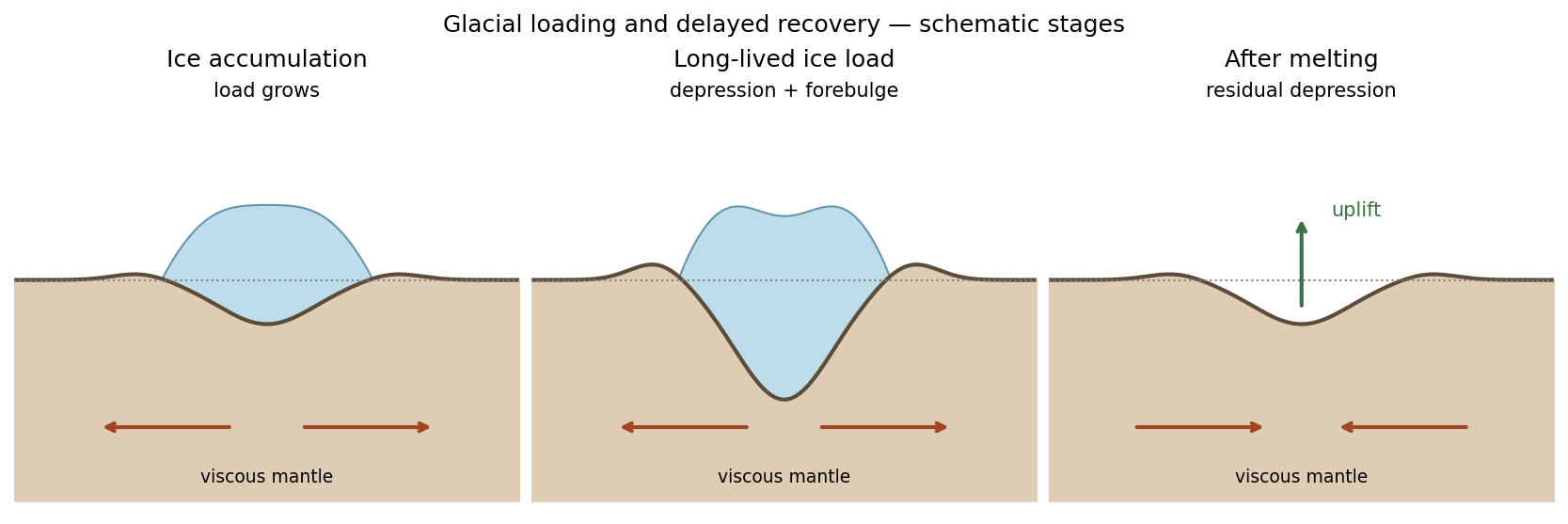
Ice accumulation adds a load that produces an immediate elastic response and slower viscous displacement of the mantle away from the loaded region. The depressed interior may be accompanied by a peripheral forebulge. A long-lived load approaches an approximately compensated state. Melting removes the load, giving rapid elastic recovery followed by mantle return flow and gradual uplift. The forebulge can subside while the formerly loaded centre rises.
Postglacial rebound can continue long after the ice disappears, because mantle relaxation is slow. Raised shorelines, changing relative sea level, vertical geodetic motion and gravity changes record glacial isostatic adjustment. Present motion depends on the whole loading and melting history, mantle rheology and lithospheric stiffness, not only the current absence of ice.

Subtract the background hydrostatic pressure. A relief amplitude produces a restoring pressure perturbation and horizontal gradient . Incompressibility makes the disturbance penetrate a depth of order its horizontal scale. For sinusoidal viscous rebound, with relaxation speed , the viscous force density is . Balancing givesThis is a small-amplitude viscous half-space estimate; numerical factors from the sinusoidal geometry are absent from a scaling argument.
Unsteady inertial force density scales as , whereas viscous force density scales as . Using the preceding timescale givesConvective inertia has ratio . Since , this is smaller by for small relief. Thus the displayed estimate controls the larger inertial contribution in this model.
Assume the original ice sheet had time to reach local isostatic compensation, melted rapidly relative to subsequent rebound, and left one exponentially relaxing depression mode. Neglect elastic layering and assign the whole present gravity deficit to that unrelaxed depression. Load balance givesThe supplied sheet-gravity approximation gives the residual amplitudeFrom ,For an order-of-magnitude single-mode estimate, choose the ice-sheet diameter as wavelength, . Taking , the more accurate specified relation then givesA circular load has a spectrum, not one uniquely specified wavelength. Choosing instead gives about ; another wavelength convention rescales the answer linearly. The robust inference is viscosity of order within this simple model. A realistic estimate would also model gradual melting, other gravity anomalies, density interfaces, lithospheric flexure and depth-dependent mantle viscosity.
Using the same diameter convention and viscosity estimate,Geometrical factors omitted in the scaling do not affect the conclusion: inertia is negligible. Convective inertia is smaller still by the small relief-to-wavelength ratio. Mantle creep is extremely slow despite the large length scale.
Articles by others on the same topic
There are currently no matching articles.