The positive centers in the supplied maps are examples of lunar mascons, especially associated with large impact basins. An empty excavation by itself removes mass and would not explain a positive central anomaly. Basin formation can thin the low-density lunar crust and raise denser lunar mantle beneath the floor; impact melting, collapse and later cooling can also create dense material and lock in a mass excess. Where a basin was later flooded, dense mare basalt adds another contribution. Mare infill is therefore one possible contributor, not a necessary explanation of every mascon.[ref]
NASA's GRAIL Mission Solves Mystery of Moon's Surface Gravity by National Aeronautics and Space Administration. Mission-team account of impact excavation, collapse, cooling and the central mass excess, 30 May 2013
The difference between the maps is the modeled topographic contribution. On a common reference surface, write schematicallyThe free-air gravity anomaly retains relief-related attraction. Rims, excavated floors and central peaks therefore contribute fine structure. The Bouguer gravity anomaly removes the attraction predicted from the measured topography at an assumed crustal density, making internal density and interface structure more apparent. A low basin floor has a negative topographic contribution; subtracting it can enhance an underlying positive central anomaly. Removing a positive rim contribution can weaken a rim high. The supplied lower map is correspondingly smoother at short wavelengths and shows prominent residual basin centers and surrounding rings. This is a change of gravity reduction, not a physical change of the craters.[ref]
GRGM900C: A degree 900 lunar gravity model from GRAIL primary and extended mission data by Frank G. Lemoine and others. Sections 4.2–4.3, gravity predicted from topography and its subtraction to obtain Bouguer gravity
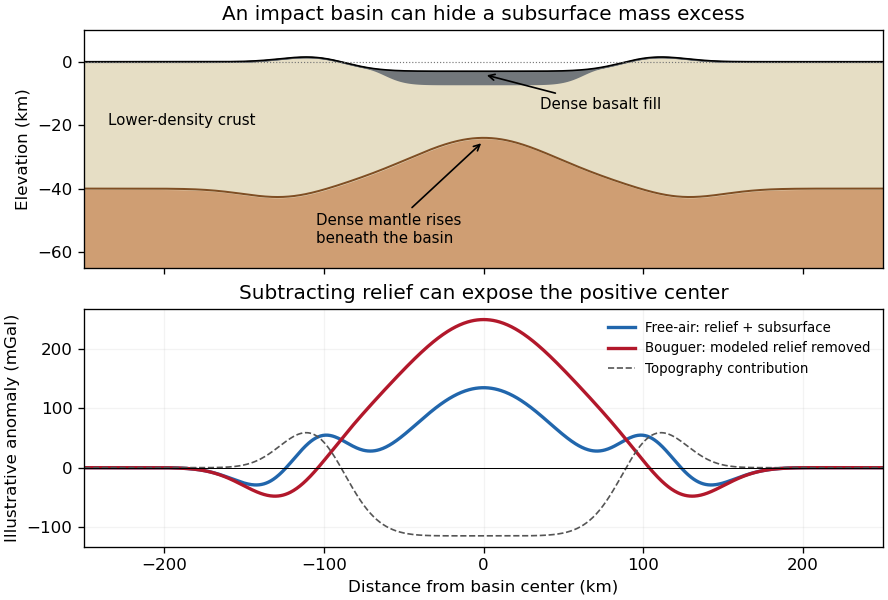
Original schematic showing how dense fill and mantle uplift can outweigh an excavated basin's missing surface mass; illustrative curves are not GRAIL measurements
. Details. 
For scale, a Bouguer slab approximation gives . A km layer with geophysical density contrast produces about mGal above an ideal infinite slab. Actual basin geometry, burial, porosity and mantle uplift require a finite three-dimensional model. Smaller craters can have central lows, damaged porous interiors or more complex rings; the maps do not imply that every crater has a positive anomaly or that positive anomalies measure basalt thickness uniquely.
Articles by others on the same topic
There are currently no matching articles.