The lunar crustal dichotomy combines several observables: the far side of the Moon has generally thicker, higher, feldspathic lunar highlands, whereas most visible lunar maria and the Procellarum KREEP Terrane occupy the near side of the Moon. These need not all have been produced by a single event. The old anorthosite crust formed mainly before the younger basaltic mare infill. Gravity-based crustal models combined with sample and seismic constraints demonstrate that crustal thickness and porosity must be considered alongside surface color.[ref]
The Crust of the Moon as Seen by GRAIL by Mark A. Wieczorek and colleagues. Science 339, p. 671, crustal density, porosity and thickness constraints
An early thermal and chemical asymmetry is one physically motivated option. In a lunar magma ocean, crystallizing, relatively buoyant plagioclase can accumulate to form feldspathic crust. On a young Moon that rapidly attained synchronous rotation, radiation from a still-hot nearby Earth would preferentially warm the nearside. The primordial Earthshine hypothesis proposes that this imposed a thermal gradient in the atmosphere and accreting material: crust-forming refractory constituents condensed preferentially toward the cooler farside, favoring thicker farside crust. This is more specific than simply saying that the farside cooled faster; it requires a persistent hemispheric chemical contrast.[ref]
Earthshine on a Young Moon: Explaining the Lunar Farside Highlands by Arpita Roy and others. Sections 2–4, early tidal locking, condensation gradient and survival of compositional asymmetry
Subsequent concentration of incompatible elements in KREEP-rich late liquids can help preserve a thermal asymmetry: potassium, uranium and thorium provide radiogenic heating, supporting later melting in the nearside source region. Lower surface elevation and a thinner crust also facilitate some magma transport and pooling, although crustal thickness alone cannot specify eruption rates. The origin of the crustal contrast and the later production and emplacement of mare basalt are separate parts of the explanation.
The thermal option is consistent with a thick feldspathic farside crust, a hemispheric chemical contrast and the existence of an early hot Earth. It is not uniquely demonstrated by those observations. Vigorous magma-ocean mixing could erase the proposed gradient; the required irradiation must persist during the relevant condensation and crust-building interval, not merely occur at some early time. A failure to find the predicted bulk compositional contrast in demonstrably ancient deep crust, or a chronology placing the asymmetry after complete crystallization, would challenge this particular mechanism. The existence of farside mare deposits and large thin-crust basins also warns against treating thickness as an on/off volcanic switch.
Accretion of a smaller companion is a contrasting option. A low-speed collision of a smaller co-orbiting moon with the lunar farside could add a broad layer of relatively cold silicate material rather than excavate an ordinary deep crater. Numerical impact models demonstrate that such a depositional event can build thick highlands and displace underlying residual liquid toward the opposite hemisphere.[ref]
Forming the lunar farside highlands by accretion of a companion moon by Martin Jutzi and others. Nature 476, pp. 69–72, accretionary collision model
Broad crustal excess and asymmetric evolved material are compatible with that mechanism, but are not unique evidence for it. The necessary companion, collision timing and impact geometry must be dynamically feasible. A predicted buried depositional interface, age discontinuity or lateral fabric should survive somewhere; their systematic absence in well-resolved, unmodified ancient crust would count against the model. Closely related bodies could have similar isotopes, so failure to find a large isotopic difference alone would not disprove accretion.Both scenarios allow later basin impacts, partial melting of the lunar mantle and mare emplacement to modify the original contrast. A useful explanation must reproduce crustal mass, chemistry, chronology and volcanic distribution together, and state which observations would distinguish its initial cause.
I would test whether the ancient farside crust grew locally with an early thermal/compositional gradient or acquired a substantial later accreted layer. The research programme should estimate a globally consistent crustal mass and chronology before tuning either mechanism to a single attractive map.
First, map crustal geometry with independent density constraints. Jointly invert GRAIL gravity and laser-altimeter surface topography, allowing spatially varying density and porosity rather than converting every anomaly to thickness. A new broad-band seismic network should include farside stations, long-lived polar power systems and a communications relay. Natural impacts and moonquakes, supplemented by calibrated active sources near landing sites, would constrain layer velocities, attenuation, crustal interfaces and the crust-mantle boundary. Crossing ray paths and receiver-side conversions are essential to distinguish a thick crust from an incorrect density or velocity assumption. A coherent buried layer or age-correlated discontinuity across the farside would favor addition or stacking; a gradual hemispheric compositional gradient would better support asymmetric local growth. Neither pattern is guaranteed to survive later impacts.
Second, obtain samples that address the initial contrast. Collect geographically distributed ancient highland rocks from both hemispheres, using basin ejecta, central peaks and drilling to sample beneath the impact-gardened regolith. Return samples with mapped geological context. Mineral chemistry and bulk Ca–Al–Mg–Fe abundances would test a primary refractory gradient; crystallization ages would date crustal construction, while shock-reset ages would date overprinting. Isotopic and trace-element measurements could identify an accreted population, but similar isotopes are possible for material derived from the same early debris system. A young deposit draped over older crust would favor accretion; coeval flotation-related crust with a systematic chemical gradient would favor local asymmetric differentiation. Multiple sites are necessary because a single basin's ejecta can mix distant sources.
Third, measure the thermal and volcanic consequences. Place shielded, sufficiently deep heat flow probes in representative highlands and mare terrains. Combine their geothermal gradients and measured thermal conductivity with orbital gamma-ray constraints on heat-producing elements. Map mare volumes and eruption ages, rather than only their exposed areas, to separate melt production from storage and eruption efficiency. A strong correlation between late volcanism, subsurface heat producers and high inferred mantle temperatures would support radiogenic amplification, while old crustal asymmetry without that correlation would show that later heating is not the entire cause.
Finally, compare forward models against withheld observations. Couple irradiation, vapor transport, condensation, lunar magma ocean mixing and crystallization for the thermal scenario; couple orbital evolution, impact deposition, mixing and later viscous relaxation for accretion. Account for later true polar wander before treating present-day hemispheric orientation as the original formation geometry. Require each model to conserve mass and energy and to reproduce the independent thickness, chemistry, age and volcanic data within their uncertainties. Vary unknown initial conditions and compare predicted observables at sites not used for calibration. The discriminating outcome is a conjunction such as a coherent accreted unit with a consistent emplacement age, or an ancient chemical gradient quantitatively consistent with transport under Earth irradiation. A lower gravity misfit alone cannot establish the historical mechanism, because gravity is a nonunique inverse problem.
The positive centers in the supplied maps are examples of lunar mascons, especially associated with large impact basins. An empty excavation by itself removes mass and would not explain a positive central anomaly. Basin formation can thin the low-density lunar crust and raise denser lunar mantle beneath the floor; impact melting, collapse and later cooling can also create dense material and lock in a mass excess. Where a basin was later flooded, dense mare basalt adds another contribution. Mare infill is therefore one possible contributor, not a necessary explanation of every mascon.[ref]
NASA's GRAIL Mission Solves Mystery of Moon's Surface Gravity by National Aeronautics and Space Administration. Mission-team account of impact excavation, collapse, cooling and the central mass excess, 30 May 2013
The difference between the maps is the modeled topographic contribution. On a common reference surface, write schematicallyThe free-air gravity anomaly retains relief-related attraction. Rims, excavated floors and central peaks therefore contribute fine structure. The Bouguer gravity anomaly removes the attraction predicted from the measured topography at an assumed crustal density, making internal density and interface structure more apparent. A low basin floor has a negative topographic contribution; subtracting it can enhance an underlying positive central anomaly. Removing a positive rim contribution can weaken a rim high. The supplied lower map is correspondingly smoother at short wavelengths and shows prominent residual basin centers and surrounding rings. This is a change of gravity reduction, not a physical change of the craters.[ref]
GRGM900C: A degree 900 lunar gravity model from GRAIL primary and extended mission data by Frank G. Lemoine and others. Sections 4.2–4.3, gravity predicted from topography and its subtraction to obtain Bouguer gravity
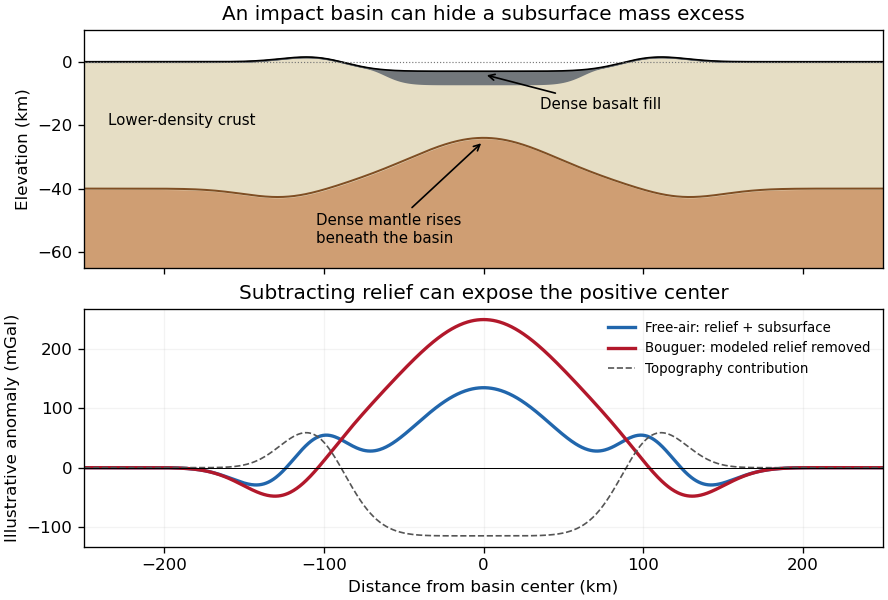
Original schematic showing how dense fill and mantle uplift can outweigh an excavated basin's missing surface mass; illustrative curves are not GRAIL measurements
. Details. 
For scale, a Bouguer slab approximation gives . A km layer with geophysical density contrast produces about mGal above an ideal infinite slab. Actual basin geometry, burial, porosity and mantle uplift require a finite three-dimensional model. Smaller craters can have central lows, damaged porous interiors or more complex rings; the maps do not imply that every crater has a positive anomaly or that positive anomalies measure basalt thickness uniquely.
Articles by others on the same topic
There are currently no matching articles.