A useful idealization is a thin sedimentary cover over a felsic upper continental crust, an intermediate middle continental crust, and a more mafic lower continental crust, ending at the Mohorovičić discontinuity at about 35–40 km. The boundaries within the continental crust are approximate compositional divisions, not three universal sharp interfaces.
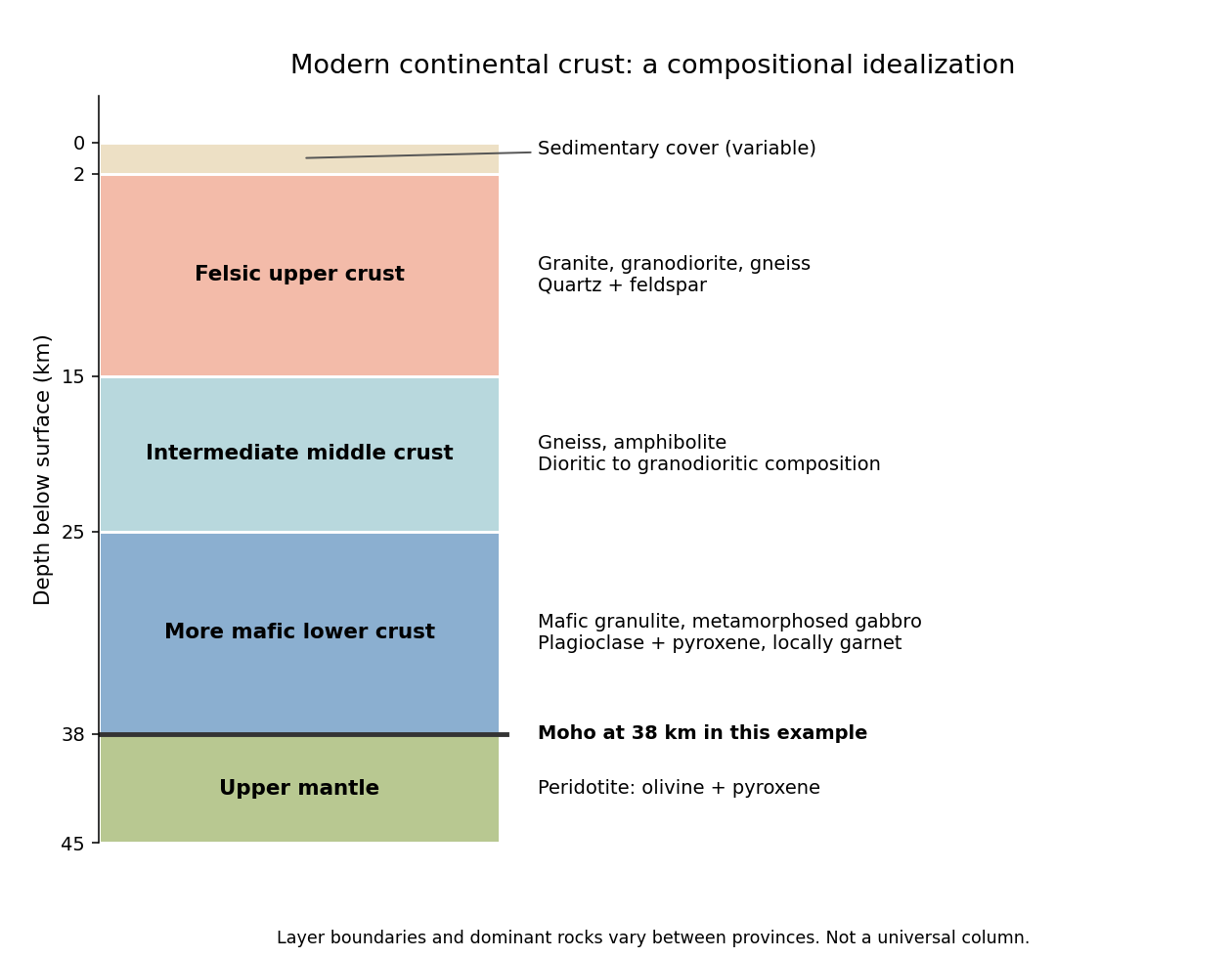
An idealized modern continental crustal column
. An original schematic for a 38 km thick continental crust. Depth ranges illustrate a compositional tendency; individual provinces have different lithologies and boundaries. Details.
- At the surface, a variable, commonly kilometre-scale sedimentary cover contains sediments and sedimentary rocks. Exposed crystalline basement can instead occur at the surface.
- In the upper roughly 15 km, representative rocks are granite, granodiorite and compositionally related gneiss, with quartz and feldspar. Sedimentary rocks, metamorphic rocks and volcanic rocks make this layer heterogeneous.
- At roughly 15–25 km, intermediate gneiss and amphibolite-facies assemblages become important. Diorite to granodiorite compositions and amphibole- and plagioclase-bearing rocks are representative.
- At roughly 25–38 km, mafic granulite and gabbro-derived metamorphic rocks are a useful average, with plagioclase, pyroxene and sometimes garnet. Some provinces instead have substantially intermediate or felsic lower continental crust.
- Below the Mohorovičić discontinuity is peridotite of the mantle, dominated by olivine and pyroxene. This is not a fourth crustal layer.
The important trend is increasing average mafic character with depth, rather than a change from granite directly to peridotite. Granulite describes a metamorphic facies, not a unique chemical composition. The synthesis in Nature and composition of the continental crust: A lower crustal perspective by Roberta L. Rudnick and David M. Fountain combines seismic and petrological evidence for these distinctions.
Articles by others on the same topic
There are currently no matching articles.