In the nearly-free electron model, a weak periodic potential has Fourier components that couple plane waves at and . Far from a degeneracy their admixture gives small perturbative energy shifts. At a Bragg plane, however,so degenerate perturbation theory is required. In one dimension the first such crossing is at , the boundary of the first Brillouin zone.
Within the degenerate pair the eigenvalues are . ThusThe eigenstates are standing-wave combinations of counterpropagating waves. Their charge densities sit differently relative to the ionic potential, giving different potential energies and removing the free-electron degeneracy. The resulting avoided crossing produces continuous allowed energy bands separated by a forbidden interval. A Fourier component or symmetry-allowed coupling is needed: geometry alone does not require every possible gap to be nonzero.
Write for the coupling Fourier coefficient, with for the supplied cosine potential. Projecting the Schrödinger equation onto the two retained plane waves givesThe diagonal potential average is zero. The characteristic equation isso the nearly-free electron dispersion near a one-dimensional band gap isOnly the coupling magnitude enters the energies; its sign changes the standing-wave eigenvectors. The two-wave truncation is controlled near this crossing when , since the other plane waves are separated by much larger kinetic energies.
Let and take as the coupling magnitude. The dispersion becomesExpanding the square root at the boundary givesUsing , the band-edge effective mass in a weak periodic potential isThe requested expression is the leading weak-potential limit. The upper band has positive band curvature and small positive effective mass; the lower band has negative curvature at its maximum and can instead be described by positive-mass electron holes. The small- expansion additionally requires ; its validity interval shrinks with the gap.
An acoustic phonon branch approaches zero frequency linearly, , because a long-wavelength translation has no restoring force. An optical phonon branch has nonzero frequency at and represents relative motion of atoms within a primitive unit cell. Such an optical branch requires more than one independent atom per primitive cell; a truly monatomic simple-cubic model has only the acoustic branches.
The Bose occupation is . At low temperature, appreciably populated acoustic modes haveAs temperature falls, the available phonon wavevectors concentrate near the zone centre and optical modes freeze out when . These are thermal-occupation restrictions, not a change in the allowed geometric Brillouin zone.
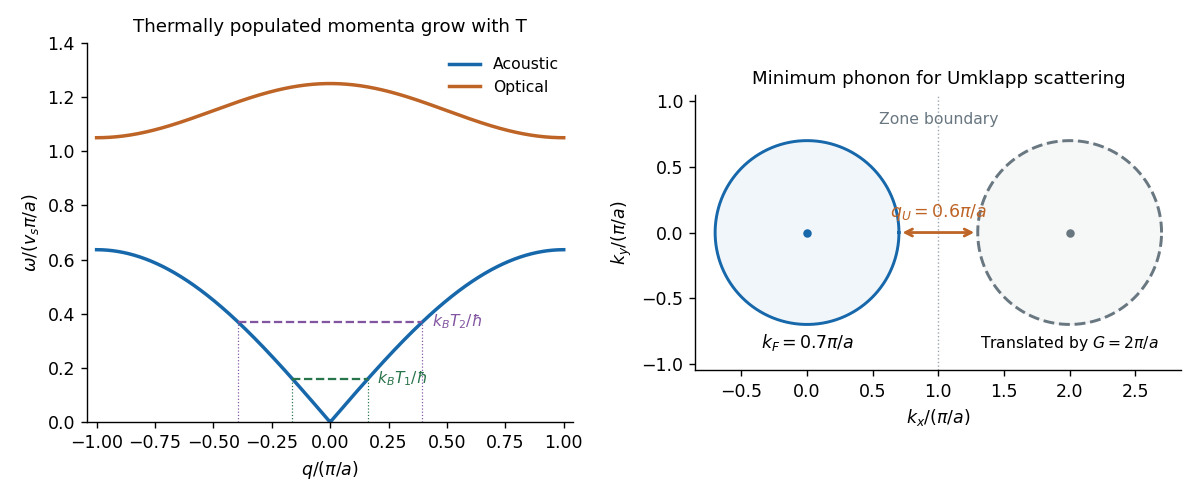

For a spherical Fermi surface inside a primitive cubic lattice zone, the shortest reciprocal vector has magnitude . The nearest translated Fermi sphere is separated by the electron-phonon Umklapp thresholdA phonon of this wavevector can connect nearly opposite-velocity Fermi states using , transferring reciprocal-lattice momentum to the crystal and efficiently relaxing electrical current. With the supplied sound speed, its thermal scale isFor such phonons have exponentially small occupation. As they become populated, Umklapp scattering can make the electrical conductivity fall rapidly. Lower-energy normal scattering and residual disorder still give resistance below this scale; this is a crossover estimate, not a sharp transition. The numerical estimate extrapolates the linear acoustic dispersion to and assumes the spherical Fermi surface implicit in giving one .
Using alone as the phonon wavevector misses this mechanism: direct backscattering would need , beyond the first-zone edge along this direction, while the reciprocal-lattice transfer permits it with .
Articles by others on the same topic
There are currently no matching articles.