For a lattice-periodic one-electron Hamiltonian, Bloch's theorem givesHere is any lattice translation and labels an energy band. Under that translation the wavefunction gains phase . The crystal momentum labels this translation eigenvalue and is defined modulo for a reciprocal lattice vector .
The mechanical momentum is different. In zero magnetic field its operator is , which acts asA general Bloch state is therefore not a mechanical-momentum eigenstate. Expanding its periodic factor gives plane-wave components with momenta , with probabilities determined by their Fourier coefficients. For a local Hamiltonian , its mean momentum satisfiesnot generally . The lattice exchanges actual momentum with the electron; crystal-momentum conservation in scattering is instead modulo reciprocal-lattice vectors, as in Umklapp scattering.
Use Thomas-Fermi screening, treating a homogeneous three-dimensional conductor in static linear response. For a positive test charge the screened electric potential and bare Coulomb potential areHere is the background permittivity before the mobile carriers screen; it is in the simplest free-electron model. Both curves have the same leading divergence near the origin, while the screened curve lies below the bare one and decays much faster.
A positive potential attracts Electrons. If is their total spin-summed density of states per volume and energy, and . Inserting this charge into Poisson equation gives the Thomas-Fermi screening lengthA larger density of states lets the conductor rearrange more charge for the same potential change and shortens the screening length. For a parabolic free electron model, , hence .
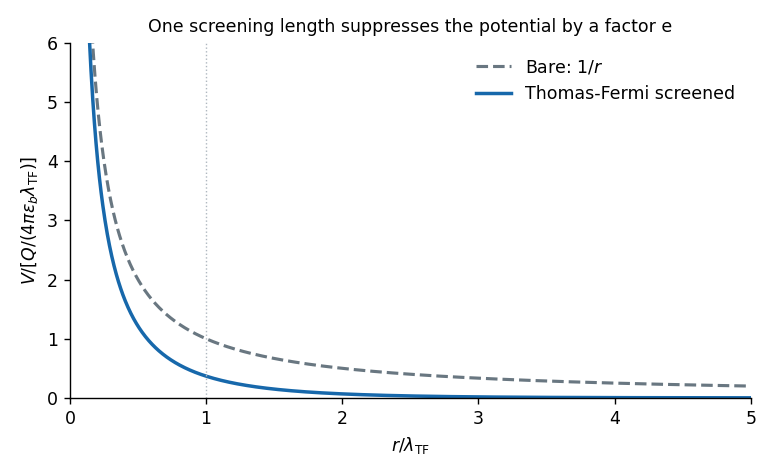

The exponential form is the intended local screening model. A microscopic zero-temperature metal also has Friedel oscillations, so the exponential alone is not an exact description at every length scale.
The Moiré pattern sets a superlattice periodFor the stipulated scalar one-dimensional model, right- and left-moving states have . The th Bragg crossing satisfies and hence . The Bragg gap ladder for a linear dispersion therefore has centresThis is the spacing of successive possible Bragg gaps. The corresponding atomic-lattice scale is , fifty times larger.
Shifting a linear branch by one full reciprocal period instead gives , twice the consecutive Bragg-threshold spacing; the first zone boundary is at . These scales should not be confused with the gap width, which depends on the weak potential's Fourier coefficients. The geometry alone does not guarantee equally wide or even observable gaps at every threshold, nor an exactly periodic full spectrum. The estimate neglects graphene's additional pseudospin selection rules and interlayer correlations, as required by the scalar-chain approximation.
In the nearly-free electron model, a weak periodic potential has Fourier components that couple plane waves at and . Far from a degeneracy their admixture gives small perturbative energy shifts. At a Bragg plane, however,so degenerate perturbation theory is required. In one dimension the first such crossing is at , the boundary of the first Brillouin zone.
Within the degenerate pair the eigenvalues are . ThusThe eigenstates are standing-wave combinations of counterpropagating waves. Their charge densities sit differently relative to the ionic potential, giving different potential energies and removing the free-electron degeneracy. The resulting avoided crossing produces continuous allowed energy bands separated by a forbidden interval. A Fourier component or symmetry-allowed coupling is needed: geometry alone does not require every possible gap to be nonzero.
Write for the coupling Fourier coefficient, with for the supplied cosine potential. Projecting the Schrödinger equation onto the two retained plane waves givesThe diagonal potential average is zero. The characteristic equation isso the nearly-free electron dispersion near a one-dimensional band gap isOnly the coupling magnitude enters the energies; its sign changes the standing-wave eigenvectors. The two-wave truncation is controlled near this crossing when , since the other plane waves are separated by much larger kinetic energies.
Let and take as the coupling magnitude. The dispersion becomesExpanding the square root at the boundary givesUsing , the band-edge effective mass in a weak periodic potential isThe requested expression is the leading weak-potential limit. The upper band has positive band curvature and small positive effective mass; the lower band has negative curvature at its maximum and can instead be described by positive-mass electron holes. The small- expansion additionally requires ; its validity interval shrinks with the gap.
An acoustic phonon branch approaches zero frequency linearly, , because a long-wavelength translation has no restoring force. An optical phonon branch has nonzero frequency at and represents relative motion of atoms within a primitive unit cell. Such an optical branch requires more than one independent atom per primitive cell; a truly monatomic simple-cubic model has only the acoustic branches.
The Bose occupation is . At low temperature, appreciably populated acoustic modes haveAs temperature falls, the available phonon wavevectors concentrate near the zone centre and optical modes freeze out when . These are thermal-occupation restrictions, not a change in the allowed geometric Brillouin zone.
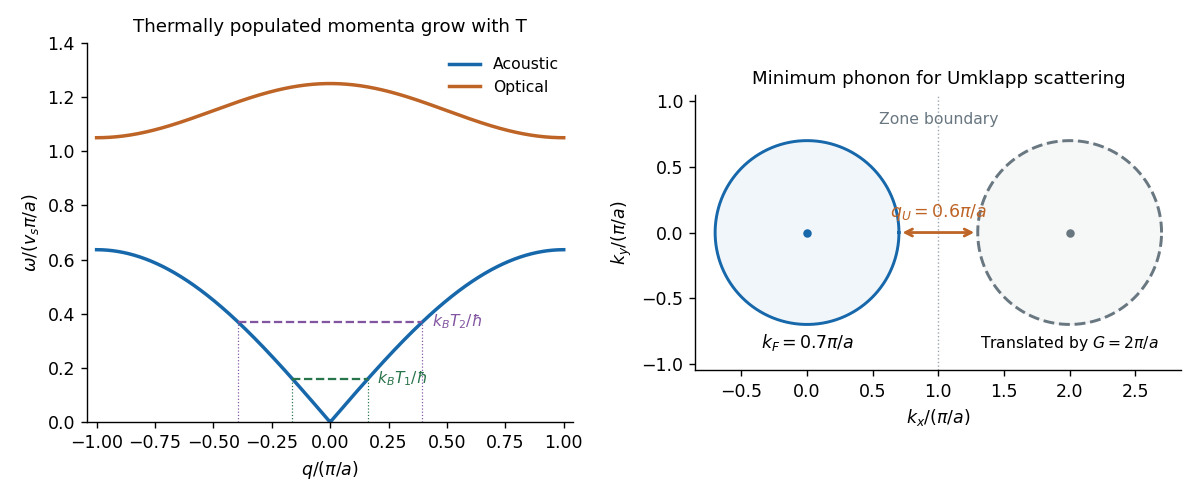

For a spherical Fermi surface inside a primitive cubic lattice zone, the shortest reciprocal vector has magnitude . The nearest translated Fermi sphere is separated by the electron-phonon Umklapp thresholdA phonon of this wavevector can connect nearly opposite-velocity Fermi states using , transferring reciprocal-lattice momentum to the crystal and efficiently relaxing electrical current. With the supplied sound speed, its thermal scale isFor such phonons have exponentially small occupation. As they become populated, Umklapp scattering can make the electrical conductivity fall rapidly. Lower-energy normal scattering and residual disorder still give resistance below this scale; this is a crossover estimate, not a sharp transition. The numerical estimate extrapolates the linear acoustic dispersion to and assumes the spherical Fermi surface implicit in giving one .
Using alone as the phonon wavevector misses this mechanism: direct backscattering would need , beyond the first-zone edge along this direction, while the reciprocal-lattice transfer permits it with .
A magnetic field quantizes the transverse cyclotron motion into Landau levels. For a parabolic band, this is a harmonic oscillator with , , where and the half arises from its zero-point energy. Equivalently, semiclassical orbit quantization gives the stated flux sequence in increments of .
To relate real and momentum space, take and electron charge . The semiclassical Lorentz force isConsequently and . The real-space orbit is a rotated copy of the transverse wavevector orbit, scaled by . Their areas satisfy . Since ,This is Onsager quantization for the ordinary half-integer phase. For a circular parabolic orbit, reproduces the Landau energy spacing. The flux increment here concerns a single electron; it is distinct from the superconducting pair flux unit.
As changes, each quantized orbit area grows linearly with field while the Fermi surface cross-section stays approximately fixed. Landau energies repeatedly cross the Fermi energy, making the density of states there oscillate. If the relevant extremal orbit has area , its crossings satisfyThus the oscillations are periodic in inverse field rather than field. In three dimensions integration over longitudinal momentum makes extremal cross-sections dominate.
One observable is the de Haas-van Alphen effect: the field-dependent occupation changes the electronic free energy, so its field derivative, the magnetization, oscillates. The corresponding oscillations of longitudinal electrical resistance are the Shubnikov-de Haas effect. Both probe Fermi-surface geometry.
The two voltage contacts in the inset lie along the current direction. The measured signal is therefore longitudinal resistance in a Hall bar, not the transverse Hall voltage.
The peaks are Shubnikov-de Haas oscillations: a broadened Landau level passes through the Fermi level, increasing the density of accessible extended states and longitudinal dissipation. Between levels the longitudinal resistance falls. At smaller , hence larger , some orbital peaks resolve into separate spin branches because of Zeeman splitting, . The splitting becomes visible when it exceeds the disorder broadening and thermal smearing. Its ratio to the orbital spacing can remain roughly constant while both become larger relative to these smearing scales.
Without material or spin information one cannot exclude other internal degeneracies in every conceivable 2D system, but the conventional interpretation requested here is unresolved spin degeneracy at low field and resolved spin peaks at high field.
For interface area , each resolved spin branch has one state per flux increment , so its degeneracy of a Landau level isIf such branches are occupied, including fractional occupation of the highest, the filling factor givesThe filling counts spin and any other internal branches separately; it is an integer when a whole number of resolved levels are full.
From the visible PDF axes, approximately ten unsplit periods lie between and , giving . Consecutive unsplit orbital peaks differ by two occupied spin branches, so carrier density from spin-degenerate quantum oscillations givesThe precision is limited by reading the plotted trace, roughly a few percent. The factor two assumes only spin remains unresolved in that part of the graph; counting individual spin-split peaks would instead use a one-branch filling increment.
At large inverse field, and the cyclotron frequency are small, so the orbital spacing becomes comparable with both disorder broadening and the Fermi occupation's thermal width. Scattering of quantum lifetime gives a typical half-width ; overlapping levels lose their density-of-states contrast. The fundamental Dingle factor and thermal damping of quantum oscillations areBoth shrink rapidly as falls. Well-resolved oscillations require a sufficiently large and a temperature small compared with the orbital spacing. The scattering time in this broadening argument is not automatically the transport time inferred from mobility; small-angle events affect the two differently.
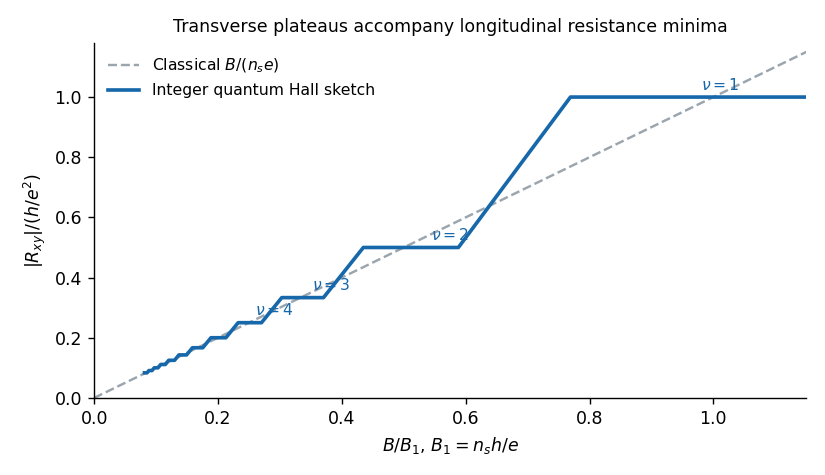
The transverse Hall resistance is approximately in the classical weak-field regime. At stronger fields the integer quantum Hall effect produces plateausaccompanied by nearly vanishing longitudinal resistance. Localized bulk states between extended Landau states allow plateau intervals, while current can be carried by quantum Hall edge states. At still larger fields and sufficiently low temperature, the cleanest samples show the fractional quantum Hall effect, with interaction-generated incompressible states at fractional fillings such as . The sign of depends on the contact and magnetic-field orientation; the sketch shows its magnitude.

A doublet has moment projections . The requested normalization assumes , so the projections are and the two Zeeman energies are . For independent localized ions, the one-ion partition function and thermal moment areTherefore the spin-one-half paramagnetic magnetization isIt saturates at for a field strong compared with . For a different Landé g-factor, replace every moment by ; alone does not fix that factor.
At weak field or high temperature, and , soUsing for the applied-field response and neglecting demagnetizing corrections, the SI volume magnetic susceptibility isThis is Curie's law. If susceptibility is instead defined as , its Curie constant is without ; stating which field is used prevents a units error.
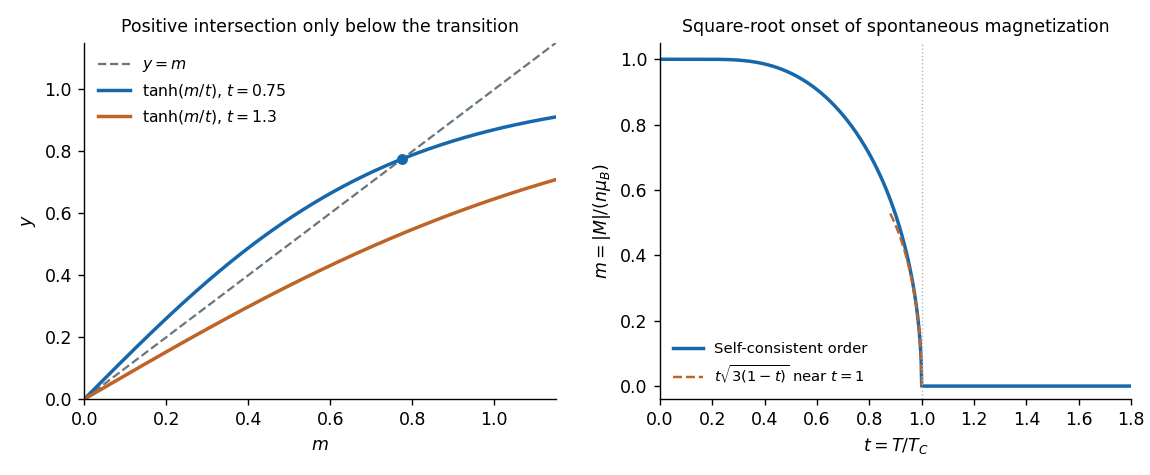
Replace the applied field in the doublet response by the Weiss molecular field . At zero applied field,The equation is odd in , so the two ordered orientations have equal magnitude. With , defineThe mean-field self-consistency equation becomesPlot and . The second has slope at zero and is concave for positive . For it starts above the straight line but is below it by , giving one positive intersection. For , for every . HenceAt the limiting solution is . The onset of spontaneous magnetization is the mean-field Curie temperature.
Close to the critical temperature on the ordered side, both and are small. Expanding the hyperbolic tangent givesFor a nonzero solution, divide by and retain the cubic-order terms:This mean-field onset of two-state ferromagnetism has mean-field critical exponent : the curve reaches zero continuously with a square-root cusp below , and remains exactly zero for all . The factor is what the cubic truncation gives; higher orders also affect the coefficient at relative order , so the robust leading asymptote is .

The large effective field primarily represents exchange interactions, which arise from Coulomb interactions, electronic hopping and the Pauli exclusion principle. It is not usually the much smaller classical magnetic dipole field of neighbouring ions. Direct exchange involves overlapping magnetic-ion orbitals. Superexchange instead uses virtual charge transfer through a ligand while real charge transport remains gapped, allowing substantial magnetic order in an electrical insulator.
Use dimensionless spin operators with eigenvalue , and count each bond once. One consistent Heisenberg model convention isThen favours a Heisenberg ferromagnet, while favours a Heisenberg antiferromagnet. Replacing neighbouring spins by their mean values gives the effective fieldFor equivalent ferromagnetic neighbours with and uniform order, , soThe last equality is the same molecular-field result derived above, not an exact transition temperature for every lattice.
Microscopically, a half-filled orbital pair with virtual hopping and a large on-site repulsion permits an energy lowering of the singlet but not the parallel-spin triplet, yielding antiferromagnetic in this convention. Ligand-mediated hopping is the analogous mechanism in many ionic insulators. Different orbital occupancies and nearly orthogonal ligand paths can suppress this antiferromagnetic term and permit ferromagnetic exchange to dominate. Thus the sign depends on electronic structure and bonding geometry, not simply whether the sample conducts.
For antiferromagnetic coupling on a bipartite lattice, the field on each sublattice is proportional to the opposite sublattice magnetization, with opposite alignment preferred. Two coupled self-consistency equations then permit and vanishing total magnetization: the order parameter is staggered. The single positive- uniform equation describes ferromagnetism and must be extended to these sublattices to describe an antiferromagnet.
Articles by others on the same topic
There are currently no matching articles.