For a Hamiltonian with a lattice-periodic potential , its simultaneous energy eigenstates and lattice-translation eigenstates can be chosen in the Bloch wave formEquivalently, . The index labels an energy band; crystal momentum is defined modulo a reciprocal lattice vector. These are the content of Bloch's theorem.
Use one orthonormalized localized atomic orbital at each position . In the nearest-neighbour tight-binding model, translation invariance gives the on-site energy and real hopping integralThe Bloch state isSince , shifting the two summation indices givesThe hopping integral is an energy, and its sign sets whether is a minimum or maximum. is the diagonal matrix element in the crystal Hamiltonian, which can differ from an isolated-atom energy.
The orthogonal tight-binding approximation matters. If raw neighbouring orbitals retain a nonzero orbital overlap in their normalization, projection instead gives a generalized eigenvalue problem and the nonorthogonal nearest-neighbour tight-binding band . The stated cosine band follows after orthonormalization and nearest-neighbour truncation, or after neglecting that overlap metric while retaining the hopping it motivates.
A site in a primitive cubic lattice has six nearest neighbours, at , and . Repeating the Bloch state calculation with equal hopping integrals along all six bonds givesThe cosine sum ranges from to within the first Brillouin zone. ThereforeFor the minimum is at the zone centre; for the maximum is there.
For , expand each cosine to second order:To this order a fixed energy fixes , so the constant-energy surfaces are spheres. The band effective mass tensor satisfiesFor bonding hopping this is a positive electron mass at the band bottom. If , is a maximum with negative electronic mass, or positive electron hole mass . The spherical shape is a quadratic approximation; cubic anisotropy appears in the fourth-order terms.
Taking so that the zone centre is a minimum, the effective mass for exponentially decaying tight-binding hopping isIts logarithmic derivative isThe curve decreases for , has a unique minimum at , and increases for :The formal limits are an divergence as and an exponential divergence as . The small-separation extrapolation eventually invalidates the localized-orbital tight-binding model; the sketch describes the specified formula.
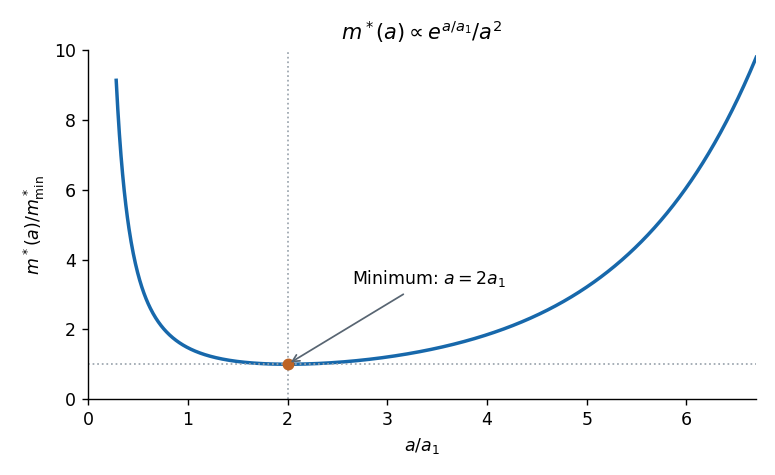
Effective mass versus atomic spacing for exponentially decaying nearest-neighbour hopping
. Original plot of the specified tight-binding model, normalized by its minimum. The minimum occurs at , where the logarithmic derivative of the hopping magnitude balances the explicit band-curvature factor. Details.
The electronic bandwidth is . With reduced from to ,Thus the energy band widens by approximately 1.005 percent, or 1 percent to first order. Compression increases the orbital coupling.
Articles by others on the same topic
There are currently no matching articles.