Write , where contains the quadratic kinetic term and mass term, and . ThenLet and let denote the unit-normalized free Gaussian vacuum expectation value. The unnormalized numerator is consequentlyThe Minkowski path integral is understood with the usual scalar Feynman propagator pole prescription, as a formal perturbation series. A real cubic potential energy is unbounded below; no nonperturbative stable vacuum is being assumed here.
Set , , and , with a common regularization understood for coincident points. The zero-order one-point term has one field and vanishes. At first order, Wick's theorem gives three choices for the contraction with the external field, leaving a tadpole diagram:The second-order term contains seven fields, so it vanishes by the vanishing odd correlators of a free Gaussian field. HenceThe coefficient is , or symmetry factor when each diagram is weighted by . No spacetime integral has been evaluated. The one-point tadpole diagram is shown in the first panel of the following figure; its other panels organize solution.
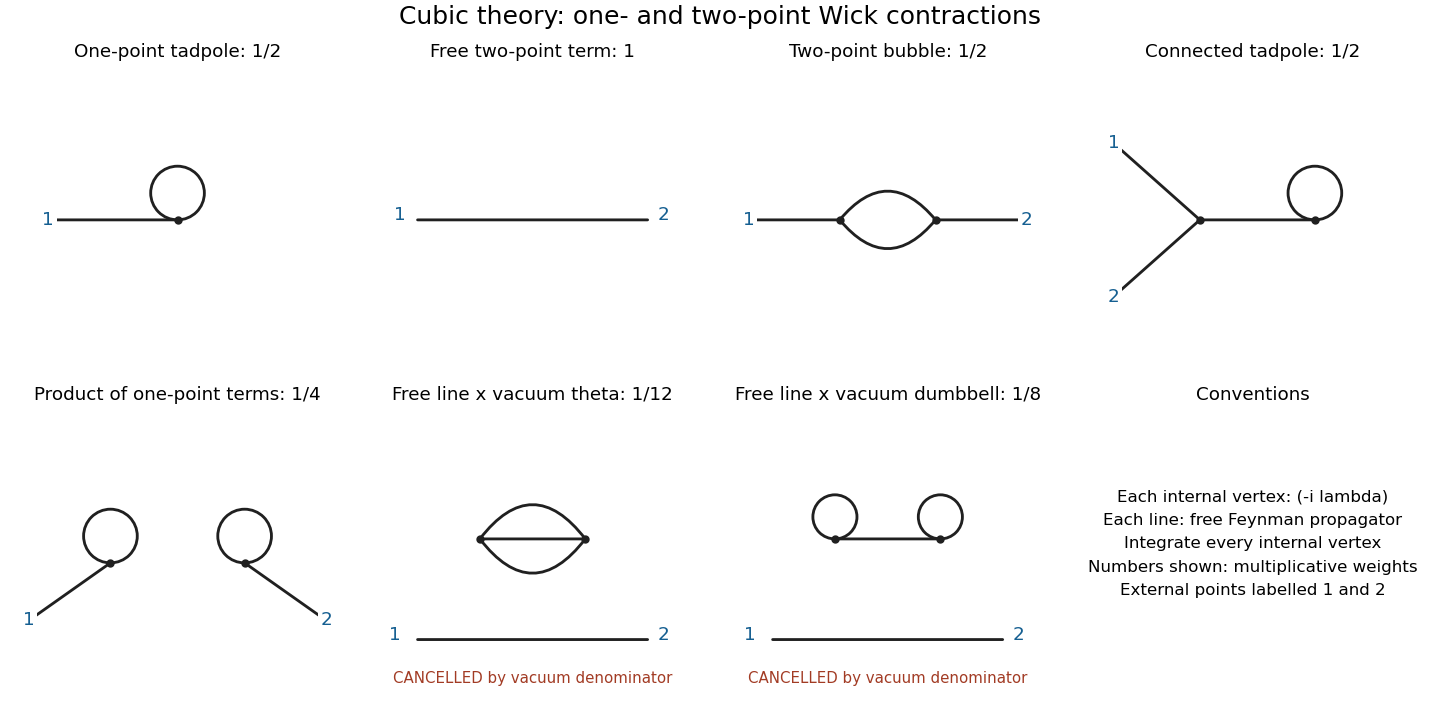
Cubic one- and two-point Wick contractions; vacuum factors cancel, but the product of two one-point tadpoles remains in the full two-point correlator
. Details. 
Articles by others on the same topic
There are currently no matching articles.