Solutions use natural units and Minkowski metric . The d'Alembert operator is . All four questions are covered, including the optional fourth question.
For the real scalar field, the two derivatives entering the Euler-Lagrange field equation areConsequently the equation of motion isThe quartic interaction therefore adds a local cubic term to the free Klein-Gordon equation. Below, write ; thus means that the field is on shell.
Take a constant infinitesimal translation with fixed-coordinate field variation . The associated change in the Lagrangian density is . Substituting this total derivative into the Noether current gives , whereThis is the canonical stress-energy tensor. The chosen sign of the translation parameter produces precisely this sign of the Noether current; reversing the parameter reverses the current without changing its conservation law.
To check current conservation directly, differentiate the tensor. The terms containing cancel against the derivative of the kinetic term, leavingThus on shell. Raising the second Lorentz index gives : this scalar field already has a symmetric canonical stress-energy tensor.
First take the trace in four spacetime dimensions:The product rule gives . For the massless equation of motion, , soBoth coefficients vanish forThe minus sign follows from the order used in the question's stress-energy tensor improvement. Commuting partial derivatives shows that this improvement has identically zero divergence, so it preserves the conservation law.
The precise trace identity, without using the equation of motion, isHence the massless tensor is traceless on shell. It is not traceless for arbitrary off shell configurations: a nonzero constant with has . This is a classical result; it does not assert absence of a quantum trace anomaly.
Under the finite dilation, the volume element transforms as , whereas . Thus the kinetic term and quartic interaction both acquire the factor . Their factors cancel the Jacobian determinant, provingA mass term would instead acquire a net factor in the action and break this scale invariance.
For the Noether current, use the variation at the same coordinate, rather than comparing values at different coordinates:At , the corresponding Lagrangian density variation is . Thus , and the stated Noether current convention givesThe frequently used dilatation current is ; this is solely an overall parameter convention. In the convention , the virial current is .
Using solution and the trace computed in solution gives the useful identityIt follows that in the massless theory on shell. Equivalently, is a conserved current, since its divergence is the trace of the improved stress-energy tensor on shell. These are classical scale invariance statements; the nonzero beta function in solution explains why the interacting quantum theory need not retain them.
Write and . Insert the mode expansion of a free field for each quantity into the commutator. Only the mixed creation operator and annihilation operator terms survive. The Dirac delta function in their canonical commutation relation sets the two momenta equal, so the square-root factors multiply to :In the second equality, each Fourier transform is the same Dirac delta function, since the integration domain is invariant under . This is the equal-time canonical commutation relation. The analogous calculation gives , because their two mixed terms have opposite signs.
The unit-normalized Fock vacuum is characterized byChoose the relativistic normalization of a one-particle state from the outset:Since any two creation operators commute, any permutation of their order gives exactly the same state vector. Thus these multiparticle quantum states are symmetric under exchange and describe bosons, without a minus sign or any additional exchange phase.
The Hilbert space is the bosonic Fock space, the direct sum of the symmetric -particle Hilbert spaces, including the zero-particle sector. Sharp-momentum kets are distributionally normalized; square-integrable wave packets provide ordinary Hilbert space vectors. For repeated occupation of a discrete mode, a unit-normalized number state uses . That factorial does not belong in the above labelled continuum-ket convention.
The normal ordering of both linear maps puts every annihilation operator to the right, soIn particular the stated Hamiltonian has already subtracted the free vacuum energy. For a one-particle state, evaluate the commutators using :Acting on the Fock vacuum therefore givesThe extra factor in the chosen relativistic normalization of a one-particle state is a scalar multiplier and does not change either eigenvalue. Applying the same argument to a multiparticle quantum state gives additive total energy and momentum.
The Fock vacuum condition and the creation operator commutator giveEquality of the square-root product and holds on the support of the Dirac delta function.
The positive-energy mass shell has the Lorentz invariant measureHere both and the four-dimensional volume element are invariant, and positive energy is preserved by a proper orthochronous Lorentz transformation. Consequently the three-dimensional Jacobian determinant is . Transforming the Dirac delta function yieldsso its factor exactly cancels that of . Thus the displayed inner product is invariant under simultaneous transformation of both momenta. This is also why the one-particle completeness measure is .[ref]
Quantum Field Theory by David Tong. Section 2.4.1, relativistic normalization and the positive-energy mass-shell measure
The Heisenberg picture evolution of the annihilation operator follows from . With , this gives the mode expansion of a free fieldDefine . The time-ordered product then gives the Feynman propagatorThe last expression follows by closing the contour integral below for and above for ; the scalar Feynman propagator pole prescription supplies the required positive- and negative-frequency terms.
For every term obeys the homogeneous Klein-Gordon equation. At , the equal-time commutator of the fields vanishes, so the propagator is continuous and there is no derivative of a Dirac delta function. Its first time derivative has the jumpThe second time derivative therefore supplies precisely the source:Thus the defined Feynman propagator is a Green's function with source normalization ; has source normalization . Keeping this factor avoids confusing the vacuum expectation value convention with conventions which define the propagator after dividing by .[ref]
Quantum Field Theory by David Tong. Sections 2.7.1–2.7.2, time ordering, pole prescription and the inhomogeneous Klein-Gordon equation
Let brackets denote mass dimension. In natural units, and , so a dimensionless action requires . The kinetic term fixesThe cubic scalar field theory interaction then requires , givingThe coupling constant is dimensionless at this critical dimension of a monomial scalar interaction. For it has positive mass dimension, while for it has negative mass dimension, the usual power counting distinction between super-renormalizable and non-renormalizable cubic interactions.
Write , where contains the quadratic kinetic term and mass term, and . ThenLet and let denote the unit-normalized free Gaussian vacuum expectation value. The unnormalized numerator is consequentlyThe Minkowski path integral is understood with the usual scalar Feynman propagator pole prescription, as a formal perturbation series. A real cubic potential energy is unbounded below; no nonperturbative stable vacuum is being assumed here.
Set , , and , with a common regularization understood for coincident points. The zero-order one-point term has one field and vanishes. At first order, Wick's theorem gives three choices for the contraction with the external field, leaving a tadpole diagram:The second-order term contains seven fields, so it vanishes by the vanishing odd correlators of a free Gaussian field. HenceThe coefficient is , or symmetry factor when each diagram is weighted by . No spacetime integral has been evaluated. The one-point tadpole diagram is shown in the first panel of the following figure; its other panels organize solution.
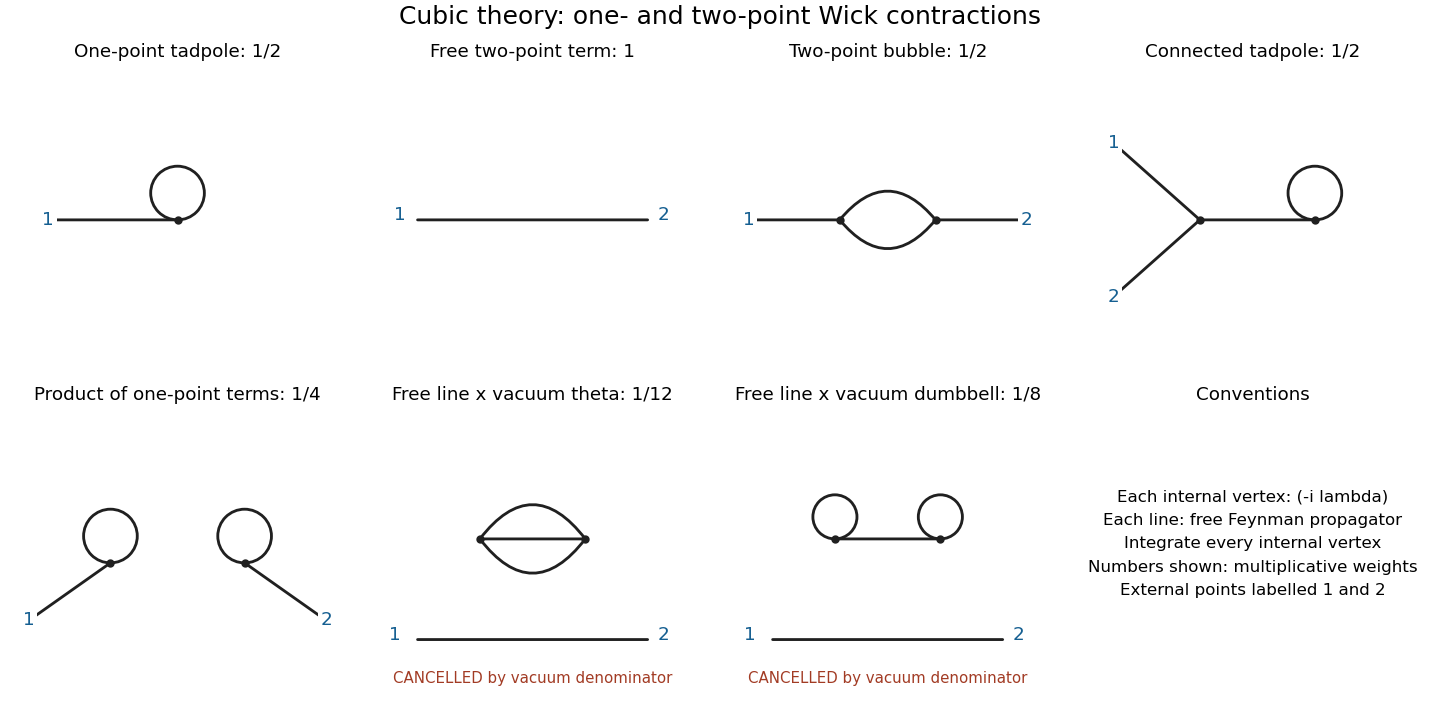
Cubic one- and two-point Wick contractions; vacuum factors cancel, but the product of two one-point tadpoles remains in the full two-point correlator
. Details. 
Use the notation , and . The order- term vanishes because it has five fields. At order , enumerate the eight-field Wick contractions, whose expansion denominator is .
If the two external fields contract with each other, the remaining vacuum diagrams are a pair of cubic vertices joined by three lines, with six Wick contractions, and a pair joined by one line with a tadpole diagram at each end, with nine Wick contractions. Define their combined integrated weight byThus . The numerator isThe three latter terms have respectively 36, 36 and 18 Wick contractions. Together with the six and nine Wick contractions, they exhaust all pairings.
Dividing by cancels the two vacuum diagrams, givingThe first correction is the two-line bubble diagram, with symmetry factor . The second is the connected tadpole contribution to a cubic-theory two-point function: both external lines meet one vertex, joined by a single line to a second vertex bearing a tadpole diagram; its symmetry factor is also . Interchanging the two integrated vertices is already included in the 36 contractions and gives no extra factor.
The final term is the disconnected Feynman diagram consisting of two separate one-point tadpole diagrams, with coefficient . It survives cancellation of vacuum bubbles, since each component touches an external point. Indeed it is precisely the leading . It would disappear from the connected two-point correlation function, but the question defines the full correlation function. No normal ordering or tadpole subtraction of the interaction was specified. All terms are depicted in solution, and all spacetime integrals remain unevaluated.
For a connected cubic Feynman diagram with internal vertices, internal lines and three external lines, . Hence is odd and the loop order is . Through order , there is one tree-level Feynman diagram at and seven labelled one-loop Feynman diagrams at :
- One triangle, with one external line at each vertex. Fixing the three external labels leaves no internal automorphism, so its symmetry factor is .
- Three bubble diagrams on external branches of the tree, one for each choice of the distinguished external label . The other two external lines meet the remaining tree vertex. Exchanging the two parallel lines gives symmetry factor for each labelled graph.
- Three tadpole diagrams at the end of a chain. The middle vertex carries the distinguished external label , the other two external lines meet one end vertex, and the other end bears the loop. Reversing the two half-edges of the loop gives symmetry factor for each labelled graph.
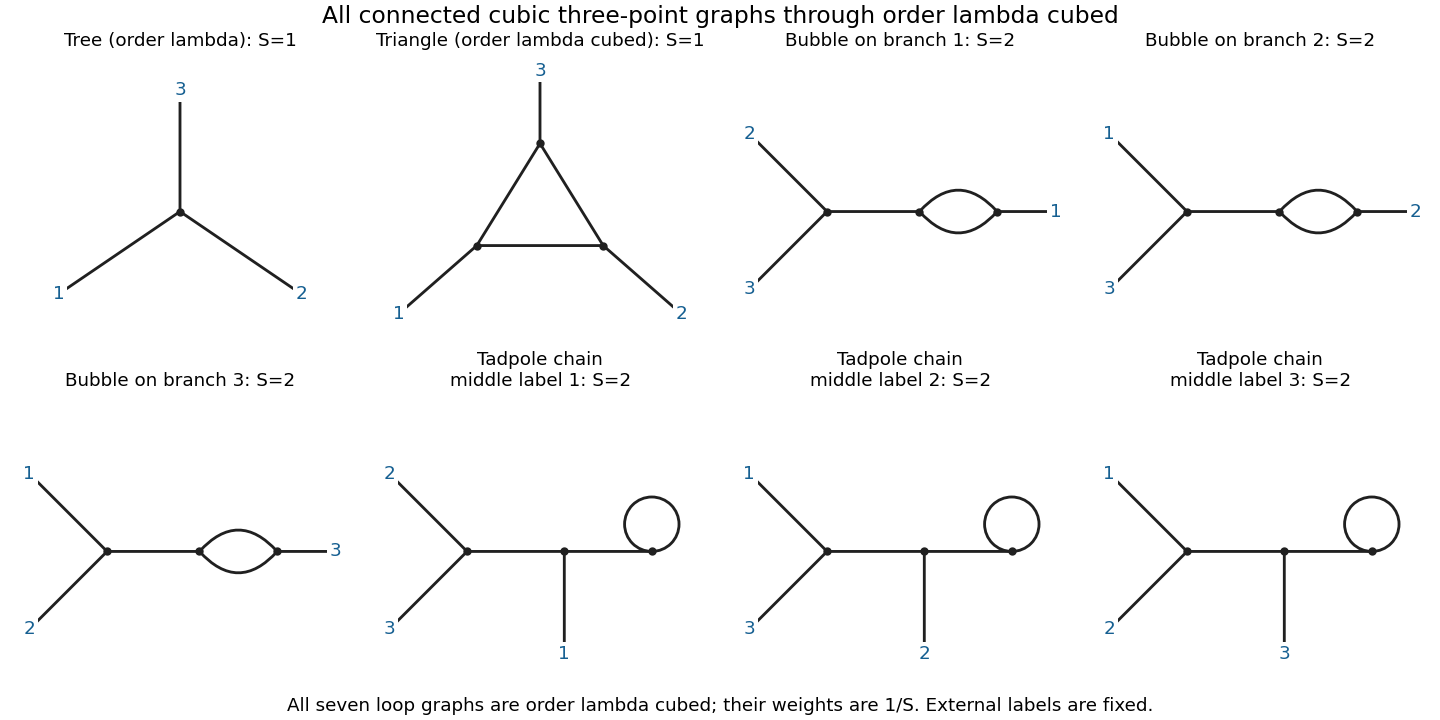
All connected cubic three-point diagrams through third order: one tree and seven labelled one-loop graphs; a diagram of symmetry factor S has coefficient 1/S
. Details. 
For an explicit check, use the propagator notation of solution and define, with ,There is no ordering of in this notation. The complete connected correlation function through this order isFor completeness of the classification, a one-loop connected internal graph either has a three-edge cycle, a pair of parallel edges and a bridge, or a self-loop and two bridges. The cubic degree condition forces exactly the external attachments just listed. Direct Wick contraction counting gives 1296 pairings for the triangle and 648 for each of the six other labelled graphs, divided by .
Connected does not mean one-particle irreducible. After amputation of external propagators, only the triangle is one-particle irreducible at this order; the six other loop graphs belong to the requested connected answer. The tadpole diagrams cannot be discarded without an additional subtraction prescription.
For incoming four-momenta, the momentum-space Feynman rules in the chosen Minkowski metric convention are:
- Each internal line contributes the scalar propagator .
- Each quartic interaction vertex contributes and for momentum conservation.
- Each independent loop momentum is integrated with ; after eliminating redundant Dirac delta functions, one overall conservation factor remains.
- Each graph is divided by its symmetry factor , with external labels held fixed.
There is one connected one-loop one-particle irreducible two-point graph: a single quartic vertex with two external lines and one tadpole diagram. Its symmetry factor is from interchange of the two loop half-edges.
There are three connected one-loop one-particle irreducible four-point graphs: two quartic vertices joined by two parallel internal lines, with external partitions , and . These are the , and scattering channels; each bubble diagram has symmetry factor . External-branch insertions are excluded by the one-particle irreducible requirement.
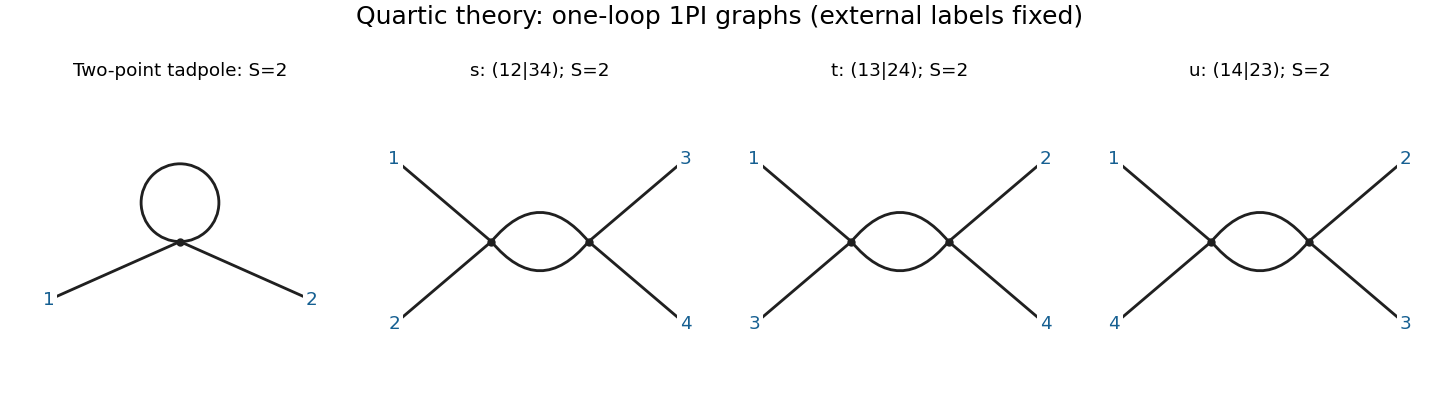
One-loop one-particle-irreducible quartic scalar graphs: the two-point tadpole and the three labelled four-point bubble channels, each with symmetry factor S=2
. Details. 
The positive denominators in this part are Euclidean. Starting with the Minkowski spacetime Feynman rules, first perform a Wick rotation; a bare Minkowski metric integral without a pole prescription would not equal the displayed positive expression. Work initially with and , where the Euclidean massive loop integral converges.
Use Schwinger parameterization followed by the Gaussian integral:The remaining Gamma function integral givesThe factorial form is for positive integral . Dimensional regularization defines the result elsewhere by analytic continuation.
For the scalar bubble integral, combine the two denominators with a Feynman parameter and shift the integration variable to . ThenFor this isThe Gamma function recurrence gives , and the parameter integral is . ConsequentlyThis ultraviolet divergence is independent of the external momentum. The assumption avoids an infrared divergence. In particular the completely massless zero-momentum integral is a scaleless integral and vanishes in dimensional regularization; its ultraviolet and infrared poles must be separated before assigning it the displayed ultraviolet residue.
It is convenient to evaluate the one-particle irreducible vertices using the Euclidean action and then translate the counterterms back to the Minkowski spacetime Lagrangian density. For the tadpole integral, analytic continuation of solution givesIndeed . The negative pole is a property of analytic continuation, not the value of a convergent positive integral.
The Euclidean space inverse two-point vertex has the one-loop correctionThe factor is the symmetry factor weight of the tadpole diagram. A mass counterterm cancels this pole. There is no momentum-dependent pole at this order, and hence no one-loop wave-function renormalization.
For the four-point vertex, the three bubble diagrams giveOne can check the relative minus sign independently from the one-loop effective action: its term has a positive term linear in and a negative term quadratic in it. Thus cancels the quartic pole.
In the Euclidean action, these two counterterms are . Returning to the Minkowski spacetime Lagrangian density givesFor a direct sign check with Feynman rules, the two amputated loop pole insertions are and , while the counterterm insertions are and .
As usual, the displayed pole residues suppress renormalization scale powers: away from four dimensions. The next part restores these powers explicitly with a dimensionless renormalized coupling. Replacing the tree coupling by its renormalized counterpart inside a one-loop residue changes only higher-loop terms.
Because the quartic coupling constant has mass dimension , introduce a renormalization scale and define the dimensionless renormalized coupling by minimal subtraction scheme:Here is the fixed bare coupling constant. Equivalently the tree-level quartic term is , and its one-loop counterterm is . This states explicitly the scale convention implicit in solution.
Put . Differentiating the bare relation at fixed givesWrite . The coefficient of in the last identity is , so . ThereforeThe first term is the engineering term in a dimensionally continued beta function. In four dimensions it disappears, leaving the positive one-loop quartic scalar beta function . Thus the renormalized coupling increases with increasing renormalization scale near weak positive coupling. This quantum running is the obstruction to extending the classical scale invariance in solution to the interacting quantum theory.
Articles by others on the same topic
There are currently no matching articles.