Let denote the incoming four-momenta and the outgoing four-momenta. Thus , and . Define the Mandelstam variables and exchanged four-momenta byThe leading connected four-point scattering amplitude uses two cubic interaction vertices. There are four tree-level Feynman diagrams: and exchange of with two vertices, and and exchange of with two vertices.
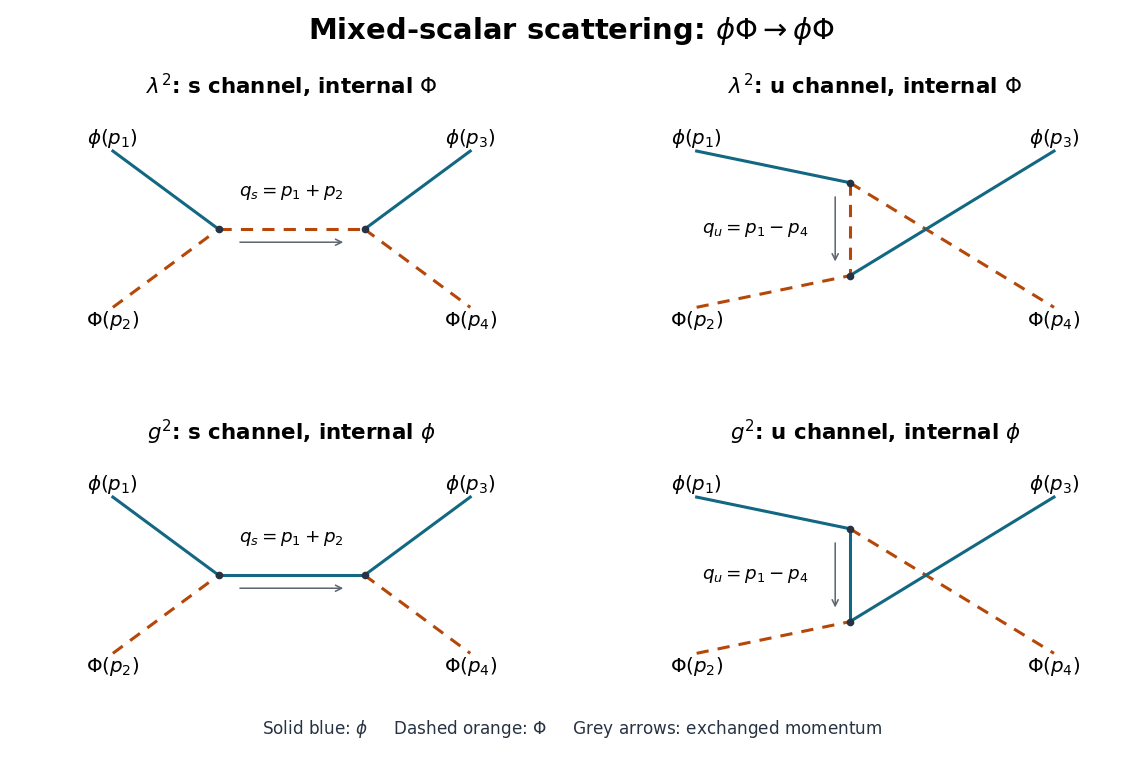
The four tree channels for mixed-scalar scattering. Blue solid lines represent and orange dashed lines . External momenta are incoming on the left and outgoing on the right; crossings have no vertex.
Details. 
There is no term proportional to : one vertex of each kind has three field slots of each species altogether, whereas the external state uses two of each. This leaves one and one to contract internally, and their mixed scalar propagator is zero. There is also no channel: grouping both external legs at one vertex would require a vertex with an internal , while grouping both external legs at the other would require a vertex with an internal .
Define after removing the overall momentum conservation delta function. The nonderivative exchange givesFor the derivative channel, the incoming four-momenta at the first vertex are , and at the second they are . The two interaction vertices are therefore and . The same reasoning with applies to the channel, givingThe mass shell conditions and momentum conservation implyCombining the four Feynman diagrams therefore yieldsEach displayed tree-level Feynman diagram has Feynman-diagram symmetry factor 1 for fixed external species and labels. The result is of order ; if both couplings are scaled by a common parameter , the next connected corrections begin at order . A four-point cubic Feynman diagram has , so its vertex count is even. The internal lines remain off shell throughout: imposing an on-shell relation on an exchanged four-momentum would incorrectly change the derivative vertices.
Articles by others on the same topic
There are currently no matching articles.