The cover establishes Hilary Term 2019 despite the bundle's 2018 filename. Use . For questions 2 and 3 the Minkowski metric has signature . Question 1 has a preferred time coordinate and does not assume Lorentz invariance.
A real scalar field suffices to describe one neutral species of bosonic quasiparticle. Let be its canonical momentum. In three spatial dimensions, choose the positive classical HamiltonianThe same construction works in any number of spatial dimensions by replacing appropriately. Under a spatial Fourier transform, becomes , so the Hamiltonian is a collection of independent quantum harmonic oscillators with squared angular frequency . The usual reality condition pairs opposite momenta; it does not introduce a second species.
The canonical action is . Varying gives ; eliminating it by the Legendre transform givesThis Lagrangian density is local: only the field and finitely many derivatives at the same point occur. It contains second spatial derivatives but only first time derivatives, so no extra canonical time data are needed. A square root of a differential operator in the classical Hamiltonian is unnecessary. The fourth-order spatial term breaks Lorentz invariance while preserving spatial rotations and translations. This is a free scalar field with quartic spatial dispersion.
For a Lagrangian density depending on , , and , direct variation givesTake to have compact support, so every boundary term vanishes. One integration by parts for the first-derivative terms and two for the second-derivative term yield the Euler-Lagrange field equation with second derivativesThe plus sign on the last term is essential. For the action in a, it is particularly transparent to vary the Laplacian directly:Thus the classical equation of motion isHere is the biharmonic operator. Substitution of the plane wave givesA real classical solution combines complex-conjugate plane waves. Quantization assigns the positive branch to the excitation energy, giving the required dispersion relation. The negative-frequency branch supplies the creation operator part of the field, rather than negative excitation energy. Independently, the Hamiltonian in a gives , , confirming the same sign.
Define and . The Hermitian quantum field has the mode expansion of a free fieldwhere the annihilation operators and creation operators obey the bosonic canonical commutation relationsBecause , its mode expansion of a free field isThe two nonzero cross commutators then giveand the equal-time field-field and momentum-momentum commutators vanish. This verifies the factor without requiring Lorentz invariance.
Substitution into the Hamiltonian, followed by normal ordering, yieldsConsequently : one application of a creation operator adds precisely the required quasiparticle energy. Before normal ordering there is the usual constant zero-point vacuum energy. If , the exactly zero-momentum mode has and is a free canonical coordinate, not an oscillator with a normalizable oscillator vacuum state; in a finite box handle that mode separately or introduce a small positive mass. The formula applies directly to all modes with .
Use the Fourier transform convention , and similarly for . All four-momenta at an interaction vertex are incoming. The quadratic terms are diagonal, so the scalar propagators areThe field interaction terms are and . The two identical field slots cancel the factor at either cubic interaction vertex. Expanding therefore givesIn the second rule are specifically the two four-momenta; there is no derivative acting on the leg. Indeed the two derivatives give , fixing the minus sign. This is a mixed scalar derivative cubic vertex. For arbitrary off-shell legs one may equivalently write , but may not replace the squared four-momenta by squared masses unless those legs are on their mass shells.
Each interaction vertex also carries for momentum conservation. Integrate independent loop momenta with and divide by the Feynman-diagram symmetry factor. An amputated external scalar leg has factor 1. The Feynman i-epsilon prescription fixes the propagator poles. As a dimensional check in four spacetime dimensions, , and in mass dimensions; the two powers of momentum in the derivative rule restore mass dimension one for its cubic interaction vertex.
Let denote the incoming four-momenta and the outgoing four-momenta. Thus , and . Define the Mandelstam variables and exchanged four-momenta byThe leading connected four-point scattering amplitude uses two cubic interaction vertices. There are four tree-level Feynman diagrams: and exchange of with two vertices, and and exchange of with two vertices.
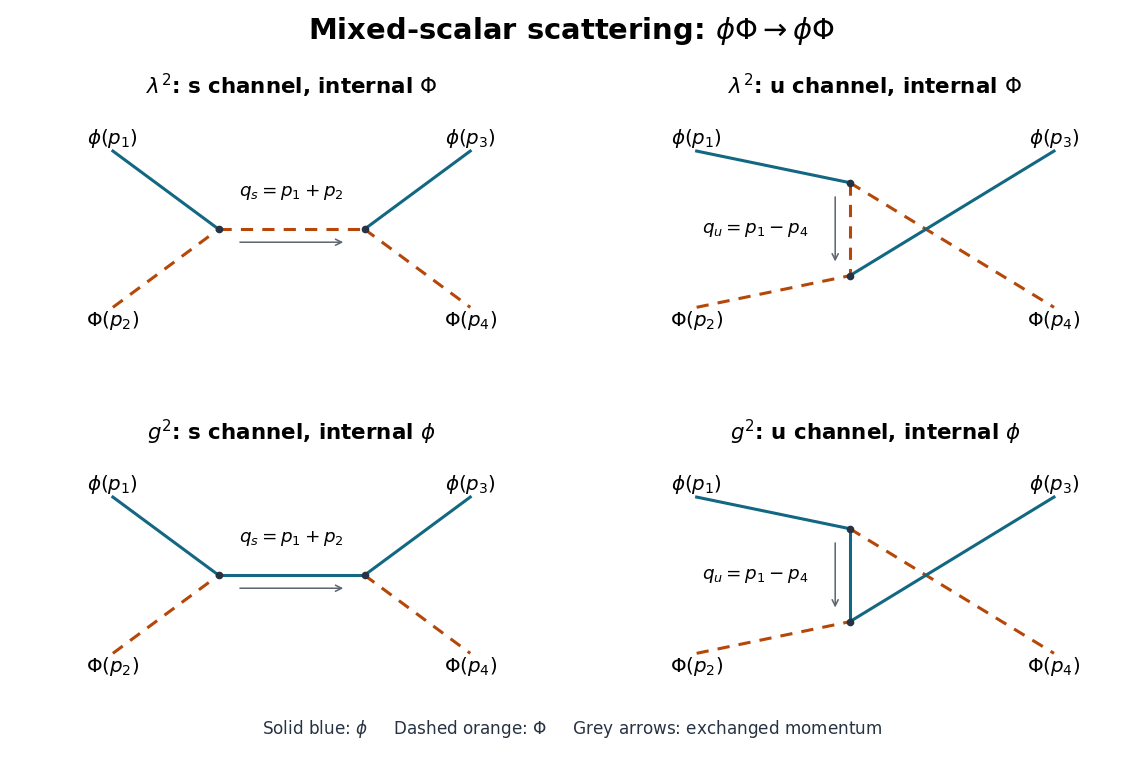
The four tree channels for mixed-scalar scattering. Blue solid lines represent and orange dashed lines . External momenta are incoming on the left and outgoing on the right; crossings have no vertex.
Details. 
There is no term proportional to : one vertex of each kind has three field slots of each species altogether, whereas the external state uses two of each. This leaves one and one to contract internally, and their mixed scalar propagator is zero. There is also no channel: grouping both external legs at one vertex would require a vertex with an internal , while grouping both external legs at the other would require a vertex with an internal .
Define after removing the overall momentum conservation delta function. The nonderivative exchange givesFor the derivative channel, the incoming four-momenta at the first vertex are , and at the second they are . The two interaction vertices are therefore and . The same reasoning with applies to the channel, givingThe mass shell conditions and momentum conservation implyCombining the four Feynman diagrams therefore yieldsEach displayed tree-level Feynman diagram has Feynman-diagram symmetry factor 1 for fixed external species and labels. The result is of order ; if both couplings are scaled by a common parameter , the next connected corrections begin at order . A four-point cubic Feynman diagram has , so its vertex count is even. The internal lines remain off shell throughout: imposing an on-shell relation on an exchanged four-momentum would incorrectly change the derivative vertices.
With , the Clifford algebra gives , , and . Henceso . Its square isChoose the following gamma matrices, expressed using the Pauli matrices:These satisfy , and . The chirality eigenvalues are therefore , and we order the spinor as throughout. Its Dirac adjoint is . No additional factor of multiplies in this spacetime dimension. This realizes a Dirac field in two spacetime dimensions.
Variation of the action with respect to the independent Dirac adjoint gives . The gamma matrices chosen in a make the Dirac equationMultiplication by gives the equivalent Dirac Hamiltonian formFor a plane wave , where is the signed one-dimensional momentum, the equation isA nonzero spinor exists precisely when the determinant vanishes:For , one possible unnormalized spinor solution is . Alternatively, follows from the Pauli matrix multiplication law, proving the same relativistic energy-momentum relation. Acting on the Dirac equation with also shows that each component satisfies , the Klein-Gordon equation.
In the chirality basis of a, the two rows of the Dirac Hamiltonian equation giveThe Dirac mass term thus couples the two opposite chirality components. In particular, the Lagrangian density isFor , the coupling disappears and the massless Dirac equation splits into the independent transport equationsThese are the two chiral transport equations in two spacetime dimensions. The chiral projectors are and ; in this basis they simply select the upper and lower components.
Continue with . Along a characteristic , the chain rule givesThus the initial wave packet evolves as . Similarly, along , the left component is constant, givingA feature initially at therefore appears at for the right component and for the left component. The profiles translate without changing shape at the speed of light, which is 1 in these units. For positive-energy plane waves, the right component has and the left component has , another way to identify their propagation directions.
The conclusion concerns the massless Dirac equation. For , the components couple as in c, and a positive-energy packet has group velocity , rather than a universal speed . For example, a massive positive-energy rest solution has and , so neither component alone describes an independently moving light-speed packet.
A continuous Lorentz transformation in one spatial dimension must preserve . In the component connected to the identity, take the image of the time axis to have velocity , with , and write . Preservation of the Minkowski norm gives , so . The spacelike column must be orthogonal to the timelike column and have squared Minkowski norm ; continuity fixes it to . ThusHere denotes the coordinate pair. This is the positive off-diagonal convention in the source; describing a passive frame moving at instead reverses the sign of .
Define the rapidity . The hyperbolic function identities giveIn light-cone coordinates, and . Therefore the derivatives transform oppositely:Use the field-transformation convention . The component action in c is invariant underIndeed, the right-component kinetic term gains , and the left-component kinetic term gains . The two factors in each Dirac mass term cancel as well. Finally , so and the whole action is unchanged. These are the chiral boost weights in two spacetime dimensions.
In spinor notation, satisfies and , so . These identities directly verify covariance of the Dirac equation and the Lorentz invariance of its action. The matrices are not unitary with respect to the ordinary component norm; the Dirac adjoint supplies the invariant bilinear.
The statement about there being only Lorentz boosts applies to the identity component of the One-dimensional Lorentz group. The full Lorentz group also has discrete transformations: the concrete spatial reflection preserves the Minkowski metric but has determinant , so it cannot equal any displayed , whose determinant is .
Articles by others on the same topic
There are currently no matching articles.