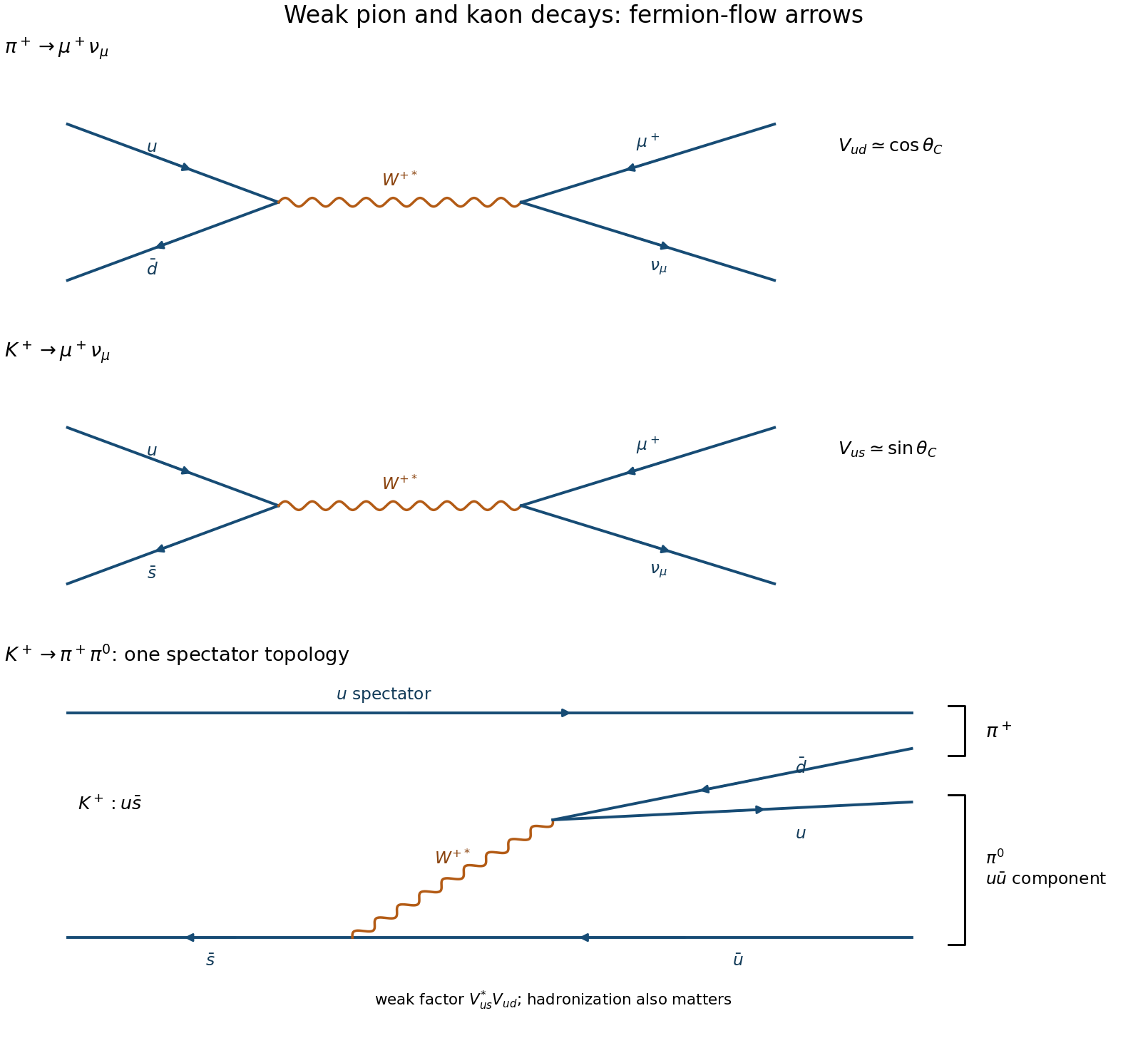
The charged meson decays proceed through a virtual :The first quark vertex has CKM factor , while the second has . In the simple Cabibbo description these are approximately and , so the strange amplitude carries a suppression relative to the nonstrange one, or in their corresponding squared weak-coupling factors.
For a charged pseudoscalar and a negligibly massive neutrino, the leading leptonic energy width has the formin natural units. The helicity factor is common to these two muon channels, while the threshold factor is much less favorable for the pion. Using the usual masses, its value is about for the pion and for the charged kaon: the pion's threshold factor alone is only about one fifth as large. Including the explicit factor gives a kinematic ratio about . The pseudoscalar decay constants also matter, so Lorentz-invariant phase space and CKM factors alone do not determine the full lifetime ratio.[ref]
Leptonic Decays of Charged Pseudoscalar Mesons by Particle Data Group. leading pseudoscalar leptonic-width formula and pion/kaon discussion
For , one tree topology has the spectator unchanged and followed by . The spectator can combine with to form , and the component supplies . This carries the strangeness-changing weak factor . Hadronization, other quark rearrangements and strong final-state interactions determine the hadronic amplitude; the diagram is not a complete precision width calculation. The small pion–muon energy release suppresses the pion leptonic channel kinematically, whereas the strange weak vertex suppresses the kaon channels through Cabibbo suppression.

Articles by others on the same topic
There are currently no matching articles.