The neutron has valence content and total spin ; its ground-state parity is positive. The two down quarks contribute charge and the up quark contributes , giving net charge zero. “Three valence quarks” specifies the net flavor quantum numbers, rather than excluding gluons or additional sea quark–antiquark components from the full Quantum chromodynamics state.
In the approximate light-flavor SU(3) classification, the neutron belongs to the ground-state baryon octet, containing eight hadrons:These are eight particle species, without counting their antiparticles again as extra members of the same octet. The corresponding antibaryons form the conjugate particle set. Within the smaller SU(2) isospin classification, the neutron instead belongs to the two-member nucleon doublet . Stating the symmetry distinguishes the usual eight-member flavor multiplet answer from the also valid two-member isospin multiplet. The baryon decuplet has different ground-state spin and is not the neutron's octet.
Uniform probability per volume does not give a uniform radial distribution. A shell of radius and thickness occupies volume , so the radial probability density function isIt integrates to one. The second radial moment isThe radial uncertainty scale in a uniform sphere supplies the position-uncertainty scale as instructed by the toy model. It is not literally the standard deviation of the scalar radius: and . Nor is a uniform spatial probability density sufficient to determine a unique momentum space wavefunction. This explicit distinction keeps the order-of-magnitude assumption separate from a fully specified quantum bound-state calculation. Replacing the radial density by a uniform density in would give a different second moment because it omits the spherical volume element.
Adopt the lower-bound scale of the Heisenberg uncertainty principle, , with the prescribed radial scale from a. Using MeV fm,For a one-sided exponential distribution of a positive momentum magnitude, , both its mean and its standard deviation are . Under the additional identification made in this estimate, set the characteristic momentum to . This identification concerns a positive magnitude; the mean of a signed momentum component in an isotropic stationary state would instead vanish.
Use the relativistic energy-momentum relation, not a nonrelativistic kinetic-energy approximation, because the momentum-energy scale is much larger than the stipulated quark rest energy:This is a characteristic energy estimated at the characteristic momentum. It is not an exact evaluation of over a fully specified three-dimensional wavefunction. An order-of-magnitude convention would give an answer about twice as large; the uncertainty principle by itself specifies a bound, not a unique confinement energy.
Adding the three characteristic quark energies from b givesThe estimate recovers a sub-GeV scale but underestimates the stated neutron mass by a factor of a few. This is consistent with its deliberately crude uncertainty and geometry assumptions; it is not a precision mass prediction.
A better model needs the actual spatial and momentum correlations, a confining interaction, and the energy in the quark and gluon fields. In Quantum chromodynamics, hadron masses are not simply the sum of three freely moving particles with tiny masses. The supplied MeV rest-energy scale resembles a light current-quark scale; a phenomenological constituent-quark mass includes substantial dressing and is a different parameter. Color, spin correlations, relativistic dynamics and sea components all matter when defining a more realistic bound-state Hamiltonian operator or performing a lattice QCD calculation. The prescribed uniform-sphere model supplies none of those extra dynamical inputs, so its discrepancy should not be repaired by an unannounced change of the given radius or mass.
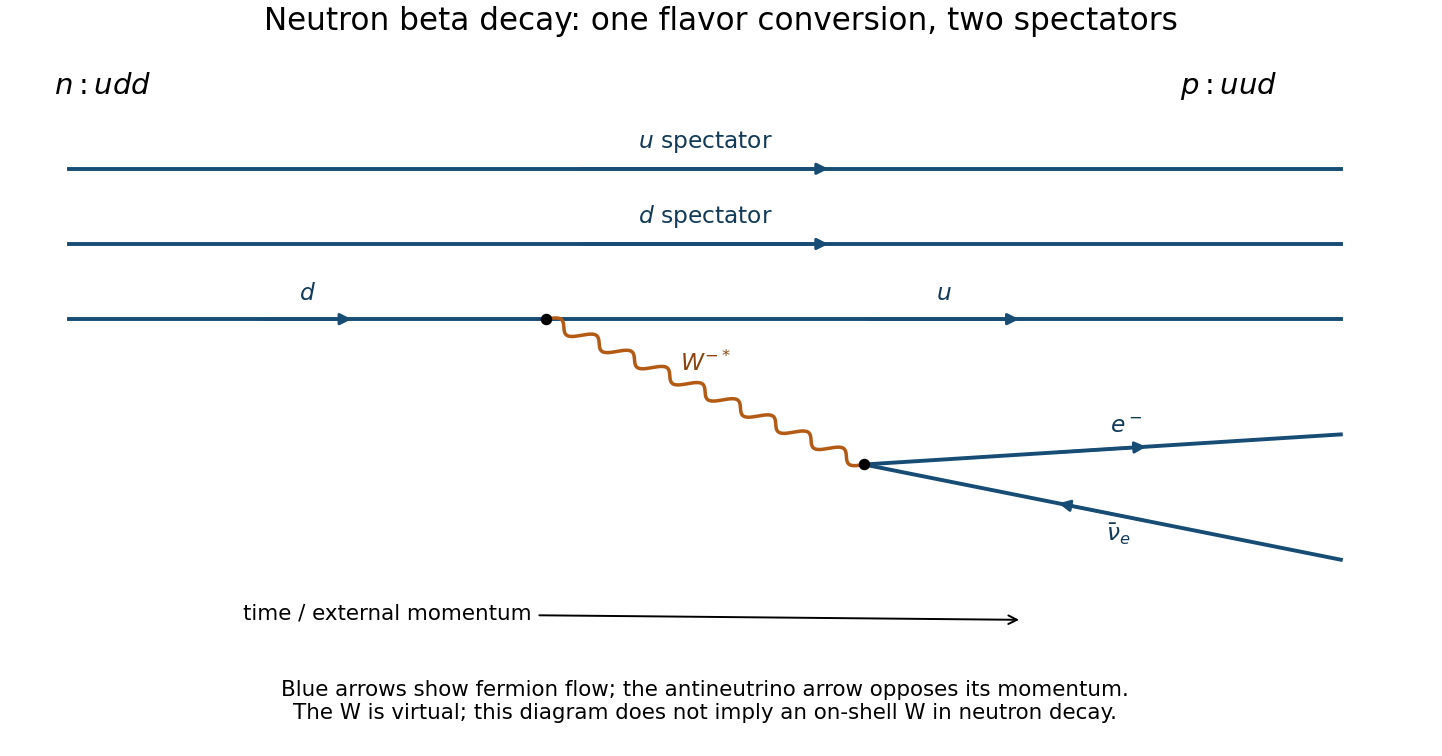
The charged weak current changes one neutron down quark into an up quark:The other two valence quarks are spectators in this tree-level Feynman diagram. The intermediate W boson is highly virtual; the available neutron decay energy is far below its on-shell rest energy. Charge is conserved at each vertex, and the electron's lepton number is balanced by the electron antineutrino.
The reversed quark-level charged current is allowed as an interaction, but a free proton cannot decay as because . Four-momentum conservation leaves no accessible final-state Lorentz-invariant phase space. The absence of this free-proton beta-plus decay is therefore kinematic, not an absence of a weak vertex. Binding-energy differences in a nucleus, or incoming energy in a collision, can change whether the corresponding conversion is possible. Exotic baryon-number-violating proton decay is a separate question and is not generated by this ordinary charged-current diagram.

Work first in units . In the neutron rest frame, let . From ,The electron's minimum possible total energy is its rest energy. This configuration has the electron at rest while the proton and massless antineutrino move back to back with equal momentum magnitudes. Their common momentum satisfies a two-body energy balance for the remaining mass :For the maximum electron energy, minimize . Since the massless antineutrino has nonnegative energy, , with the boundary reached as its energy tends to zero. ThenAt this limiting endpoint the electron and proton have equal and opposite momenta. The proton recoils; it is not at rest. A massless neutrino has no rest frame, so “neutrino at rest” must be replaced by the precise soft-energy limit . The electron's maximum kinetic energy is the displayed total energy minus , rather than the same number. These endpoint configurations lie on phase-space boundaries; their kinematic existence does not imply a nonzero event density exactly at the boundary.
For exponential decay with mean lifetime , the state amplitude evolves as and its survival probability is . Hence the energy decay width isThe exceptionally small energy width expresses the long lifetime of this weak decay. Use , not , because is an energy width in the complex-energy convention; changing to a frequency convention introduces the appropriate factor of . The quoted lifetime is treated as the mean lifetime. If a half-life were supplied instead, one would first use . No extra logarithm is needed for the given mean-lifetime interpretation. This calculation uses the source's approximate 15-minute value rather than silently replacing it with a more precise contemporary neutron-lifetime measurement.
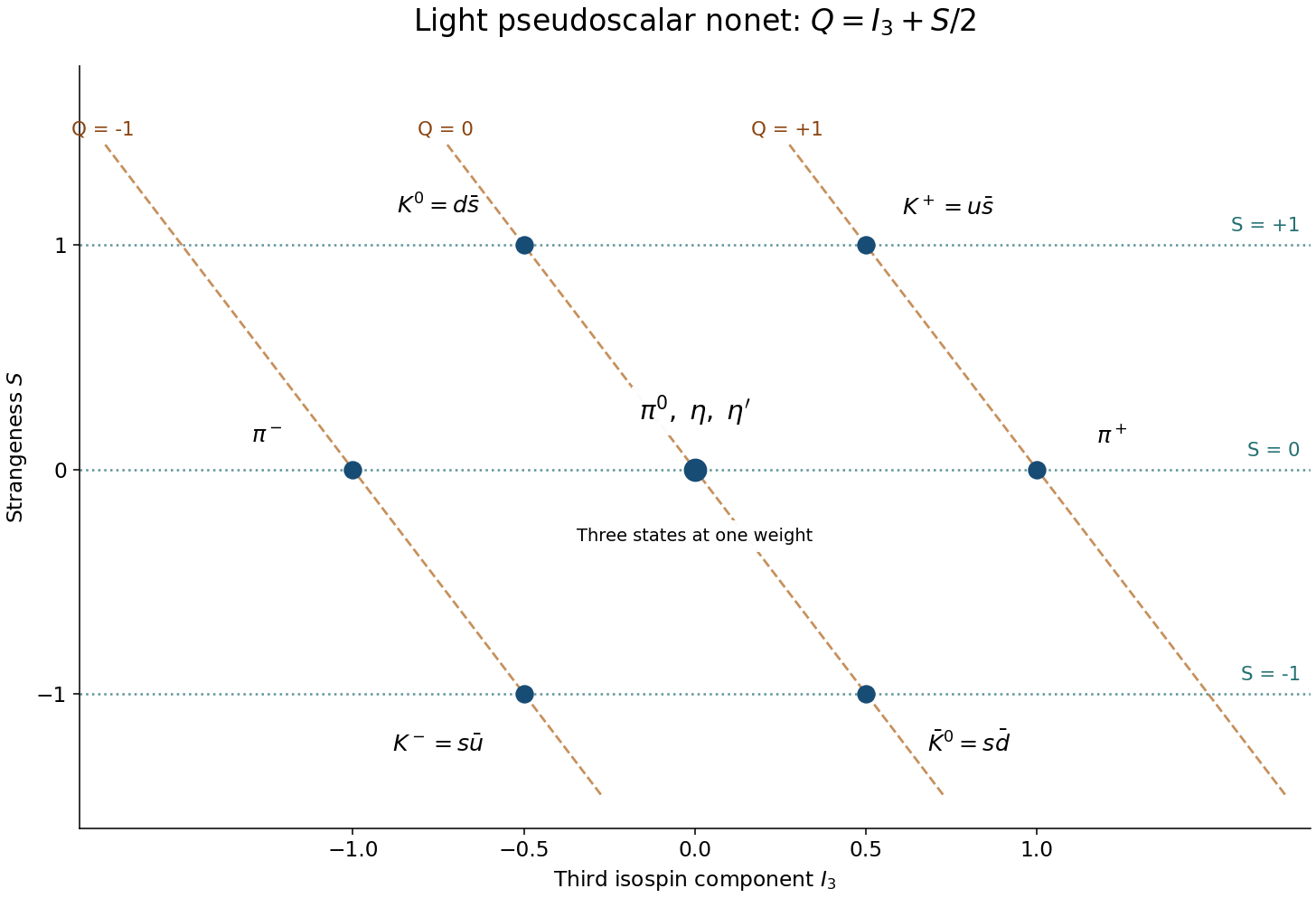
The light pseudoscalar meson nonet has and flavor structure . Its members are the three pions, four kaons, and the two neutral isospin-zero states eta meson and eta prime meson. For mesons the baryon number is zero, so the Gell-Mann--Nishijima formula reduces toHere is strangeness, with an quark carrying and an antiquark carrying . Thus the upper row is at and at . The lower row is at and at . The charged pions lie at , while share as flavor-weight coordinates.
The neutral pion direction is . The octet and singlet isoscalar directions mix to make the physical eta and eta-prime states; counting three central states is essential to obtaining nine rather than seven particles. Horizontal lines in the diagram have constant , while lines mark constant charge. Meson exchange describes part of the residual nuclear force; the underlying quark-level strong interaction is mediated by gluons, not by treating pions as elementary gauge bosons.

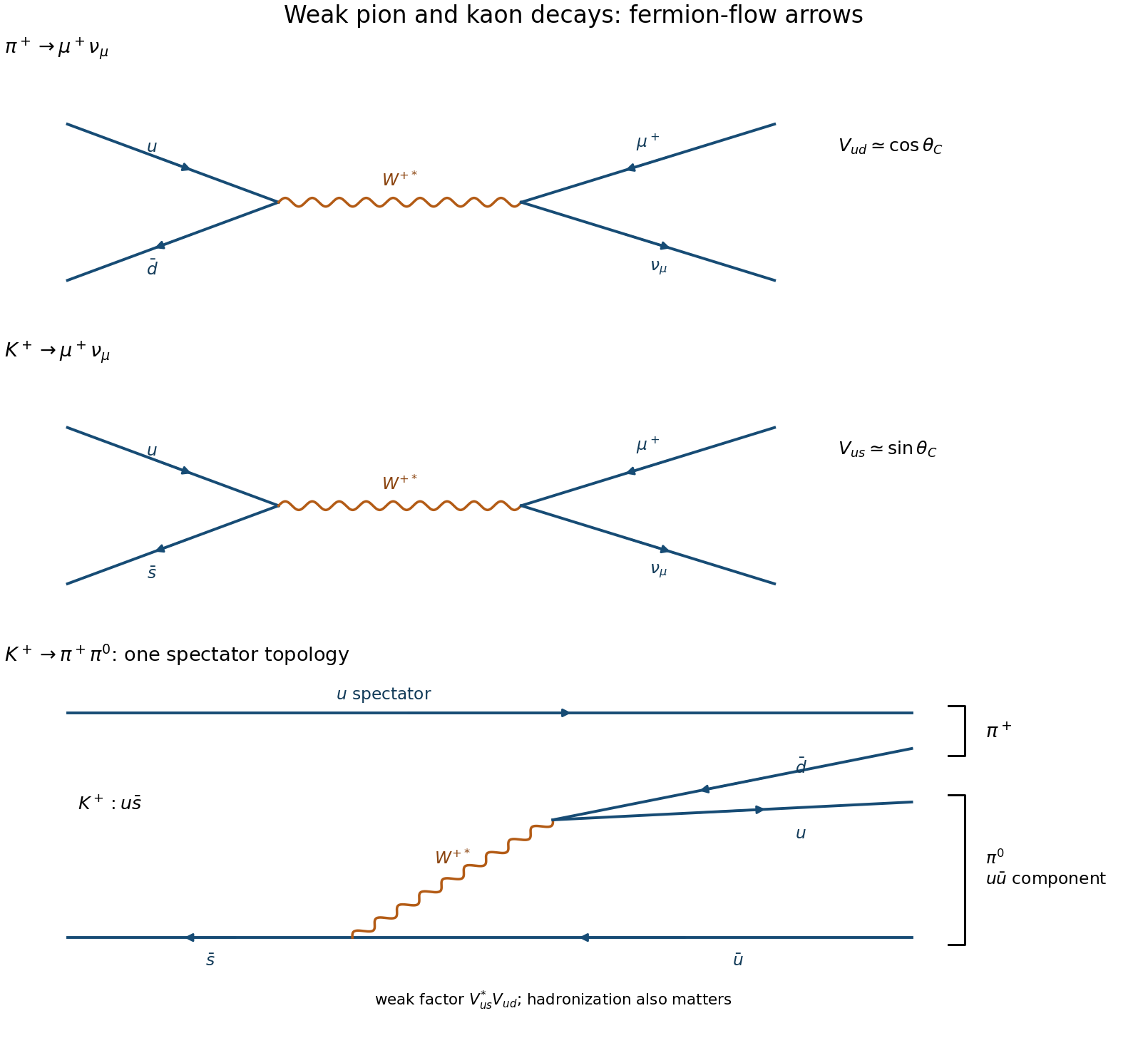
The charged meson decays proceed through a virtual :The first quark vertex has CKM factor , while the second has . In the simple Cabibbo description these are approximately and , so the strange amplitude carries a suppression relative to the nonstrange one, or in their corresponding squared weak-coupling factors.
For a charged pseudoscalar and a negligibly massive neutrino, the leading leptonic energy width has the formin natural units. The helicity factor is common to these two muon channels, while the threshold factor is much less favorable for the pion. Using the usual masses, its value is about for the pion and for the charged kaon: the pion's threshold factor alone is only about one fifth as large. Including the explicit factor gives a kinematic ratio about . The pseudoscalar decay constants also matter, so Lorentz-invariant phase space and CKM factors alone do not determine the full lifetime ratio.[ref]
Leptonic Decays of Charged Pseudoscalar Mesons by Particle Data Group. leading pseudoscalar leptonic-width formula and pion/kaon discussion
For , one tree topology has the spectator unchanged and followed by . The spectator can combine with to form , and the component supplies . This carries the strangeness-changing weak factor . Hadronization, other quark rearrangements and strong final-state interactions determine the hadronic amplitude; the diagram is not a complete precision width calculation. The small pion–muon energy release suppresses the pion leptonic channel kinematically, whereas the strange weak vertex suppresses the kaon channels through Cabibbo suppression.

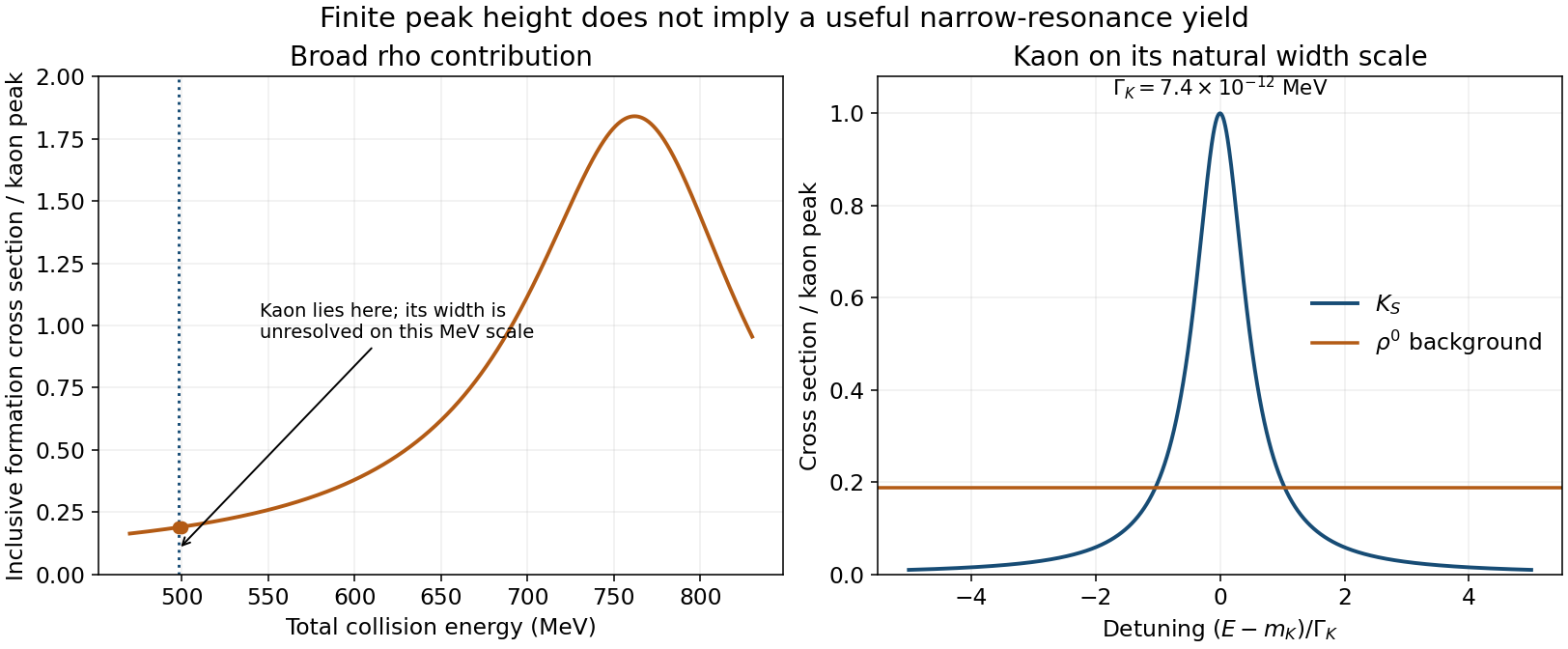
Use and let denote the total center-of-momentum energy, not one beam's energy. Opposite equal momenta give MeV, so the kaon is at its stipulated resonance mass MeV. Write the unspecified selected exit branching fractions as and . The supplied line shape givesThe distinction between inclusive and exclusive resonance branching factors matters here. For inclusive resonance formation, sum over all decays, so . At the small kaon width cancels from the peak value:If instead the measured cross section is specifically resonant elastic , its exit branching fractions equal the entrance ones: , . ThenThe source says production without specifying an observed decay channel, so both conventions are made explicit rather than silently squaring a branching fraction for an inclusive measurement. The quoted kaon width and two-pion branching fraction identify the short-lived propagation state ; a pure flavor state is a superposition of short- and long-lived states. This exercise uses the stipulated resonance model and equal omitted proportionality factors.
Raising each beam energy to 250 MeV makes MeV. The kaon denominator is now dominated byrather than by . Substituting into a givesThe enormous change is a tiny-width effect, not a comparably abrupt change in the broad rho contribution. The center-of-momentum energy has moved about kaon widths from the peak. A width of MeV is only eV, requiring an energy-selection scale of order relative to the several-hundred-MeV beam energy.
Real beams have vastly broader energy distributions. Averaging over such a distribution suppresses the useful narrow-resonance contribution: the finite peak value does not imply a large energy-integrated formation rate, whose resonant area shrinks with the width at fixed branching fractions. The weak inverse-decay entrance coupling and the broad strong-interaction rho background therefore make this a poor way to study kaon resonant formation. The supplied broad-resonance formula is used algebraically as requested; a practical calculation would convolve an appropriate narrow line shape with the actual beam distribution.

The beam energy is a total pion energy, so the momentum follows the relativistic relation . Taking the standard charged-pion rest energy MeV,[ref]For motion perpendicular to a uniform magnetic field, the Lorentz force supplies the transverse momentum change and gives . With the stipulated eV s m,The unit cancellation leaves length after dividing by in metres per second. Equivalently, the usual magnetic-rigidity conversion is for unit charge. The sign of the pion charge chooses the bending direction, while the radius uses its magnitude. Treating the pion as massless would give about m and is not a good approximation at this modest total energy. The production target does not determine the downstream orbit once the pion momentum and magnetic field are specified.
The first step of the proton–proton chain isHere is the deuteron. A weak charged current converts one proton into a neutron, while the resulting proton–neutron pair becomes bound. The Q value follows from the difference of initial and final rest energies:This includes the emitted Positron's rest energy in the final-state mass and excludes its subsequent electron-positron annihilation. The nuclear binding energy of the deuteron makes this reaction possible although the isolated conversion is energetically forbidden. The released energy is shared by final-state kinetic energies, including the escaping neutrino.
The radiation registered in the stated solar luminosity includes two Positron annihilations but excludes the two escaping neutrinos. Thus the visible energy per completed helium-producing chain isThe signs in this energy ledger matter: adding the neutrino energy would overestimate the energy available to sustain the measured radiation. Using J, the chain rate and hydrogen-consumption rate areWith a year taken as days, the stated elapsed time is s. Consequently,At the same fixed luminosity, the remaining time would beOnly about of the stipulated initial reservoir has been consumed under these assumptions. This is a calculation for an entirely accessible hydrogen reservoir with constant luminosity. It is not a prediction of the Sun's remaining main-sequence lifetime: only part of the hydrogen participates in core burning, and stellar structure and luminosity evolve.
Interpret the displayed semi-empirical mass formula as an equation for mass energy, using for the mass terms. Its seven contributions are as follows.
The term is the rest energy of the protons and atomic electrons; is the rest energy of the neutrons. Including makes this an atomic-mass approximation. Small atomic electronic binding energies are neglected.
The volume contribution represents the short-range attractive strong interaction. Saturation gives each nucleon roughly a fixed number of neighbors, so the nuclear binding energy is approximately proportional to ; binding lowers the mass. The surface contribution restores the binding missing from nucleons near the surface. Approximately constant nuclear density gives radius proportional to and area proportional to , explaining that power and the positive mass correction.
The Coulomb potential energy contribution is positive because proton charges repel. A sphere's electrostatic self-energy scales as , and . The more refined proton-pair count differs from the approximation explicitly used here.
The nuclear symmetry energy contribution penalizes unequal neutron and proton populations. By the Pauli exclusion principle, filling one species' higher-momentum states is energetically more expensive than balancing the two Fermi seas; nuclear interactions also contribute to the empirical coefficient. The stated convention is equivalent to MeV, since . It must not be combined with the usual coefficient near MeV without this factor of four.
Finally, nuclear pairing favors paired protons and paired neutrons. In the mass formula,The signs reverse when this correction is written as a contribution to positive nuclear binding energy. This smooth liquid-drop model omits detailed nuclear shell corrections.
The bookkeeping reaction isBoth mass number and electric charge are conserved: and . Express each atomic mass as the sum of its constituent rest masses minus its nuclear binding energy. The total constituent masses, including the atomic-electron masses, cancel between the two sides. Neglecting incident-neutron kinetic energy, the Q value is thereforeThe relevant initial binding is that of uranium-235. Introducing uranium-236 as an intermediate state is possible only if the neutron-capture energy is also accounted for.
In the stated coefficient convention,Uranium-235 has odd , hence . Both products are odd–odd: rubidium has and caesium has . Each therefore has MeV. Direct substitution givesThis is the estimate from the supplied smooth mass formula, rather than a value imported from measured isotope masses.
For MW recovered as the stated fission energy, the annual energy output is J. ThusEach event consumes one uranium-235 atom. With Avogadro constant mol and molar mass approximated as g mol,This uses the stated power directly as recovered fission power; an unspecified conversion efficiency or additional heat-loss correction cannot be inferred from it.
The supplied average retained-energy fraction in one elastic collision isThe mean-energy neutron moderation count follows by iterating the stated mean-energy model for neutron moderation, giving . Equivalently, take logarithms to solve the geometric decrease:Hence the estimated integer count isAfter collisions the predicted mean energy is about eV; after it is about eV, bracketing the target. This is a mean-energy estimate using the given average retention factor. Individual scattering angles and energy losses fluctuate, so a specified single neutron is not guaranteed to reach the target on exactly its th collision. An estimate based on the average logarithmic energy decrement is a different statistical convention.
For the first generation the flavor-diagonal weak neutral current permitsEach quark channel has three possible matching color charges. The weak charged current permitsThe two charges have equal partial decay widths to charge-conjugate channels to the accuracy needed here. Lepton universality and color multiplicity in a decay width give one unit of width for a massless lepton pair and three for a quark pair, apart from quark mixing and radiative corrections.
If only the first generation is included, the branching fractions are to the lepton channel and to quarks. For the actual accessible Standard Model channels, there are three lepton units and two accessible up-type quark rows, and , each with three colors. The top quark is too heavy. Unitarity of the CKM matrix sums over accessible down-type partners, giving nine units in total:These fractions concern a charged lepton together with its appropriate neutrino; “lepton pair” does not mean two charged leptons in a decay. The Z boson has different vector and axial couplings for different fermions, so the same simple equal-unit rule cannot be transferred to all its partial decay widths.
Using the measured single-flavor leptonic partial decay width as one unit,This agrees with three leptonic channels plus six color-distinguishable quark channels in the leading massless approximation. The six quark units are two accessible up-type flavors times three color charges, with the sums of squared CKM matrix elements over down-type partners approximately unity. They are not nine generations or nine new flavors. Small mass and Quantum chromodynamics radiative corrections prevent the ratio from being an exactly integer channel count.
An extra active generation with the same weak neutral current couplings would increase the Z boson total decay width if any new particle–antiparticle pair were light enough. A simple sufficient kinematic condition for closing each such two-body channel isThe corresponding within-generation W boson channels close whenIf both members of each doublet already exceed , these two sum constraints follow automatically. Mixing with lighter generations can also open charged-current channels involving one heavy and one light particle, depending on the mixing amplitudes; that information is not specified.
These are threshold estimates, not precise confidence limits. Close to threshold, two-body decay phase space suppresses a new partial decay width, and a quantitative lower mass bound requires the experimental width uncertainties and the fermion's couplings. The given observations yield no upper mass bound. A sterile neutrino with no standard active coupling would not obey the stated -width inference, whereas the question specifies the same quantum numbers as the existing generations.
Under the stipulated peak-energy approximation, set separately for in the supplied Breit-Wigner resonance cross section. For a spin-one resonance,Define the measured ratio as . With the known production prefactor ratio neglected as instructed, the spin factors cancel andSolving for the positive physical width givesIf the production prefactors are retained as , multiply the quantity under the square root by . The partial decay widths in this extraction are calculated inputs, while the total decay width being inferred need not be fixed to its Standard Model value.
The peak and integrated resonance width dependence explains why the square root is essential to the specified peak approximation. An energy-integrated narrow-width cross section contains one inverse power of the total decay width, because integrating over the resonance supplies a factor proportional to its width. That different observable leads to a different extraction formula. Real hadron-collider analyses also include parton distribution functions and the energy convolution; the present result follows the explicit approximation in the source.
The new light active leptons open one additional channel and two channels. At the stated equal-partial-width approximation,The quoted MeV is the total invisible width into the three known neutrino flavors, not the width into one flavor. The invisible Z width per active neutrino fixes this interpretation. The notation in the numerical input is ambiguous; the Standard Model normalization fixes the new active-neutrino contribution to MeV. Adding the new charged-lepton width therefore givesThis interpretation is consistent with the usual determination of the effective number of active neutrinos from the invisible width divided by the predicted width of a single species.[ref]
Number of Neutrino Types by Particle Data Group. definition of the effective neutrino count from the total invisible width and the single-species neutrino width
Keep the original light-fermion production and observed-decay partial decay widths, masses and prefactors fixed. New leptonic channels alter their branching fractions through the total widths. From the peak formula in d,Consequently,The relatively small change is a cancellation between the increase in the two total widths; each separately changes substantially more. This assumes that the new quarks do not contribute and that adding leptons leaves the old partial decay widths unchanged.
If the source's MeV were instead imposed literally as the width of a single neutrino flavor, the algebra would give MeV and . That would be a different numerical premise, inconsistent with the Standard Model interpretation of the supplied invisible-width value. It is recorded to make the normalization issue explicit, rather than silently treating the three-flavor sum as a one-flavor partial decay width.
For a measurement of the cross-section ratio with standard deviation , the separation of the fourth-lepton prediction from the ordinary prediction isThus the peak-ratio model predicts only about a one-standard-deviation shift in this observable. In contrast, the direct Z boson width changes by MeV, givingUnder these assumptions the direct width measurement is overwhelmingly more sensitive. These are separate expected displacements, using the supplied experimental uncertainties and fixed theoretical inputs; they are not a combined statistical significance. The single-neutrino normalization and the peak-energy assumption are the same as in e. If the alternative literal MeV per neutrino premise were used, the corresponding displacements would instead be and standard deviations, illustrating why that normalization must be stated.
Articles by others on the same topic
There are currently no matching articles.