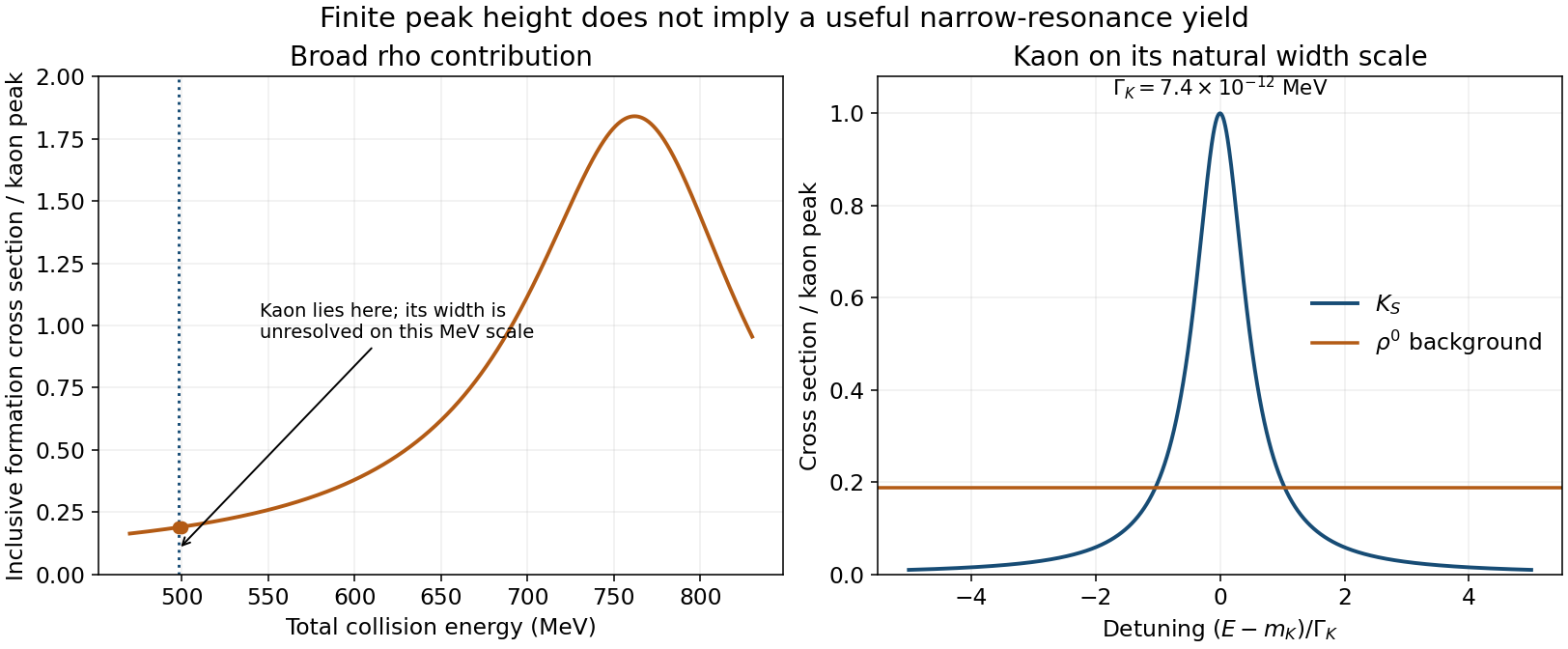
Use and let denote the total center-of-momentum energy, not one beam's energy. Opposite equal momenta give MeV, so the kaon is at its stipulated resonance mass MeV. Write the unspecified selected exit branching fractions as and . The supplied line shape givesThe distinction between inclusive and exclusive resonance branching factors matters here. For inclusive resonance formation, sum over all decays, so . At the small kaon width cancels from the peak value:If instead the measured cross section is specifically resonant elastic , its exit branching fractions equal the entrance ones: , . ThenThe source says production without specifying an observed decay channel, so both conventions are made explicit rather than silently squaring a branching fraction for an inclusive measurement. The quoted kaon width and two-pion branching fraction identify the short-lived propagation state ; a pure flavor state is a superposition of short- and long-lived states. This exercise uses the stipulated resonance model and equal omitted proportionality factors.
Raising each beam energy to 250 MeV makes MeV. The kaon denominator is now dominated byrather than by . Substituting into a givesThe enormous change is a tiny-width effect, not a comparably abrupt change in the broad rho contribution. The center-of-momentum energy has moved about kaon widths from the peak. A width of MeV is only eV, requiring an energy-selection scale of order relative to the several-hundred-MeV beam energy.
Real beams have vastly broader energy distributions. Averaging over such a distribution suppresses the useful narrow-resonance contribution: the finite peak value does not imply a large energy-integrated formation rate, whose resonant area shrinks with the width at fixed branching fractions. The weak inverse-decay entrance coupling and the broad strong-interaction rho background therefore make this a poor way to study kaon resonant formation. The supplied broad-resonance formula is used algebraically as requested; a practical calculation would convolve an appropriate narrow line shape with the actual beam distribution.

The beam energy is a total pion energy, so the momentum follows the relativistic relation . Taking the standard charged-pion rest energy MeV,[ref]For motion perpendicular to a uniform magnetic field, the Lorentz force supplies the transverse momentum change and gives . With the stipulated eV s m,The unit cancellation leaves length after dividing by in metres per second. Equivalently, the usual magnetic-rigidity conversion is for unit charge. The sign of the pion charge chooses the bending direction, while the radius uses its magnitude. Treating the pion as massless would give about m and is not a good approximation at this modest total energy. The production target does not determine the downstream orbit once the pion momentum and magnetic field are specified.
Articles by others on the same topic
There are currently no matching articles.