Choose electric scalar potential and the symmetric gauge , whose curl is . Minimal coupling gives . Since and ,The magnetic term is velocity dependent; it is not an ordinary position-only potential.
The canonical momenta areTaking the Legendre transform givesIts four Hamilton equations, in a polar chart with , areCanonical angular momentum includes the vector-potential contribution and is not simply mechanical angular momentum.
Direct variation of the Lagrangian givesFor a static configuration, and . Since and the radius is positive,The magnetic force vanishes at rest and does not shift this equilibrium. In canonical variables it has but , rather than zero canonical angular momentum.
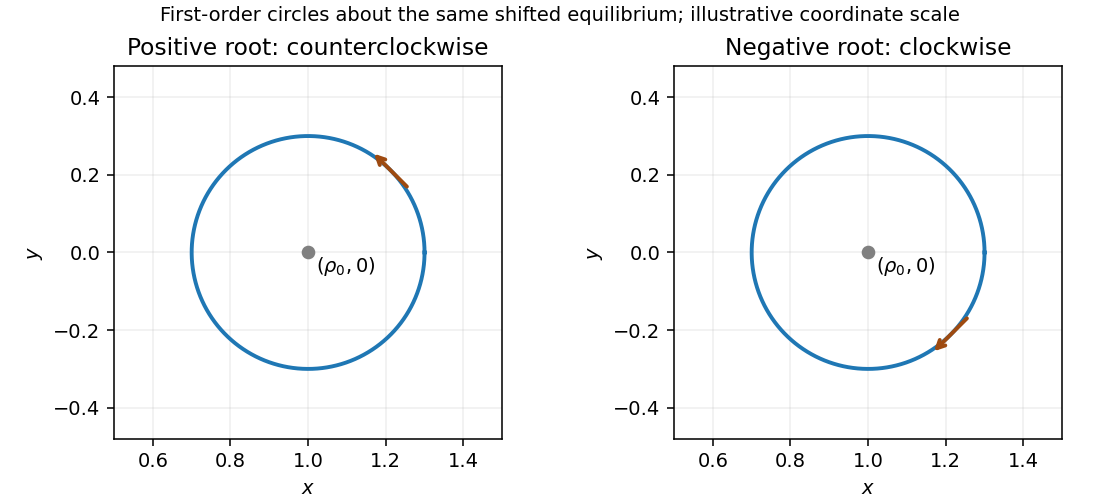
Substitution of the proposed sine and cosine displacements into either linearized equation gives . ThusThese are signed angular frequencies, not two positive frequency magnitudes. To first order, with ,The orbit is therefore a circle of radius about at this order. The positive root runs counterclockwise; the negative root runs clockwise and has the larger magnitude. A positive charge in alone circles clockwise. Here the spring permits an additional counterclockwise mode by providing inward force against its magnetic force.

Articles by others on the same topic
There are currently no matching articles.