Measure both angles from the downward vertical, as in the source diagram. With upward , the cylinder centres areThe large hoop has central inertia and angular velocity , while the small hoop has no spin in this part. Translation and rotation therefore giveThus . Counting each angle and velocity as first order, replacing the cosine in the velocity product by one changes only fourth-order terms. Expanding the potential and dropping its constant gives
The Euler-Lagrange equations from the quadratic Lagrangian areFor a normal mode proportional to , let . Nonzero amplitudes requireHenceThe corresponding amplitude ratios are . The lower-frequency mode has , with the angles in phase; the higher-frequency mode has , with opposite signs. The small hoop's spin remains zero in both modes.
Let be the small hoop's absolute spin angle with the same angular sign convention. Equating the two contact-point velocities cancels the large hoop centre's translation. The remaining tangential equality isThis rolling constraint inside a moving circular track adds small-hoop rotational energy . At quadratic order its cross term cancels the translational cross term in part a. The potential is unchanged, soStatic friction enforces rolling; ideal no-slip contact dissipates no energy.
The new kinetic matrix is diagonal, givingFor the first mode, : the line between the centres stays vertical, both centres translate together, and . For the second, : the outer hoop stays still while the inner hoop rolls within it, with . These coordinate motions are independent only at the retained quadratic order.
Choose electric scalar potential and the symmetric gauge , whose curl is . Minimal coupling gives . Since and ,The magnetic term is velocity dependent; it is not an ordinary position-only potential.
The canonical momenta areTaking the Legendre transform givesIts four Hamilton equations, in a polar chart with , areCanonical angular momentum includes the vector-potential contribution and is not simply mechanical angular momentum.
Direct variation of the Lagrangian givesFor a static configuration, and . Since and the radius is positive,The magnetic force vanishes at rest and does not shift this equilibrium. In canonical variables it has but , rather than zero canonical angular momentum.
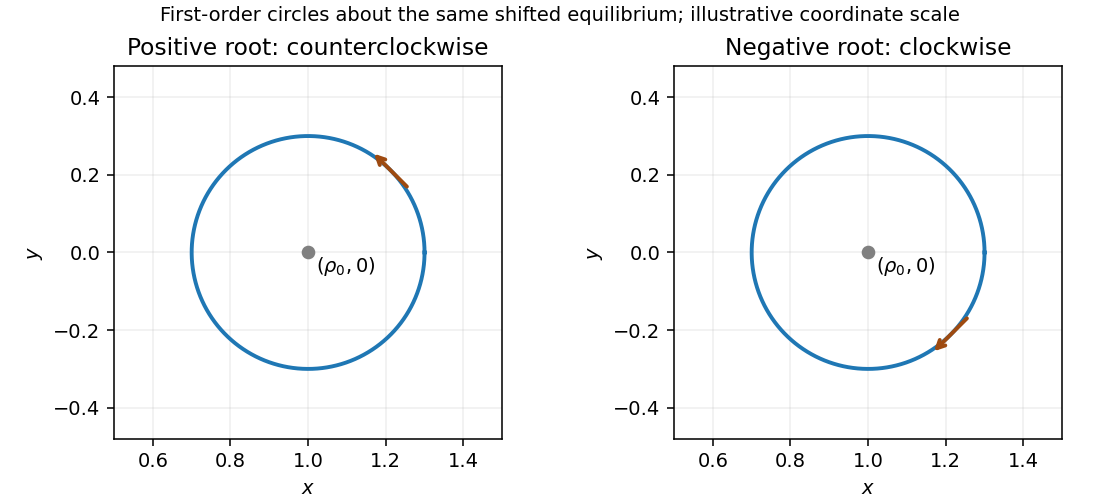
Substitution of the proposed sine and cosine displacements into either linearized equation gives . ThusThese are signed angular frequencies, not two positive frequency magnitudes. To first order, with ,The orbit is therefore a circle of radius about at this order. The positive root runs counterclockwise; the negative root runs clockwise and has the larger magnitude. A positive charge in alone circles clockwise. Here the spring permits an additional counterclockwise mode by providing inward force against its magnetic force.
For a regular Lagrangian define and . Its differential isThe velocity differentials cancel. Using and comparing independent coefficients givesThe last equality concerns explicit partial derivatives in their respective natural variables; it does not assert that total time derivatives are always negatives.
The assumed relation makes the old and new actions differ by the endpoint term . Fixed endpoint values of both coordinate sets make its variation zero. Therefore stationarity of the old action is equivalent to stationarity ofVarying independent and integrating by parts givesBoth coefficients vanish: the new variables satisfy Hamilton's equations, so a locally invertible transformation with this action identity is canonical.
When the Hamiltonians agree, exactness of the one-form givesThe action argument of part b then proves canonicity. Equivalently, exterior differentiation preserves the symplectic two-form. For a time-dependent transformation, the exact differential must supply the full action identity; a fixed-time check alone would not establish that the new Hamiltonian equals the old one without a time-dependent correction.
The general action identity isTreating as independent and comparing coefficients givesChoose a complete integral of the Hamilton-Jacobi equation,Then , and Hamilton's equations become . Completeness and local invertibility are needed: a solution with too few independent parameters cannot generate an arbitrary trajectory.
Separating gives . On the positive-momentum branch chooseWith and , differentiation with respect to givesSince is constant,The displayed integral is a local positive- branch. Continuing the trajectory through turning points switches momentum branches and extends the sine solution over the complete orbit. is the oscillator energy, and fixes its time phase.
Use metric signature and units . Varying and independently givesIn the divergence of the stated current, the products of first derivatives cancel, leavingThe two identical mass terms cancel on the field equations.
An infinitesimal constant phase change has and . Both the derivative product and the mass term are invariant. Noether's theorem gives, per unit ,Thus the global phase symmetry supplies the conserved current in part a.
The derivatives needed for varying areTherefore the electromagnetic Euler-Lagrange equation isAntisymmetry of and commutation of derivatives imply , hence . In ordinary derivatives, ; the interaction contribution must not be omitted.
Under the combined local transformation,The derivative of the phase cancels the added gauge potential. The conjugate derivative gains the opposite phase, so their product and are invariant. AlsoEvery term of the interacting Lagrangian is therefore invariant.
The local gauge symmetry contains the constant-phase subgroup. For constant , , and Noether's theorem applied to the matter fields givesThus on the matter field equations. More explicitly, allowing in the matter variation while holding fixed gives . On shell it also equals , so equality for arbitrary implies conservation. In the full gauge transformation, varying cancels the term; this is the related Noether second-theorem identity, not a new independent charge for every gauge function.
For the supplied Lagrangian, variation with respect to usesThus . In the Lorenz gauge,For real external fields and driving, the conjugate equation has acting on . The supplied model has no term; one must not insert such a term from a different minimally coupled Lagrangian.
First fix the source at the spatial origin. Fourier transform replaces by and by in the free term. Multiplication by a static background becomes a momentum convolution; the derivative in acts on the Green function, so it carries the internal momentum . ConsequentlyThe transformed point source supplies the right-hand side one. The signs follow from in these conventions.
Source-position qualification. For a nonuniform , the general Green function is not translation invariant. In the printed basis , its coefficient must also depend on , and the convolution contains an extra factor . The displayed source equation is valid for , or with the background itself expressed in coordinates centred on that source. Equivalently, a general spatial Fourier Green function has two momentum arguments and a momentum-delta-function source. Staticity alone permits the time-difference transform, not a general position-difference-only transform.
The delta function in the artificial constant potential collapses the convolution. Put and . ThenInverse Fourier transform gives the stated real-frequency integral with exponential . For , the poles have opposite real parts and common imaginary part . For , both are imaginary, at . They remain in the upper half-plane if , or the lower half-plane if . At equality they merge into a second-order pole at . For one pole reaches the real axis, requiring a prescription.
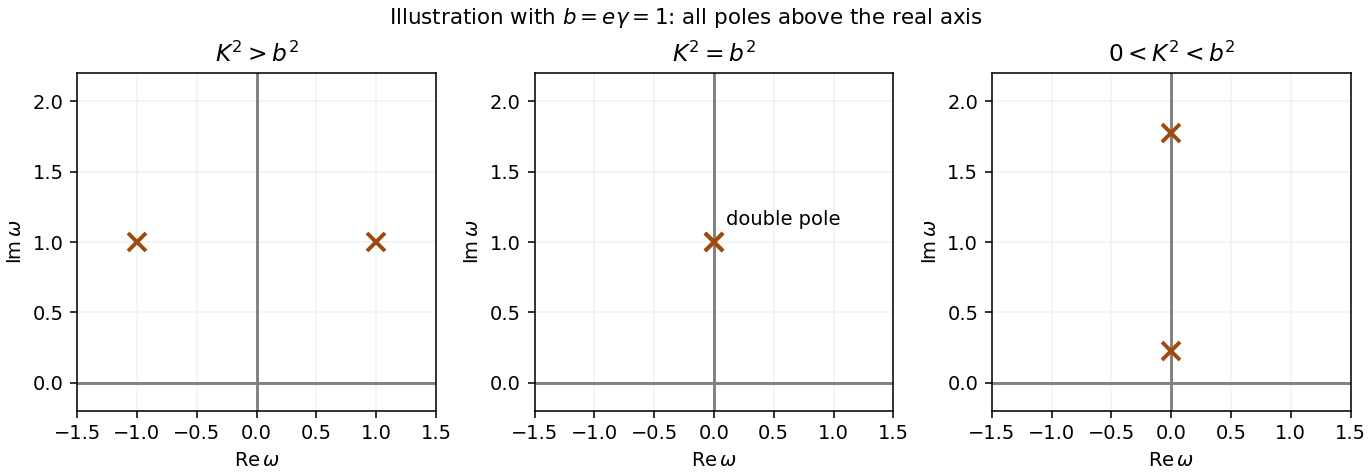


Let and . Because , close below for and above for . The lower closure is clockwise. The two residues sum to . Hence, for nonzero ,In particular, the printed sign with gives zero for and an advanced Green function for . Reversing that sign puts the poles below and gives a retarded Green function. Both solutions have the unit derivative jump required by . If , the bare integral has real-axis poles and requires an additional contour prescription; a unique retarded or advanced answer cannot be inferred without one.
At mean-field level, positive gradient stiffness favours a spatially uniform order parameter. Writing , minimization of giveswith arbitrary constant . The minimized density is zero above the transition and below it. The order parameter vanishes continuously as ; the first derivative of the minimized free energy is continuous while the second changes. This is the continuous mean-field transition.
The broken symmetry is global U(1) symmetry, not merely the Ising sign symmetry. Selecting one ordered phase breaks this continuous symmetry and leaves a soft phase direction. These are minima of the supplied Landau free energy, not an exact finite-temperature long-range-order claim in one dimension: phase fluctuations invalidate that inference for a short-range one-dimensional system.[ref]
Statistical Field Theory by David Tong. §4.2.3, continuous symmetry, phase fluctuations and the Mermin-Wagner theorem
Take the ordered phase selected by a small positive real field, so is real and positive before sending . Stationarity gives . Differentiation yields . ThereforeBoth have mean-field critical exponent one, with a factor-of-two amplitude difference. The below-transition result is the longitudinal response of a selected pure phase. The transverse phase direction is soft, so a transverse zero-field response is singular; an unselected phase average is not the same susceptibility. At , and the linear susceptibility diverges.
Set and . The trial density is . At fixed , its minimum is if and otherwise, with density . Minimizing usesFor , minimizes the quadratic coefficient. For , the minima are at and have . ThusEverywhere else the minimum is ; at the transition boundary the ordered amplitude tends to zero. The zero-field minimum is respectively or in the two ordered regions. For the helical solution is lower than a uniform ordered extremum whenever the latter exists, and lower than the disordered state whenever its amplitude is nonzero. The assumed positive-amplitude ansatz must allow its zero-amplitude boundary to describe disorder.
The phase remains arbitrary because the functional has global U(1) symmetry. At nonzero , a translation shifts that phase; separate translation and phase operations retain a combined unbroken subgroup. The two signs of also select opposite handedness. The meeting point of the uniform, modulated and disordered mean-field regions is the Lifshitz point .
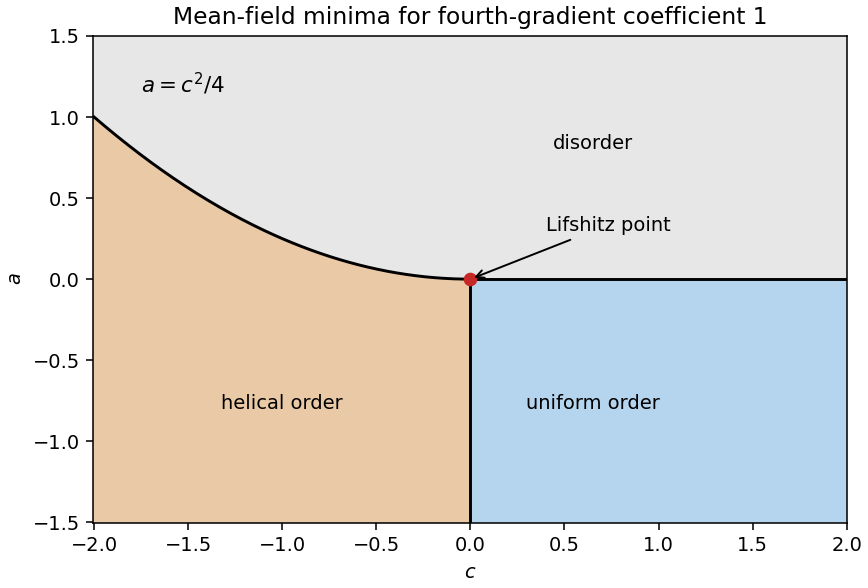
Uniform, helical and disordered minima of the specified complex Landau free energy
. Details. 
Articles by others on the same topic
There are currently no matching articles.