For canonical coordinates , the Poisson bracket isIt is bilinear and antisymmetric, obeys the Leibniz rule in either argument, and satisfies the Jacobi identity. These properties encode the symplectic structure of phase space. The two printed inline applications are treated separately below.
An invertible change is canonical when it preserves the Poisson bracket. Its fundamental brackets must beThe chain rule then makes the bracket of any two observables identical in the old and new coordinates. Consequently Hamilton's equations retain their canonical form. A time-dependent canonical transformation also requires the corresponding extra term in the transformed Hamiltonian; bracket preservation by itself concerns each fixed time.
Along Hamiltonian motion,Substituting and givesFor the printed there is no explicit time term. In particular, an autonomous observable is conserved when its Poisson bracket with vanishes. Taking or recovers Hamilton's equations.
For ,The derivatives of are and . Its Poisson bracket with is thereforeDirect differentiation, , gives the same expression and checks the bracket sign.
In one canonical degree of freedom it is enough to check for a locally invertible transformation. Hereso and . To obtain exactly the requested Hamiltonian, choose and the positive branch for :The identities and giveThis is a local canonical chart, with inverseIt is not a global identification of the real half-plane with the entire oscillator plane. The negative branch for gives the analogous lower wedge. This domain matters if an oscillator trajectory is continued beyond the boundary of the chart.
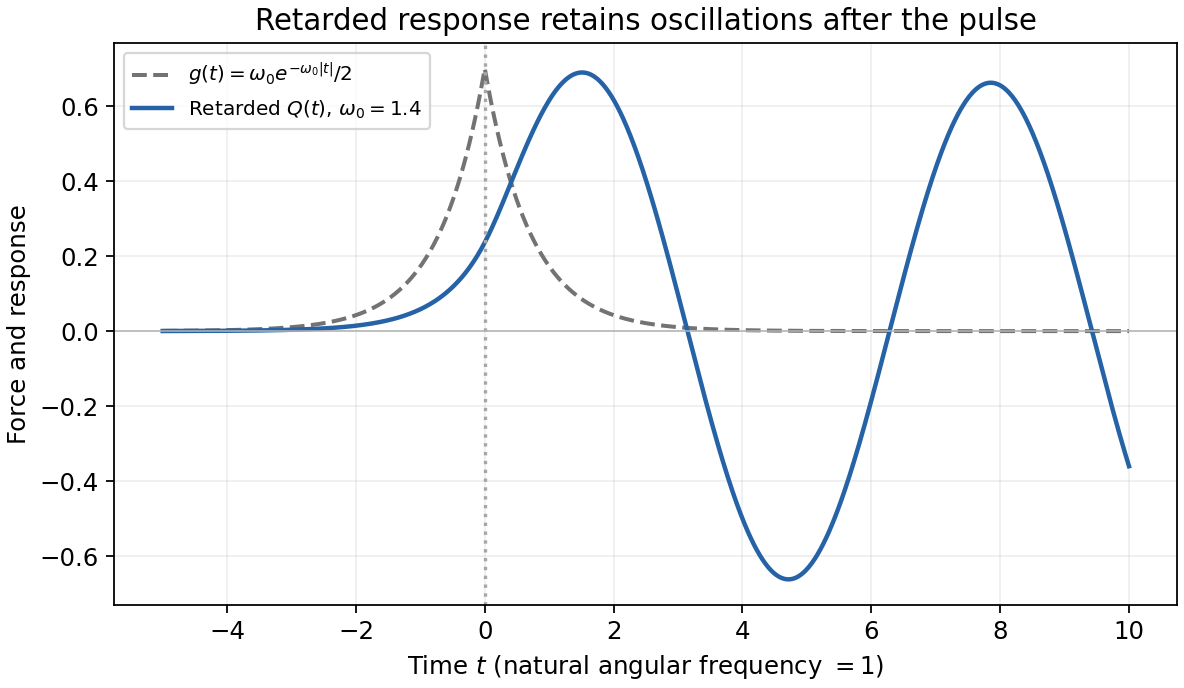
The perturbed Hamiltonian is . Hamilton's equations give , , henceIn the paper's time units the natural frequency is one. The retarded Green function is : it vanishes before the source, is continuous at zero and has a unit derivative jump there. With Fourier convention ,Both real-frequency poles are displaced below the real axis. Causality therefore selects the convolutionFor the exponential rises as throughout the integral. For , split the integral at . Evaluation yieldsThe response is nonzero before because the prescribed force is already nonzero then; this does not violate causality. Both and are continuous at zero. The force eventually decays, leaving the free oscillation . A general solution adds , but the retarded condition of no incoming free oscillation as fixes .
The oscillator equation is well-defined on the full plane. Interpreted through the positive- chart of part (c), it describes the original real variables only while , with . The requested retarded oscillator solution is a continuation in the new variables; it is not a claim that this canonical chart remains valid at all times for every .

Articles by others on the same topic
There are currently no matching articles.