Assume a real, central, short-range potential and elastic quantum scattering. At large radius, normalize the stationary wavefunction aswhere and is the scattering angle. Equal incoming and outgoing speeds give the differential scattering cross-section .
The partial-wave scattering expansion separates the spherical harmonics. The incident plane wave has expansion , with Spherical Bessel functions and Legendre polynomials . The regular radial solution outside the potential has asymptotic form . Its real scattering phase shift changes the ratio of outgoing to incoming waves to the Partial-wave S-matrix . Matching outgoing coefficients yieldsHere labels the orbital angular momentum, with squared magnitude . The assumption of purely elastic scattering is what makes every have unit modulus.
Integrate the squared partial-wave expansion of a scattering amplitude over the solid angle. Legendre polynomial orthogonality eliminates terms with unequal angular-momentum indices, givingAt zero scattering angle, and . ConsequentlyThis is the optical theorem. In the present elastic problem the total and elastic cross sections coincide. For an absorptive interaction the inclusive total still obeys the optical theorem, but need not equal the integral of the elastic differential cross section.
The radial S wave vanishes at the hard surface, so outside the sphere . Comparison with givesThe hard-sphere S-wave scattering amplitude and cross section are thereforeThe three prominent features are the finite low-energy limit , the oscillations with exact zeros at for positive integers , and the decreasing envelope . The zero-energy value is four times the geometric area . Near zero the normalized cross section is . The large- fall here concerns the S wave alone; summing all partial waves gives a different high-energy total.
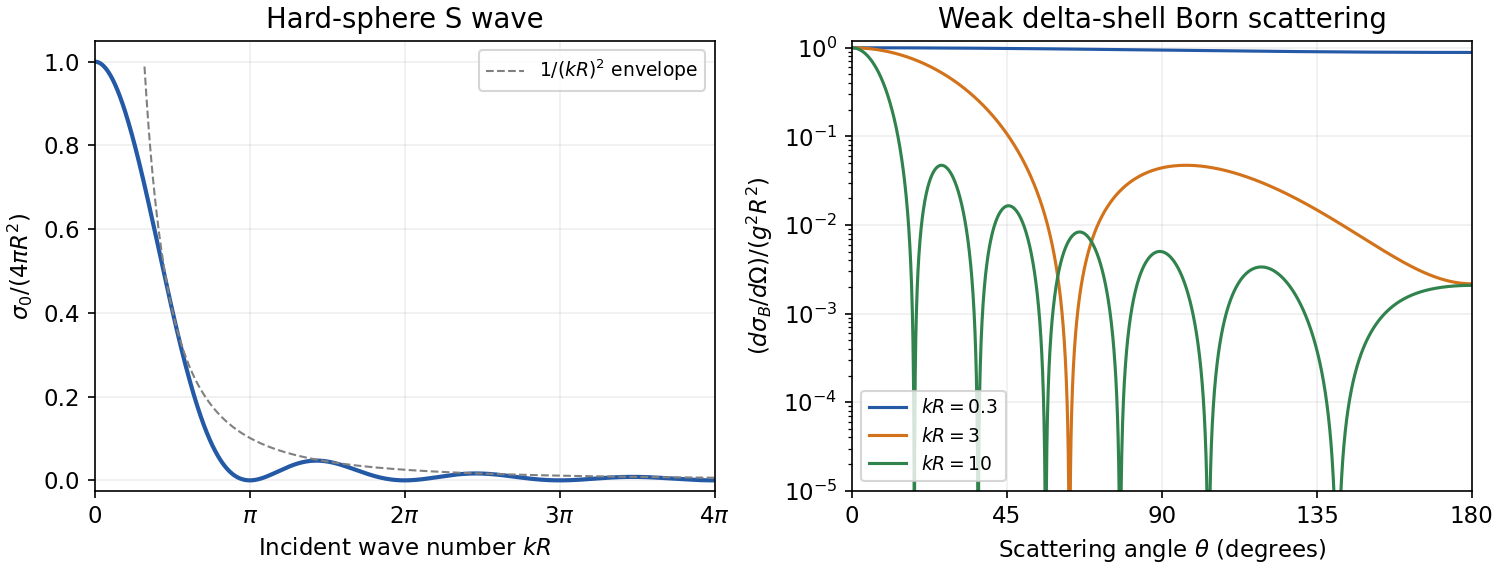

In the first Born approximation, let be the transferred wave number. The angular integral in the three-dimensional Fourier transform is , soWriting and , with value one at zero, the delta-shell Born amplitude givesFor the scattering is approximately isotropic, with total cross section . For it has a forward lobe of angular width of order and oscillatory zeros where . At a fixed nonzero scattering angle, its envelope decreases as . The right-hand panel of the figure shows this angular dependence.
For real the first-order scattering amplitude is real, so inserting it literally in the optical theorem would predict zero total cross section, contrary to its nonzero squared modulus. The first Born amplitude alone does not satisfy the optical theorem at order . This is an order-of-approximation issue: the squared first-order amplitude is already second order, and the second Born term supplies the required second-order imaginary forward amplitude. At first order both sides vanish. A weak-shell regime is needed for the Born truncation itself to be accurate.
Articles by others on the same topic
There are currently no matching articles.