Evaluate the two-body Lorentz-invariant phase space in the decaying particle's rest frame, . The spatial delta function sets . Both massless particles have energy , leavingHere the factor in the second equality is the Jacobian of the energy delta function. Integrating the solid angle gives . If the decay is isotropic, the squared amplitude is angle independent, soThis uses distinguishable final particles or an amplitude/phase-space convention with any required identical-particle symmetry factor already included. Two genuinely identical final bosons require an additional if the full angular domain is integrated without such a factor. The complex particle and antiparticle in the following parts are distinct, so no such division is required there.
Define the free Feynman propagators byThe interaction preserves the global phase symmetry , with the real neutral. Therefore the charge-two correlator vanishes in a symmetry-invariant perturbative vacuum:In Wick contractions, a complex field contracts only with its conjugate; one vertex has one of each and cannot absorb both external fields. The symmetry shows this vanishing holds to all perturbative orders, not only first order.
The neutral connected correlator has one allowed contraction to each external point at order :The propagators are even functions of their separation; their orientations encode the conjugate-field contractions. Equivalently, with every external momentum Fourier transformed as incoming,No factor of two accompanies the vertex: and are distinct fields.
For the full correlator as literally written, a disconnected scalar three-point tadpole is also possible. Contract the two external complex fields with each other and contract the complex pair at the vertex into a loop. Unless normal ordering is imposed on the interaction or a tadpole counterterm fixes , addThe coincident propagator is regulator dependent; in dimensional regularization the massless scaleless tadpole diagram vanishes. More generally this is to this order and is removed by taking the connected correlator or imposing the stated vacuum-renormalization condition. Normalizing by vacuum bubbles alone does not remove an external-leg disconnected tadpole diagram. The charged correlator remains zero in every one of these conventions.[ref]
Quantum Field Theory by David Tong. §§3.3.2 and 3.7.1, Wick expansion, connected Green functions and vacuum normalization
At a single interaction insertion, the Dyson series supplies . Amputating the three external propagators in b gives the momentum-space ruleIf the momentum-conservation factor is included in the vertex convention, append , with all momenta incoming. There is one charged line entering and one leaving the vertex, and a neutral real-scalar line. The absence of a factorial in the interaction is appropriate because its three fields are distinct. The amputated decay amplitude has magnitude with the usual convention that a graph computes .
The leading decay is into one complex particle and its antiparticle, which are distinguishable. Using in a givesIn four space-time dimensions a canonically normalized scalar has mass dimension one, so has mass dimension one. The amplitude starts at order , a rate is quadratic in that amplitude, and the only mass scale in the massless-daughter decay is . Those facts already require , leaving only a dimensionless numerical factor to calculate.
For low-energy charged-scalar scattering through a neutral scalar, label the incoming particle and antiparticle as and their outgoing counterparts as . Charge flow allows -channel annihilation and exchange of the real massive scalar. It forbids a separate -channel graph for this fixed assignment of distinguishable final charges. The tree amplitude isAt low energy it is approximately angle independent. The massless two-body scattering formula then givesIn particular the requested scale estimate is , not with the incoming-energy dependence omitted. Integrating out gives at this order, whose complex-scalar four-leg combinatorics reproduce the same amplitude. These are weak-coupling perturbative results about the specified vacuum; possible ultraviolet stabilizing interactions are not determined by the cubic term alone.
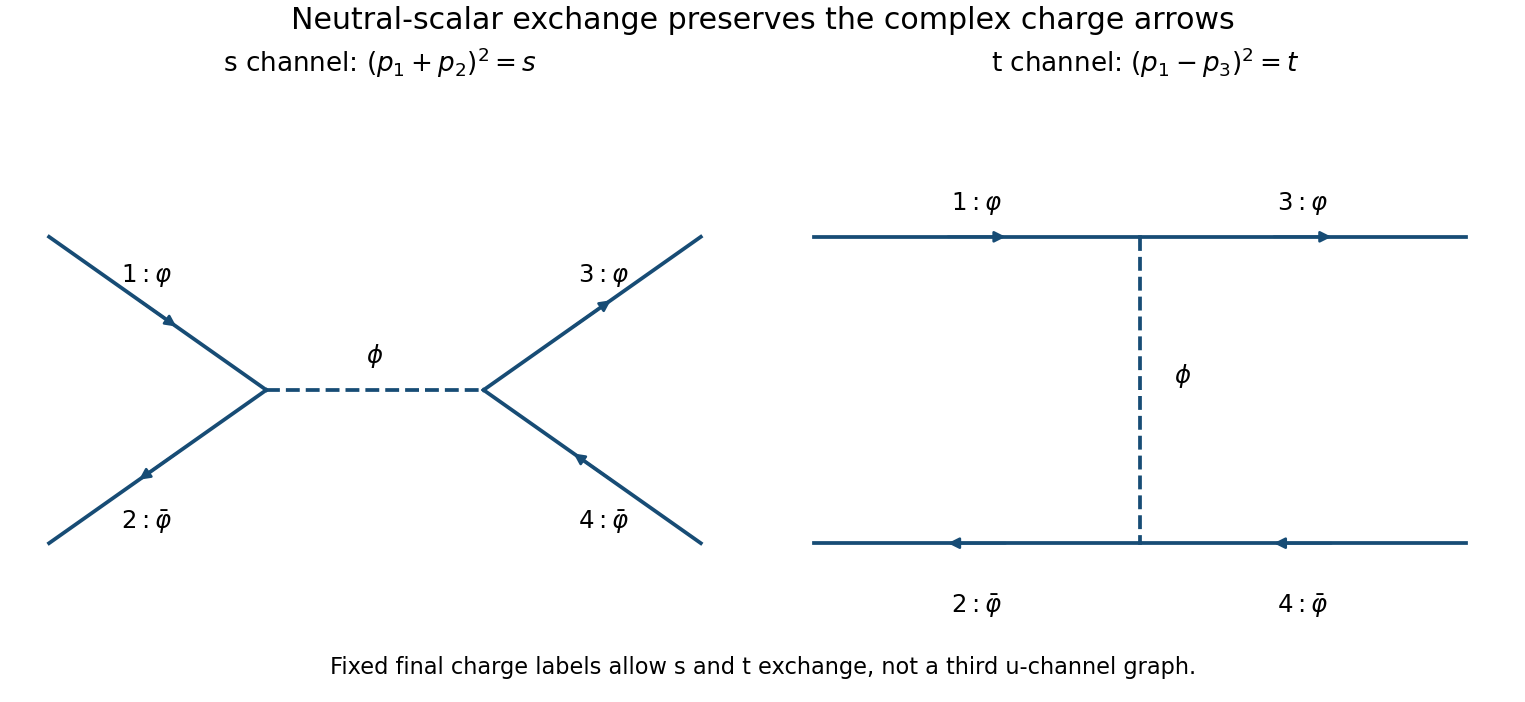
The two allowed leading particle-antiparticle scattering diagrams
. Original s-channel annihilation and t-channel exchange graphs. The internal dashed line is the massive neutral scalar; solid arrows show conserved complex charge. A u-channel graph would connect the wrong final charges for the fixed labeling. Details.
Articles by others on the same topic
There are currently no matching articles.