Source bundle pages 48–54; the cover identifies Trinity Term 2022 despite the attachment filename. Solutions use except where is displayed. In Questions 4–6 the Minkowski metric is , and spatial surface terms vanish or cancel under periodic boundary conditions.
For the sawtooth Ising chain, there is a source inconsistency: the printed Ising spin values are , with no definition of . The requested transfer matrix follows for , namely the usual Ising model with values . For arbitrary , summing an apex spin actually givesFor example, , and give the bracket , whereas the claimed hyperbolic cosine gives . Thus the printed identity is false literally. The rest of Question 1 uses the intended symmetric Ising spin values, .
For a fixed configuration of base spins, each apex spin appears in only one local Boltzmann factor. The apex spins are therefore conditionally independent, and their finite sums factorize:Only the base spins carry information from one triangle to the next. The apex spins have already been summed out, so no apex index remains in the transfer matrix; the final trace implements the periodic boundary condition.
In the basis the transfer matrix and its eigenvalues areFor finite positive temperature, and . Consequently and in the thermodynamic limit. There are spins, so the Helmholtz free energy per spin isThe factor is essential: one transfer matrix step counts two spins. For completeness, if the undefined is retained, set , and . The same thermodynamic limit gives whenever these are two distinct spin values.
Differentiate the Helmholtz free energy at fixed couplings. With from solution, the entropy per spin isIt is particularly useful to writeAt , this is , so . For fixed , the first exponential dominates alone, giving . Hence the residual entropy isThe finite positive difference must be kept fixed in the second limit; taking it to zero first gives the other answer.
At high temperature, and , whenceAll configurations become equally probable because their Boltzmann factors tend to one. The two available states per spin, rather than the coupling values, determine this entropy.
For one triangle, equal base spins give energy . Their minimum occurs at and is . Opposite base spins give energy , independently of the apex spin. The all-equal configurations have energy .
When , the six configurations with precisely one spin different from the other two all have minimum energy . For a fixed first base spin, there is one minimum choice if the next base spin is the same, and two choices of apex if it is opposite. The ground-configuration counting transfer matrix is thereforeThis ground-state counting of the frustrated sawtooth Ising chain proves the extensive geometric frustration and the residual entropy .
When , . Every triangle must have equal base spins and the opposite apex spin. Shared base spins propagate that choice around the chain, leaving just two global ground states, of energy . Their entropy per spin is .
For couplings favoring ferromagnetism, write , with . Both orientations of an all-equal triangle minimize every bond simultaneously. The common base spins then make the whole chain uniform. There are two global ground states for either or , so no corresponding distinction in residual entropy occurs. This statement assumes all bonds remain nonzero.
The continuous internal symmetry is a common rotation around :Both the transverse exchange and the Dzyaloshinskii-Moriya interaction contain one raising and one lowering spin operator, so the phases cancel. Equivalently, and the continuous group is U(1).
The discrete internal symmetry is time reversal, , together with . Each term in contains two spin operators, so it is invariant. The operation is antiunitary; treating the reversal of all three spin components as a unitary rotation would violate the spin commutation relations. It reverses the magnetization and interchanges the two easy-axis ordered orientations. A convenient equivalent representative, composed with a rotation, is , which reverses while preserving as operators.
The statement about one continuous and one discrete internal symmetry describes generic parameters. At , additional unitary rotations about transverse axes are allowed; at , the continuous internal symmetry enlarges to full spin rotation symmetry. Spatial translations of the uniform chain are separate symmetries of the sites.
The Holstein–Primakoff transformation maps the finite spin basis to bosonic Fock states with . Thus is the fully polarized reference state, and creating a boson lowers by one. The physical subspace has the Holstein–Primakoff occupation constraint , not the whole infinite oscillator Hilbert space.
The specified ordering of the square root givesThese are the exact spin ladder operator matrix elements; in particular, the lowering amplitude vanishes at . The underlying oscillator obeys its usual canonical commutation relation on the enlarged space, while the spin operators preserve the constrained physical subspace. Projecting the oscillator operators themselves to a finite space would change their commutator at its upper endpoint.
Expanding converts an ordered spin problem to approximately free magnons, with interactions in higher orders of . Two complications are the nonpolynomial, order-sensitive square roots, which generate interacting bosons, and loss of the occupation bound when a truncated expansion uses the full bosonic Fock space. Large depletion, high temperature, or soft modes near a phase transition can invalidate the assumption even when is large.
Expand around the polarized ground state. With fixed as , the Holstein–Primakoff transformation gives , and . The longitudinal exchange contributesUseThe transverse exchange then gives , and the Dzyaloshinskii-Moriya interaction gives . Discarding the constant and all interactions yieldsHere periodic boundary conditions make each occur twice in the longitudinal sum. The approximation is the linear spin-wave approximation, controlled by small local magnon occupation compared with .
Choose the unitary discrete Fourier transformThe finite-sum orthogonality identity gives . It also gives . Substituting from solution therefore gives the dispersion relationUsing the opposite sign in the Fourier transform reverses and the sine term together, without changing the spectrum.
For every , so the ground state of this quadratic Hamiltonian is the bosonic vacuum, for every . In the original spin variables it is the fully polarized product state. Its energy is zero after the constant subtraction. Repeating the construction about the fully polarized state describes the other easy-axis sector of the original Hamiltonian.
A one-magnon excitation has energy above the reference ground state. A normalized many-magnon Fock state with occupations has excitation energy , within the dilute regime of the linear spin-wave approximation. The lowest excitation in this sector has the minimum allowed .
Let and . Since , the continuum minimum of the dispersion relation isFor , the energy gap closes at a positive , at wave vector . Below it, the quadratic expansion about the polarized state has a negative mode and is no longer a stable ground state approximation; higher-order terms and a different ordered reference state are needed.
Two qualifications are required by the actual assumptions. First, is permitted, in which case ; it is a concrete counterexample to the printed strict inequality . Second, a finite ring only has discrete momenta. Its finite-ring spin-wave threshold with antisymmetric exchange isThis approaches in the thermodynamic limit and equals it when is allowed. For example, and give , since the maximum of is one. Thus the continuum formula and its positive threshold require the large-ring interpretation. The two symmetry-related polarized ground states already have equal exact energy; the calculated energy gap refers to excitations about one chosen orientation.
Here is the probability of occupying state , and for is the transition rate from to . More precisely, over that transition has probability . This is a time-homogeneous continuous-time Markov chain: the present state contains all information needed for the next transition, the rates do not depend on time, and finite rates make multiple jumps have probability . In a physical rate description, untracked coherent dynamics or memory must be negligible on the timescale being modeled.
The master equation separates incoming and outgoing terms:Columns, rather than rows, sum to zero with this indexing. These conditions preserve normalization and nonnegative probabilities. For infinitely many states one also needs a well-defined nonexplosive process. Detailed balance is an additional equilibrium condition, not a general requirement on a master equation.
Write the probability column vector as , with denoting the uncharged state. The arrows in the original figure give transitions at rate , at rate , at rate , and at rate . Exclusion of double occupation means injection occurs only from state . Thus the master equation isFor example, . Every allowed jump adds to one probability and subtracts from another, which verifies the zero column sums.
Set the time derivatives in the master equation to zero. The first and third rows give and . Normalization then gives, with ,These expressions assume positive rates, or a limiting choice for which and the stationary distribution is unique. If rates vanish so that multiple closed classes appear, the initial condition can matter.
The word “equilibrium” in this part must mean a stationary distribution. With positive the one-way contact transitions support a nonzero stationary electric current, so the process is not in thermodynamic equilibrium and does not satisfy detailed balance. In particular, carries positive probability flow while the direct reverse rate is zero.
Count net transmitted charges per unit time, taking left-to-right as positive. The contact on the left, the internal bond, and the contact on the right give respectivelyThe backward rate must be subtracted in the internal count. Substitution of solution yieldsThe equalities also follow directly from and : there can be no stationary accumulation of electric charge. If each carrier has charge , the electric current is . During a stationary interval of duration , the expected net number crossing any one bond is . In particular, counting both directions of internal hopping as positive would count traffic, not transmitted charge.
For set and . The master equation becomesUsing and givesInitially the molecule occupies , so and . The characteristic roots are ; the constant particular solution is . ConsequentlywhenceIt has the required initial slope , tends to the stationary uncharged probability , and remains nonnegative. As a further check, and are nonnegative and sum with to one. If , no jump occurs and , also obtained directly from the boxed expression.
The free complex Proca field has Poincaré symmetry, with transforming as a spacetime four-vector, and the global internal U(1) symmetryThe free theory is also invariant under charge conjugation and the usual parity and time reversal transformations of a vector field. The internal real-field description consists of two equal-mass real Proca fields, with an symmetry containing the phase rotations and charge conjugation.
A gradient shift of leaves unchanged, because partial derivatives commute. It changes the mass term byThis is generally nonzero: for example, and real produce . Thus a massive Proca field has no such gauge symmetry. The massless kinetic term alone would have it.
Treat and as independent variables in the Euler-Lagrange equation. Varying gives the Proca equationThe divergence of its first term vanishes by antisymmetry and commuting partial derivatives. Since , it follows that . Substitution into the original equation givesThe complex-conjugate variation gives , hence and .
For an on-shell plane wave , the Lorenz constraint in Proca theory is . In the rest frame it sets , leaving three complex particle polarizations. Thus the complex Proca field has three independent complex dynamical components, or six real ones; its quantized particle and antiparticle each have three physical particle polarizations. The conjugate field is not another unrelated classical field.
Use the upper-index coordinates specified in the paper. Differentiation of the Lagrangian density gives the canonical momentaIn particular, and . No time derivative of appears, so the zero momenta are primary constraints, not invertible equations for .
For spatial indices, , so , with the conjugate relation for . AlsoThe Legendre transform for the complex Proca Hamiltonian, therefore givesRepeated spatial indices in the positive product denote an ordinary three-component sum. A total Hamiltonian additionally includes multipliers for .
The Hamiltonian printed in the source cannot follow from the given complex Lagrangian density: its missing conjugations, mass coefficients and spatial mass sign are inconsistent. A concrete check is spatially uniform initial data , , with all canonical momenta zero. The correct Hamiltonian density is , while the printed expression gives . These data satisfy the initial constraints and evolve as a spatially uniform massive oscillator. Thus the discrepancy is not a harmless surface term or a different complex-field normalization.
Preserve the primary constraints using the corrected Hamiltonian from solution. After a spatial integration by parts, the terms in its density are . Hamilton's equations giveWith the definitions of in the paper, the actual massive Gauss law is thereforeThis is also the component of the Proca equation. The zero right-hand sides printed in the source apply only to the massless theory or to special configurations with .
For a concrete counterexample, take , , and the longitudinal on-shell plane waveIt satisfies , but and . Imposing the printed zero-divergence condition would incorrectly remove the physical longitudinal particle polarization.
The naive equal-time canonical commutation relations would bewith all coordinate-coordinate, momentum-momentum and mixed conjugate-sector commutators zero before enforcing constraints. But the relation contradicts as an operator identity: its left side would vanish and its right side would not.
The primary zero-momentum constraints and the secondary massive Gauss laws form second-class constraints; their Poisson bracket matrix contains nonzero terms proportional to . They must be eliminated, or treated using a Dirac bracket, before quantization. In a reduced description the three complex spatial coordinates and their momenta are canonical, whileare dependent operators. Substituting them in the integrated Hamiltonian gives the positive density, up to a surface term,Thus the problem is a constrained choice of canonical variables, not an absence of a consistent free quantum field theory.
Introduce the electromagnetic electromagnetic field tensor and the charged vector field strength , with . Minimal coupling givesUnder and ,Consequently the required relation isThen , its complex conjugate transforms oppositely, the mass bilinear is invariant, and . Each term in the total Lagrangian density is therefore invariant under the electromagnetic U(1) gauge symmetry. This phase gauge symmetry does not reinstate the broken gradient-shift gauge symmetry of the massive field itself.
Set , so . Expanding the minimally coupled Lagrangian density givesThus there is a derivative cubic interaction vertex of order , and a quartic interaction vertex of order . There is no pure contact term in this minimal coupling theory, nor an Abelian three-photon interaction vertex.
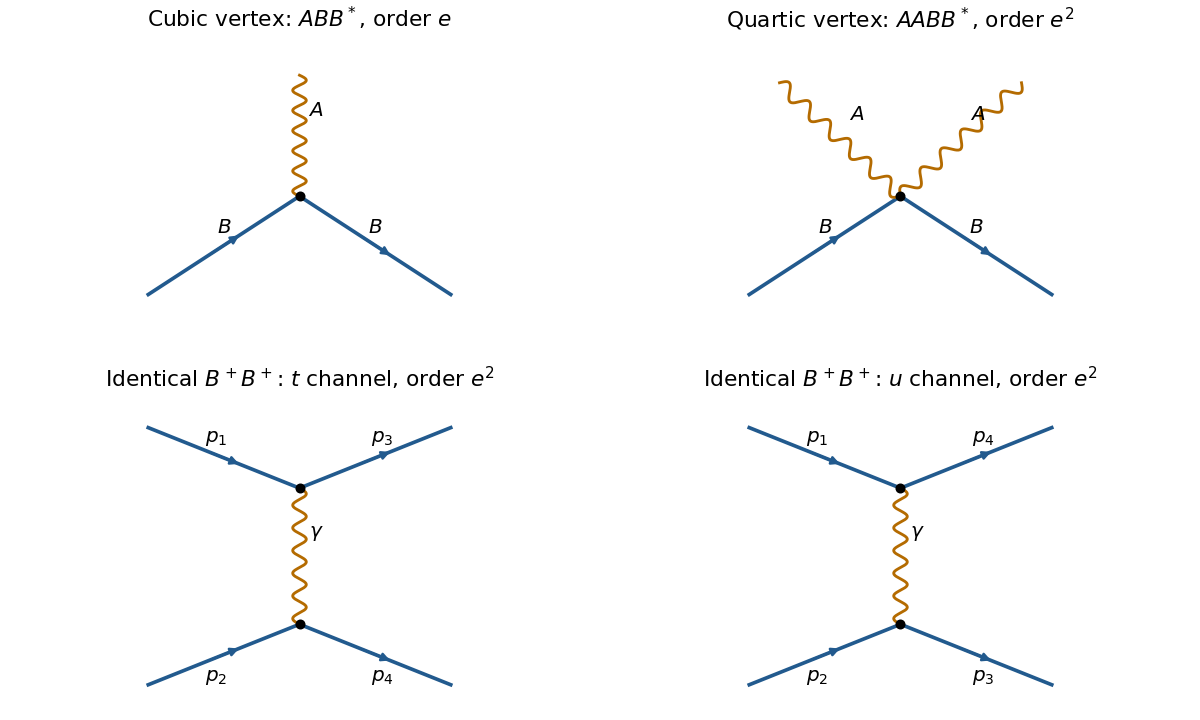
Cubic and quartic charged-vector vertices, and the two photon-exchange channels for identical charged vector bosons
. Details. The straight arrowed lines in the original schematic denote charged massive vector bosons; the wavy lines denote photons. For two identical positively charged vector bosons, the leading scattering amplitude has the order- -channel photon-exchange Feynman diagram, together with its -channel interchange required by identical bosons. A quartic interaction vertex cannot directly attach four external massive vector bosons. For a particle-antiparticle incoming pair, the leading channels instead are -channel exchange and -channel photon annihilation. The shown arrows track charge flow; an outgoing charged particle corresponds to the conjugate field at a vertex.
At fixed time, the coordinate field and the canonical momentum are independent variables. Their functional derivatives satisfyPutting , in the Poisson bracket definition therefore givesThe superscript on the species label in the printed denominator has no spacetime-metric significance; with the ordinary species Kronecker metric it is the same expression.
A scalar field has for a pure change of spacetime argument. With and , its variation at a fixed argument is . The supplied Noether charge becomesSince , solution and antisymmetry of the Poisson bracket giveCanonical quantization replaces the Poisson bracket by a commutator divided by :With this sign convention one may use and . Because , the negative shift of the field argument follows with the required sign.
For the Noether charge is , with the Hamiltonian density and . Invertibility of the momentum-velocity relation allows . When taking a functional derivative at fixed , the implicit dependence of cancels in the Legendre transform:It follows thatThis proves the same generator relation for time translations. In a constrained theory the assumed inversion fails, so the appropriate reduced variables or Dirac brackets are needed instead. That is precisely the issue encountered for the Proca field in Question 4.
For a first-derivative Lagrangian density with no explicit spacetime dependence, introduce the canonical energy-momentum tensorDirect differentiation giveson solutions of the Euler-Lagrange equations. The four Noether currents are the four columns of this tensor, whereas their spatial integrals are the conserved four-momentum components:For this is the Hamiltonian; for a spatial lower index it is . Under the paper's passive-translation convention, the corresponding generator is . Conservation of the integrated quantities also uses the stated vanishing boundary flux.
For the spatial momenta, integration by parts givesTheir Poisson bracket is thereforeFor the mixed case, and the spatial generator acts on both canonical fields by differentiation: , . Hence, for a translation-invariant local Hamiltonian density,Finally by antisymmetry. Together these proveThe proof requires commuting derivatives and no surviving boundary terms. It expresses the Abelian translation subgroup of Poincaré symmetry at the level of its canonical generators.
Write , and . The Fourier expansion in the source is compatible with the oscillator canonical commutation relationsFor the free real scalar field, andSubstitution of the Fourier expansion produces spatial Dirac delta functions. Terms with two annihilation operators or two creation operators cancel: in their coefficient is , and in their integral is odd under . The two mixed terms combine, with normal ordering removing the vacuum constant, to giveIn particular, contains the lower component in this Minkowski metric convention.
To check commutativity without manipulating a square of a Dirac delta function, define . The oscillator algebra gives and . Thus and . Taking , provesThese identities hold on the usual dense domain of finite-particle states, or can first be proved in a finite box and then continued to the continuum.
The real scalar field action has spacetime translations and Lorentz invariance, together giving Poincaré symmetry. With a real scalar transformation law it also has parity and time reversal. A generic polynomial potential has no continuous internal symmetry. The additional field reversal is a symmetry precisely when every nonzero odd-power coupling vanishes. The free massless special case also admits a constant shift of ; generic interactions remove it.
In mass units, and the dimensionless action requires . Normalizing the kinetic term fixes the classical mass dimension of the scalar field:For each interaction, , soThese are classical or engineering scaling dimensions; quantum corrections can change the scaling of operators and couplings. The scale transformation prescribed later has field weight one, which equals this canonical weight only at .
Put . The Euler-Lagrange equation for the scalar field is , or explicitlyThe derivative of is ; all interaction terms therefore enter with the displayed plus sign for the chosen Minkowski metric.
The finite passive dilatation is , . To compare at the same argument, invert the coordinate change:Consequently the fixed-argument infinitesimal variation isThis also follows from and . The plus sign on the derivative term is a consequence of this specified contraction of coordinates.
Under the finite dilatation, , and . Keeping the couplings fixed givesThus the full finite change isFor invariance for arbitrary fields and all constant , the fixed nonzero kinetic term requires . Then the mass term requires , and every nonzero coupling must have . Henceincluding the free choice . At the canonical mass dimension is and , so only the quartic interaction has a dimensionless coupling. A mass introduces a scale. This recovers the same result from solution.
The fixed field weight in the question matters: if it were replaced by the general canonical weight , the kinetic term could be invariant in other dimensions, and a nonzero monomial interaction would require for . That is a different transformation from the one specified here. The result above is classical; quantum running generally breaks the quartic theory's scale invariance.
In the classically scale-invariant case from solution, use , and . Dividing the supplied Noether current expression by givesSince , this isThe first term in this dilatation current comes from the intrinsic weight of the scalar field, while the second comes from moving its spacetime argument. Using the canonical energy-momentum tensor alone without the first term would not give the stated conserved current.
For a translation-invariant potential, the on-shell energy-momentum tensor obeys . The divergence of the dilatation current is thereforeUse the equation of motion to obtain the useful general identityFor , and only nonzero, every term vanishes. More explicitly, while ; adding the first kinetic term cancels both remaining contributions. Thus , and is conserved when the boundary flux vanishes. Outside the parameter conditions of solution, the boxed formula displays the classical sources of scale breaking; the same current need not be conserved.
For a free real scalar field in four spacetime dimensions, and . Canonical quantization promotes these canonical fields to Hermitian operator-valued distributions with equal-time canonical commutation relationsExpand the solution of the Klein-Gordon equation into positive- and negative-frequency modes:Hermiticity pairs the two coefficients as adjoints. The field commutators are equivalent toFor example, inserting the expansion in yields two equal Fourier integrals, each with coefficient , and hence . The vacuum obeys , and repeated creation operators generate the symmetric bosonic Fock space. Normal ordering of the quadratic Hamiltonian removes its vacuum constant and gives ; the same computation for the spatial momentum gives the stipulated four-momentum .
The oscillator algebra now impliesConsequentlyIndeed, . For , the result is , which is the Heisenberg equation of motion with the correct sign. As usual, the field identities are interpreted after smearing the operator-valued distributions, or on a suitable common finite-particle domain.
TODO: Verify how much of this paper is covered by the solution notes advertised for 2021. The course page labels the notes as the quantum-field-theory part; their complete paper coverage has not been established.
Advertised solution notes: www-thphys.physics.ox.ac.uk/people/AndreiStarinets/C6-MASTER/C6_exam_solutions_2021.pdf
TODO: Establish coverage of Questions 1–6 of the held paper. Indexed fragments alone do not establish complete answers.
TODO: Check complete coverage of this exact paper by the publicly advertised 2019 solution notes before writing new solutions. The available material has not established complete coverage.
Source paper: www.whatdotheyknow.com/request/oxford_physics_past_papers_2/response/2340696/attach/6/Physics%20Papers%202017.pdf?cookie_passthrough=1. The cover identifies Trinity Term 2018; the annual bundle's 2017 filename does not determine the examination year. We use natural units for the classical field theory and quantum field theory in four spacetime dimensions and Minkowski metric .
The Euler-Lagrange equation for the real scalar field givesThus the conjugate momentum and Hamiltonian density areThe spatial Fourier transform reduces the Klein-Gordon equation to , with positive frequency . Hence a general real solution is the mode expansion of a free fieldThe two coefficients are complex conjugates because the field is real. Each pair of initial data fixes these coefficients. The normalization anticipates canonical quantization and the relativistic normalization of one-particle states.
Promote the mode expansion of a free field coefficients to annihilation operators and creation operators, replacing by . The canonical commutation relations areTogether with the normalization in part a, they give and vanishing equal-time commutators between two fields or two conjugate momenta.
Insert the mode expansion of a free field in the Hamiltonian. The spatial integral produces . The and coefficients cancel because . The remaining terms giveThis is a continuum of quantum harmonic oscillators. In a finite periodic volume , . The Fock vacuum satisfies , so its vacuum energy density isNormal ordering would subtract this constant; here it must be retained because it is the quantity being calculated.[ref]
Quantum Field Theory by David Tong. Section 2, canonical quantization of the real scalar field and its zero-point Hamiltonian
A spherical three-momentum ultraviolet cutoff givesFor and , the asymptotic expansion isIn particular, the leading ultraviolet divergence is quartic. For , exactly.
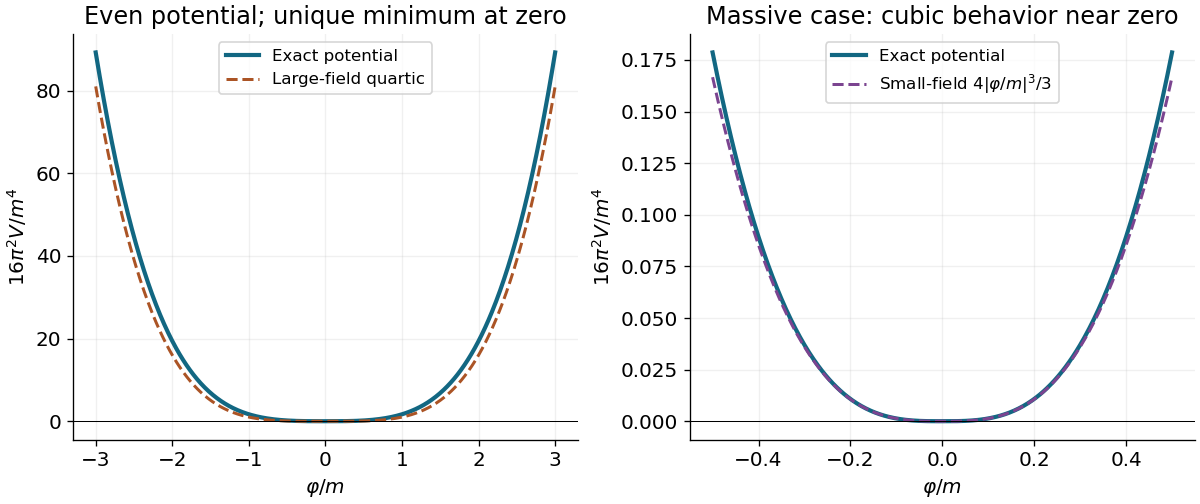
Write . Under the proposed identification, the scalar potential from a field-dependent momentum cutoff is . It is even and nonnegative, and its derivative with respect to is away from zero. Consequently its only global minimum is at : this contribution alone does not cause spontaneous symmetry breaking. At large it grows quartically. At small with fixed positive , however,Thus the quartic sketch is an asymptotic shape, not the exact small-field behavior for a massive original field. Identifying a regulator with a new field is an additional modeling prescription; an actual effective potential also depends on the new field's dynamics and any other allowed terms.


Use one common ultraviolet cutoff for all physical degrees of freedom, with positive sign for each bosonic degree of freedom and negative sign for each fermionic degree of freedom. For the mass-moment cancellation of vacuum energy divergences, define the weighted supertrace . The large-momentum expansion isAfter multiplication by the radial measure , these three terms produce quartic, quadratic and logarithmic ultraviolet divergences. Therefore the necessary and sufficient cancellations for the displayed unsubtracted finite-species vacuum energy areThey respectively mean equal numbers of bosonic and fermionic physical degrees of freedom, equal sums of squared masses, and equal sums of fourth powers of masses. Once they hold, the remaining radial integrand falls as and is integrable at infinity. Nonnegative masses introduce no lower-end divergence.
Pairing every bosonic degree of freedom with a fermionic one of the same mass, as in an unbroken supersymmetric spectrum, is sufficient and cancels the entire expression. It is stronger than these three moment conditions. For a concrete non-paired example, take bosonic squared masses and fermionic squared masses . Both have three degrees of freedom, squared-mass sum and fourth-power-mass sum , but their spectra differ. If a vacuum energy counterterm is instead permitted, a renormalized finite answer need not satisfy them; that is a different prescription from finiteness of the source's bare sum.
Goldstone's theorem states that a spontaneously broken continuous internal global symmetry in field theory of a local relativistic quantum field theory produces massless Goldstone bosons. For a Lorentz invariance vacuum breaking to its stabilizer , there are independent symmetry-required massless directions. Additional accidentally massless modes are possible. A gauge redundancy does not obey this physical-state counting, and nonrelativistic systems need not have one independent mode per broken generator.
For the classical proof, consider real scalar fields with a positive canonical kinetic term and an invariant smooth scalar potential . An infinitesimal generator satisfiesLet be a stationary vacuum and differentiate this identity with respect to . At , the term proportional to vanishes, leavingThe Hessian matrix is the scalar mass matrix. An unbroken generator has ; broken generators span the tangent space of the vacuum manifold . Each independent nonzero tangent vector is a zero eigenvector of . The quadratic Euler-Lagrange equations in these directions are , giving the massless dispersion relation . This proves the classical result and explains why the Goldstone bosons describe motion along the degenerate minima rather than against a restoring curvature.
Both the canonical kinetic term and are invariant under the orthogonal group . The stated nonzero vacuum expectation value has length . Its stabilizer is the orthogonal group acting on the perpendicular subspace. HenceThe two nonzero coordinates of this particular vacuum do not break more generators than an axis-aligned vacuum: the two choices are related by a common orthogonal transformation.
Explicitly, with ,stationary point at nonzero requires . The transverse eigenvalues vanish, while the radial squared mass is . If this curvature also vanishes, there is an additional accidental massless radial mode; the number of symmetry-protected Goldstone bosons remains . If , the symmetry is unbroken and none is required.
Assume . At zero source, the vacuum manifold is the sphere of radius . The source tilts the scalar potential by . Its force should be small compared with the radial restoring-force scale , so a useful quantitative condition isFor nonzero , the exact global symmetry in field theory of the Lagrangian is , rotating . The global vacuum aligns with the source:This vacuum preserves the entire remaining symmetry. There is therefore no exact Goldstone boson for . Expanding the scalar potential to quadratic order givesThus there are degenerate light pseudo-Goldstone bosons and one heavy radial scalar. The small-source condition makes their squared masses parametrically smaller than the radial squared mass. Sending to zero restores the original massless modes.
The breaking of the internal global symmetry in field theory to removes generators. The relativistic Goldstone theorem therefore requiresOther states fall into multiplets of the unbroken special unitary group, but their masses are not fixed by this counting. For the usual diagonal embedding , the Goldstone bosons form its adjoint multiplet.
If small explicit symmetry-breaking terms are added, the broken-generator directions generally acquire small curvature, producing light pseudo-Goldstone bosons rather than exactly massless states. Their squared masses tend to zero with those breaking parameters. Small breaking can also split multiplet degeneracies. These claims concern a small perturbation of the broken phase; approximate symmetry alone does not establish which vacuum is selected.
The light states have the counting . This suggests approximate chiral symmetry breakingwith a nonzero quark chiral condensate for the three light flavours . The three pions, four kaons and predominantly octet eta meson are the resulting pseudo-Goldstone bosons. Their small nonzero masses reflect explicit chiral symmetry breaking by the light-quark masses; for example, is proportional to at leading order. The larger strange-quark mass makes the kaons and octet eta meson heavier than the pions, while electromagnetic interactions help split charged and neutral partners.[ref]
Gauge Theory by David Tong. Chapter 5, chiral symmetry breaking and section 5.3 on adding quark masses
Although the massless strong-interaction terms admit independent rotations of all six flavours, the charm, bottom and top masses are too large to treat six-flavour chiral symmetry as a small explicit breaking at the light-hadron scale. Full approximate breaking would suggest 35 light modes, rather than this octet. The classical axial is also broken by the chiral anomaly, so it does not supply a ninth equally light Goldstone boson.
Articles were limited to the first 100 out of 360 total.
Articles by others on the same topic
There are currently no matching articles.