The based lifting criterion isUnder the stated path-connected and locally path-connected domain hypotheses, it is necessary and sufficient for a continuous based lift. Two based coverings are equivalent if a homeomorphism between their total spaces takes one chosen basepoint to the other and commutes with their projections.
For the usual classification by subgroups, total spaces are taken to be connected. They are then path-connected and locally path-connected because they cover a locally path-connected base. If two such coverings have the same subgroup , apply the lifting criterion to each projection to obtain based maps and over . Their composites and the identity maps are based lifts of the same projections. Uniqueness of lifts on a connected domain gives and . Thus is an equivalence, proving at most one connected based covering realizes a given subgroup.
The connected-total-space qualification is necessary. If arbitrary disconnected coverings are allowed, the identity cover of a circle and the disjoint union of two identity covers have the same subgroup at a basepoint in the first component, yet are inequivalent. The subgroup only records the chosen component in that setting.
The degree is the cardinality of a fibre. Over a path-connected base this is independent of the basepoint, by path lifting. For a connected total space it equals the subgroup index , and it may be infinite.
On the torus with basepoint take and . Both are connected two-sheeted coverings. Their induced subgroups of are and , which are different. Equivalence over the fixed base would force equal based subgroups. Thus the two degree-two covers are inequivalent.
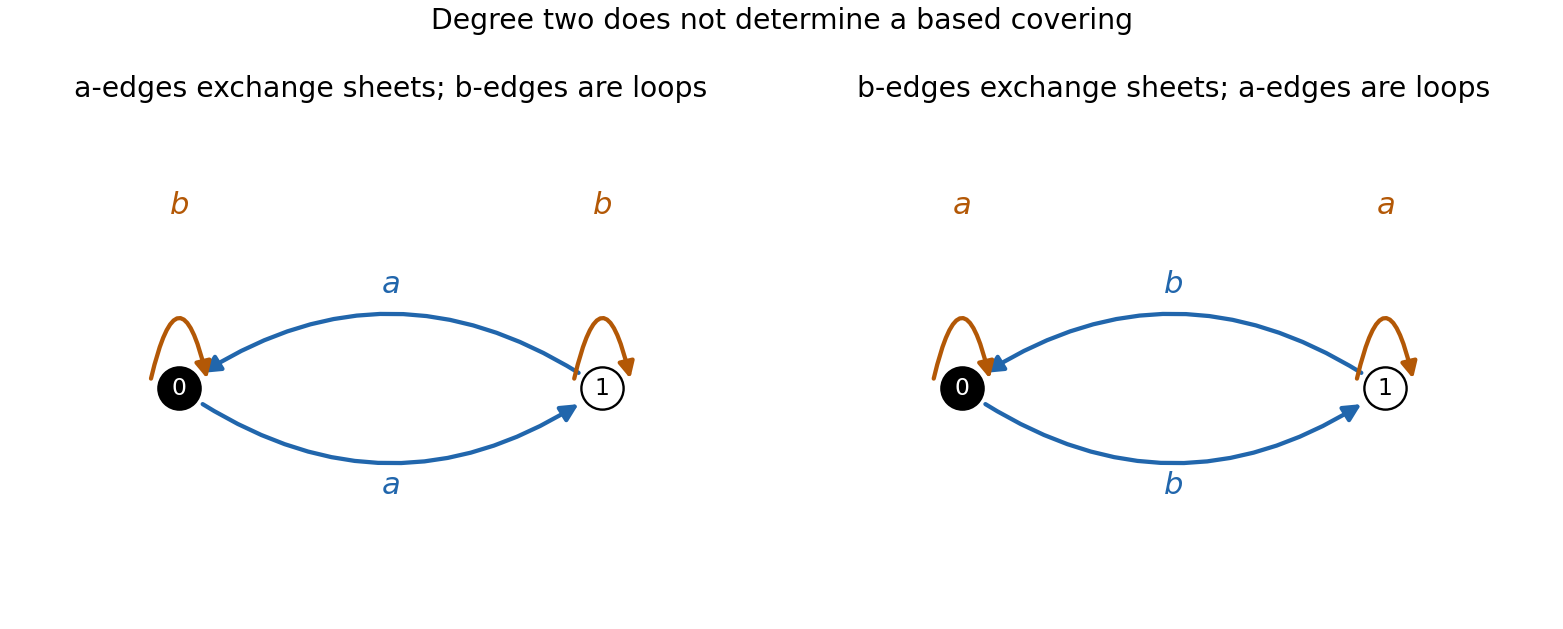
Write the wedge's fundamental group as the free group on . Use the index-two subgroupswhere each map has target . Explicitly, the first cover has two vertices, two directed lifts of exchanging the vertices, and a -loop at each vertex. The second interchanges the roles of . Each vertex has exactly one incoming and one outgoing lift of each labelled edge, so these are genuine two-sheeted graph coverings. They are connected, and a chosen vertex gives a based cover.
The subgroups differ because belongs to but not , while belongs to but not . Hence the covers have the same degree and are inequivalent.

Articles by others on the same topic
There are currently no matching articles.