A homotopy from to is a continuous with and . Precomposing gives , a homotopy from to ; postcomposing gives , a homotopy from to .
A homotopy equivalence consists of maps and with and . Identity maps prove reflexivity, and exchanging proves symmetry. For equivalences and , compose their forward maps and compose their inverse maps in reverse order. The two compositions with these candidate inverses are homotopic to the respective identities by the pre- and postcomposition result. Concatenating the homotopies proves transitivity.
For the first listed space, radial projection onto the unit sphere gives a strong deformation retraction:The scalar is positive, so a point outside the two coordinate axes never enters either removed axis. Their intersection with the sphere is the four points . The allowed homeomorphism statement therefore identifies this retract with the four-punctured sphere in the list.
Stereographic projection from one puncture identifies that sphere with the plane minus three points. Remove small disjoint open disks around the punctures and choose a larger enclosing disk. Radial motions in the three punctured disks push their remaining points to the small boundary circles, while the exterior pushes to the large boundary circle. This reduces the space to a compact disk with three holes. It has a spine consisting of three loops connected by a tree of arcs; cutting along those arcs gives a disk and collapsing its collar gives the retraction onto the spine. Collapsing a maximal tree in the spine is a homotopy equivalence onto a wedge of three circles.
Finally the three parallel removed lines give the productThe homotopy retracts this onto the punctured plane, hence onto the same rank-three graph. Composing these maps and homotopy inverses proves all four listed spaces have the same homotopy type. The two intersecting axes produce four spherical punctures, which is why three loops appear rather than two.
Use letters and their formal inverses. An elementary contraction deletes an adjacent pair or . A reduced word has no such pair. Repeated contraction terminates because each step reduces length by two, so every word has a reduced descendant.
For uniqueness, two possible first contractions either occur on disjoint pairs, when performing both yields a common descendant, or overlap in three letters , when either contraction produces the same remaining letter. Induct on word length: the shorter descendants of both first contractions therefore have the same eventual reduced word. This proves every contraction sequence from a given word ends at the same reduced word. An insertion or deletion of an inverse pair preserves that reduced result. Since the word model of the free group identifies words exactly under finite sequences of these moves, every group element has a unique reduced representative.
To define the requested homomorphism, substitute for and for in any word. Inverse-pair insertions or deletions map to inverse words that cancel, so substitution is well defined on group elements and respects concatenation. This proves the universal property of the free group in this case.
For an automorphism of order four, take and . Its iterates on are ; its fourth iterate also fixes . Unique reduced representatives show the first three iterates on differ from . Hence its order is exactly four.
For the final map, every iterate of is a positive word and contains an . Substituting once replaces each occurrence of by and leaves each unchanged. If , its length consequently increases by at least on every iteration. No cancellation occurs in a positive word, so . It cannot equal , proving no positive iterate of this endomorphism is the identity. Surjectivity of this last endomorphism is not assumed.
One standard five-operation version of the Tietze transformations is: invert a relator; conjugate a relator by a word; multiply a relator on either side by another relator; insert or delete the empty relator; and introduce or eliminate a generator together with a defining relation , where uses the other generators and an eliminated generator occurs nowhere else. The elementary relator operations are reversible. Renaming and reordering the generators and relators is harmless. The Tietze theorem states that two finite presentations define isomorphic groups exactly when they are related by a finite sequence of these transformations.
For a connected cell complex with one vertex, take one generator for each oriented one-cell and one relator from the attaching loop of each two-cell. Higher-dimensional cells do not change the fundamental group. This is the cellular presentation theorem, obtained by applying van Kampen to the two-skeleton. Conversely a finite presentation is realized by a bouquet of its generator circles with one disk attached along each relator word, giving a finite connected complex with the required fundamental group.
Triangulate each relator polygon by adding diagonals from one boundary vertex. Each diagonal is a new one-cell, and every triangular two-cell has an attaching word of length at most three. Algebraically, for a word with , introduce successive partial-product generators . Use relatorsEliminating the new generators recovers the original word; words already of length at most three need no change. This proves the triangular-presentation claim geometrically and algebraically.
For the free abelian group of rank two, useIts two relations say . For the requested transformation sequence, replace the second relator by the product of the first and second, freely reducing it to . Invert the first relator, giving , the definition . Eliminate together with this defining relation. The remaining presentation is exactly the stated two-generator commutator presentation.
The construction is a triangular group presentation.
The based lifting criterion isUnder the stated path-connected and locally path-connected domain hypotheses, it is necessary and sufficient for a continuous based lift. Two based coverings are equivalent if a homeomorphism between their total spaces takes one chosen basepoint to the other and commutes with their projections.
For the usual classification by subgroups, total spaces are taken to be connected. They are then path-connected and locally path-connected because they cover a locally path-connected base. If two such coverings have the same subgroup , apply the lifting criterion to each projection to obtain based maps and over . Their composites and the identity maps are based lifts of the same projections. Uniqueness of lifts on a connected domain gives and . Thus is an equivalence, proving at most one connected based covering realizes a given subgroup.
The connected-total-space qualification is necessary. If arbitrary disconnected coverings are allowed, the identity cover of a circle and the disjoint union of two identity covers have the same subgroup at a basepoint in the first component, yet are inequivalent. The subgroup only records the chosen component in that setting.
The degree is the cardinality of a fibre. Over a path-connected base this is independent of the basepoint, by path lifting. For a connected total space it equals the subgroup index , and it may be infinite.
On the torus with basepoint take and . Both are connected two-sheeted coverings. Their induced subgroups of are and , which are different. Equivalence over the fixed base would force equal based subgroups. Thus the two degree-two covers are inequivalent.
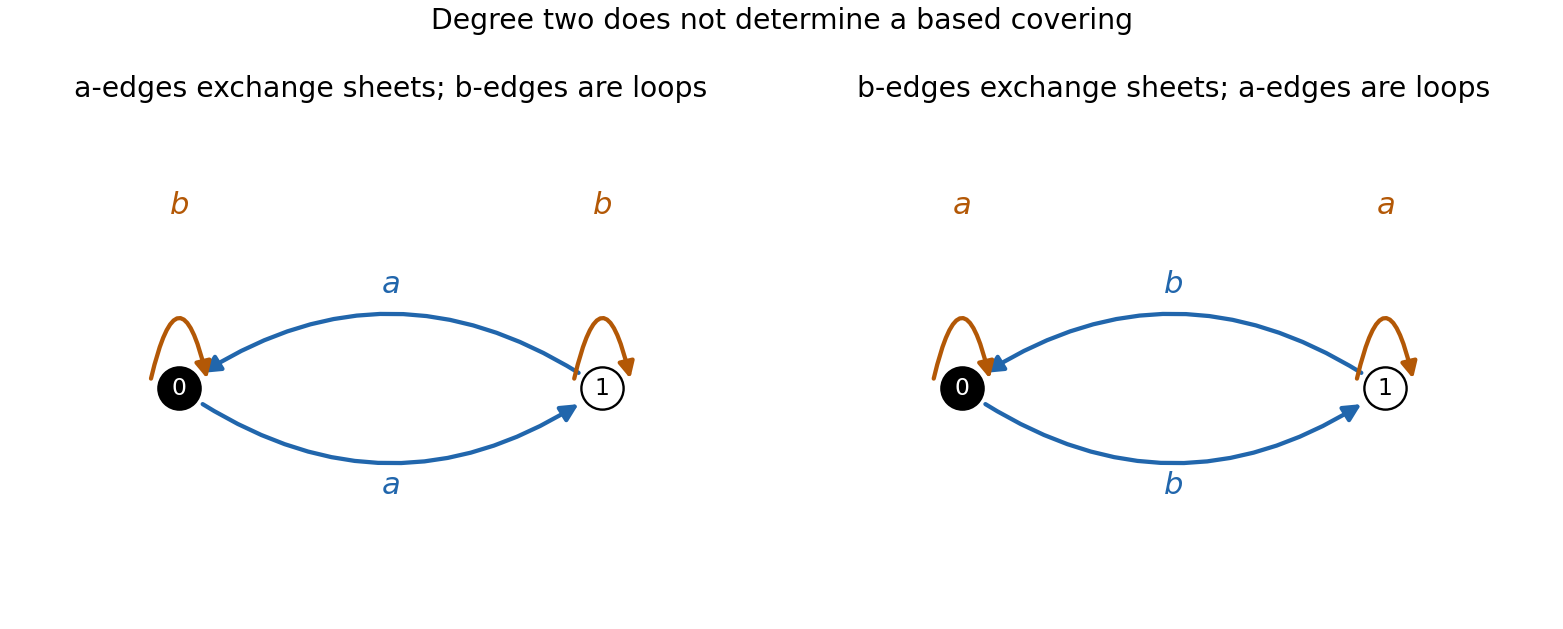
Write the wedge's fundamental group as the free group on . Use the index-two subgroupswhere each map has target . Explicitly, the first cover has two vertices, two directed lifts of exchanging the vertices, and a -loop at each vertex. The second interchanges the roles of . Each vertex has exactly one incoming and one outgoing lift of each labelled edge, so these are genuine two-sheeted graph coverings. They are connected, and a chosen vertex gives a based cover.
The subgroups differ because belongs to but not , while belongs to but not . Hence the covers have the same degree and are inequivalent.

Articles by others on the same topic
There are currently no matching articles.