Label the endpoints around the original polygon by so that the successive boundary arcs areThe two occurrences of have the same boundary-traversal direction, as prescribed by the word. We use cutting along a new diagonal followed by gluing the old sides. Cutting introduces two copies of the diagonal with opposite orientations, so rejoining them later exactly recovers the original quotient.
First move. Draw a diagonal from to . The two pieces have boundary words and . Glue them along their sides, turning one piece over in the planar drawing to match the arrows. Reading the outside boundary of the joined disk givesReverse the orientation of this entire disk and change the starting point of its boundary word. The same side-paired disk then has word . Renaming the new paired edge as yields
Second move. Instead cut along from to . The pieces now have words and . Gluing along the old sides gives outside word . A cyclic change of starting point gives , and renaming yieldsAll side identifications inside the strings and are carried along unchanged; reversing a piece reverses the order of its string and inverts each letter. The construction therefore gives homeomorphic quotients, not merely an equality of Euler characteristics. This is the crosscap extraction move for a polygonal word.
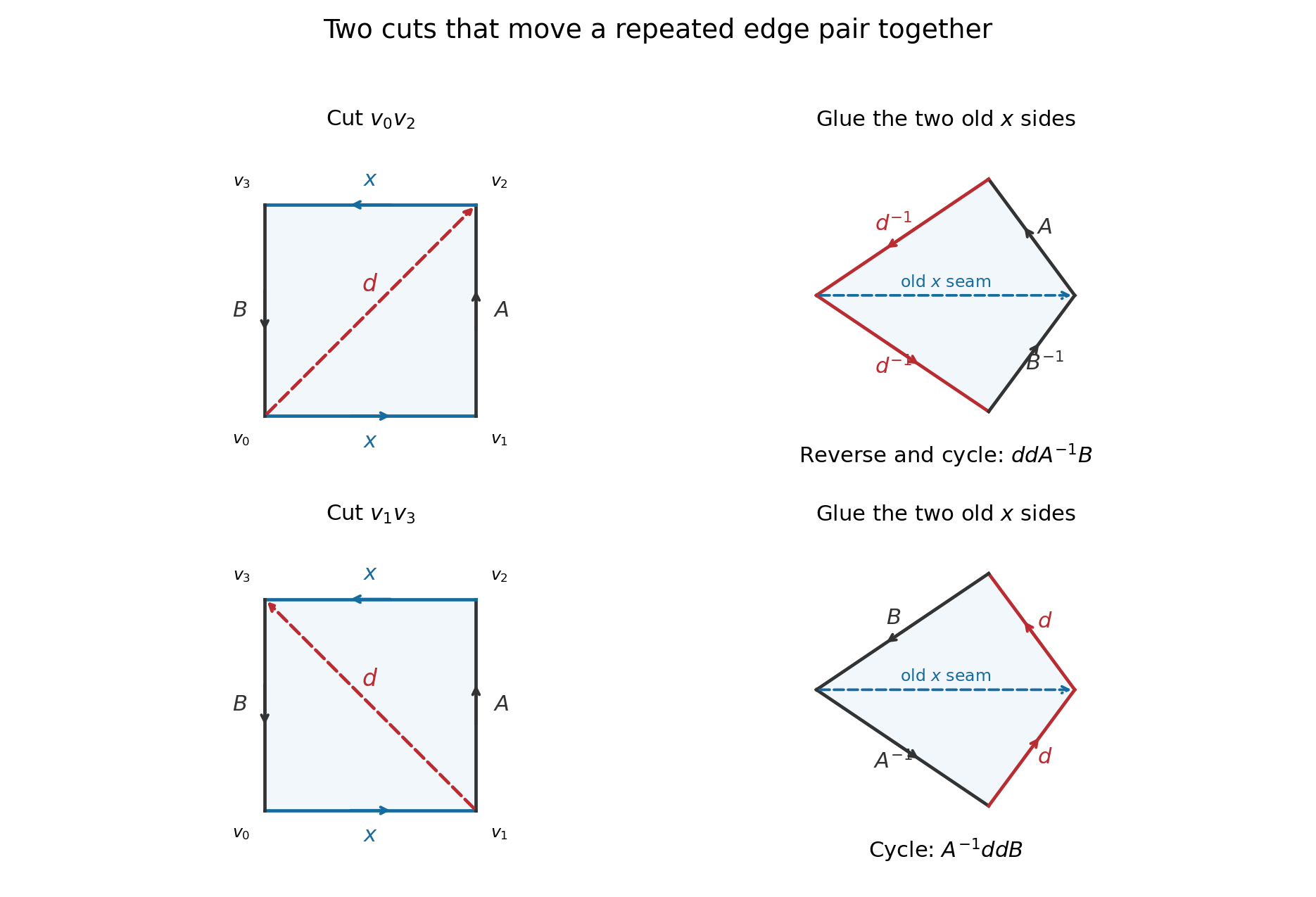

Apply the first extraction move to the two outer occurrences of , then cyclically rotate the word to expose the two occurrences of :In the third line the repeated letter for the move is , and the intervening string is , whose inverse is . Rename as a new edge label. The final word has the standard form .
Each same-direction repeated pair represents a projective-plane summand, so the classification theorem for surfaces identifies this word with the connected sum of three real projective planes:Thus the surface has crosscap number three. As a check, the original identifications make all six polygon vertices equivalent, leaving one vertex, three edges and one face. Its Euler characteristic is , consistent with that crosscap count.
Articles by others on the same topic
There are currently no matching articles.