An abstract simplicial complex consists of a vertex set and a collection of finite nonempty subsets containing every singleton and every nonempty subset of each member. A member with vertices is an -simplex.
Its topological realization glues a standard geometric simplex for each member along common faces. A concrete model iswith finite support and the weak topology of a simplicial realization: a set is closed precisely when its intersection with every simplex is closed. This agrees with the quotient topology of the gluing construction. Specifying this topology matters for complexes with infinitely many vertices.
The open star in a simplicial complex of a vertex is the union of the relative interiors of the simplices containing . In barycentric coordinates it isLet be the subcomplex consisting of all simplices not containing . The complement of the star is exactly : the positive-coordinate support of a point misses precisely when it is a simplex of . By the allowed closed-subcomplex theorem, is closed in . Hence the star is open.
This is the open-star convention required by the question. The closed star, which also includes the opposite faces, is a different subset and need not be open.
The vertex stars form an open cover of : every point has a nonempty positive-coordinate support, and therefore belongs to the star of at least one vertex. At a vertex itself, only its own barycentric coordinate is positive. Thus belongs to its own star and to no other vertex star.
Any finite selection of stars omits every vertex not among their finitely many labels. Infinitely many vertices therefore prevent a finite subcover, provingNo local-finiteness hypothesis is needed for this vertex-star cover obstruction to compactness.
Label the endpoints around the original polygon by so that the successive boundary arcs areThe two occurrences of have the same boundary-traversal direction, as prescribed by the word. We use cutting along a new diagonal followed by gluing the old sides. Cutting introduces two copies of the diagonal with opposite orientations, so rejoining them later exactly recovers the original quotient.
First move. Draw a diagonal from to . The two pieces have boundary words and . Glue them along their sides, turning one piece over in the planar drawing to match the arrows. Reading the outside boundary of the joined disk givesReverse the orientation of this entire disk and change the starting point of its boundary word. The same side-paired disk then has word . Renaming the new paired edge as yields
Second move. Instead cut along from to . The pieces now have words and . Gluing along the old sides gives outside word . A cyclic change of starting point gives , and renaming yieldsAll side identifications inside the strings and are carried along unchanged; reversing a piece reverses the order of its string and inverts each letter. The construction therefore gives homeomorphic quotients, not merely an equality of Euler characteristics. This is the crosscap extraction move for a polygonal word.
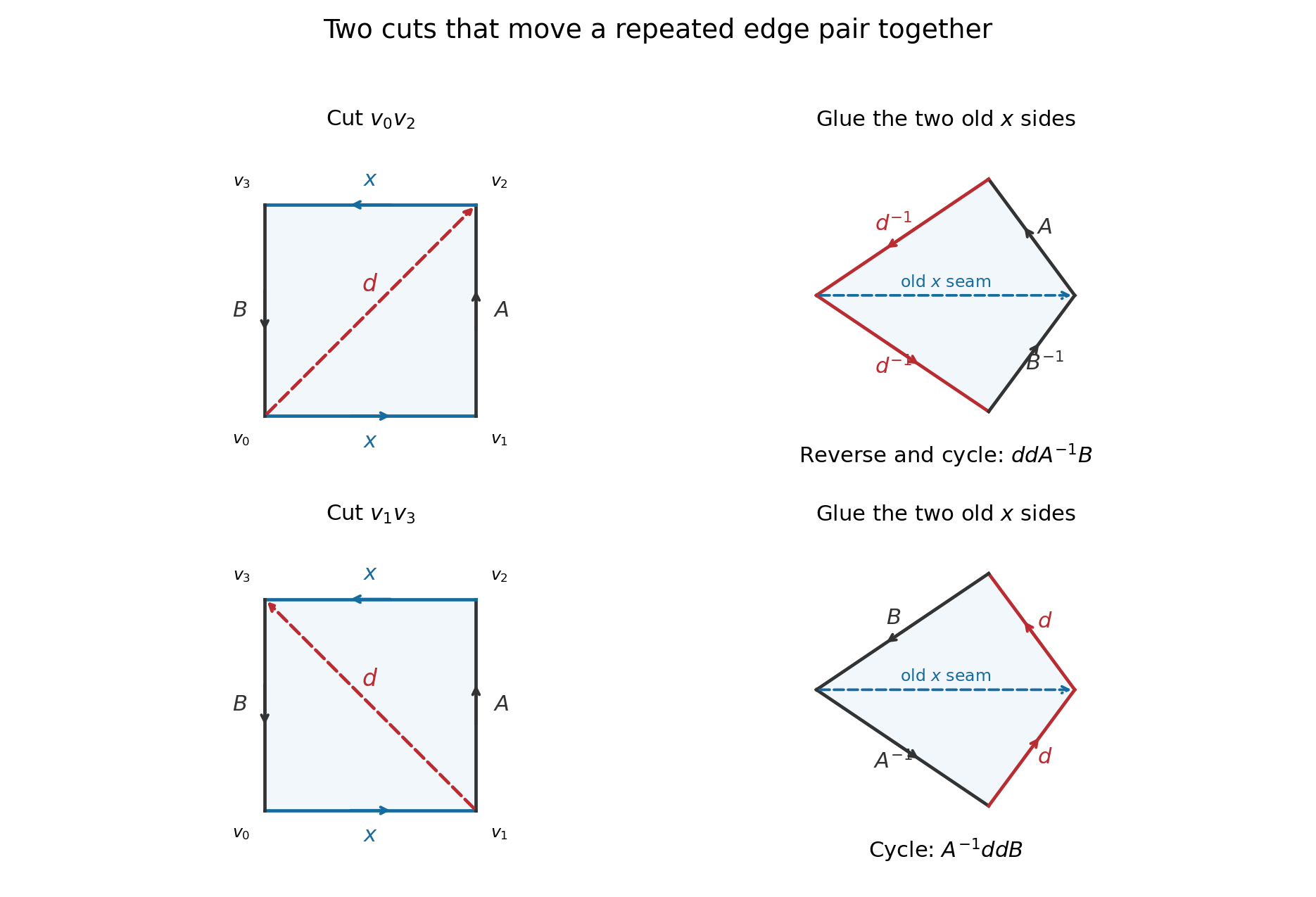

Apply the first extraction move to the two outer occurrences of , then cyclically rotate the word to expose the two occurrences of :In the third line the repeated letter for the move is , and the intervening string is , whose inverse is . Rename as a new edge label. The final word has the standard form .
Each same-direction repeated pair represents a projective-plane summand, so the classification theorem for surfaces identifies this word with the connected sum of three real projective planes:Thus the surface has crosscap number three. As a check, the original identifications make all six polygon vertices equivalent, leaving one vertex, three edges and one face. Its Euler characteristic is , consistent with that crosscap count.
Articles by others on the same topic
There are currently no matching articles.