First-come-first-served disk scheduling follows the arrival order:The total seek distance isThe initial position is 133; the earlier completed request at 135 is used to determine direction for the elevator policy, not added again to this total.
133 -> 76 -> 157 -> 91 -> 142 -> 97 -> 135 -> 112 -> 23Shortest-seek-time-first disk scheduling chooses the nearest remaining track after each service:The distances are , giving 158 tracks. There are no distance ties along this service sequence.
133 -> 135 -> 142 -> 157 -> 112 -> 97 -> 91 -> 76 -> 23The previous motion from 135 to 133 fixes the initial direction as downward. Under SCAN disk scheduling, the head continues to the physical endpoint 0 before reversing:Thus SCAN crosses tracks, stopping once the final pending request has been served.
133 -> 112 -> 97 -> 91 -> 76 -> 23 -> 0 -> 135 -> 142 -> 157If “elevator” means LOOK disk scheduling, reversal occurs at the lowest pending request, 23, rather than track 0. Its route omits 0, and the total is tracks. Stating the turnaround convention is necessary to make the numerical answer unambiguous.
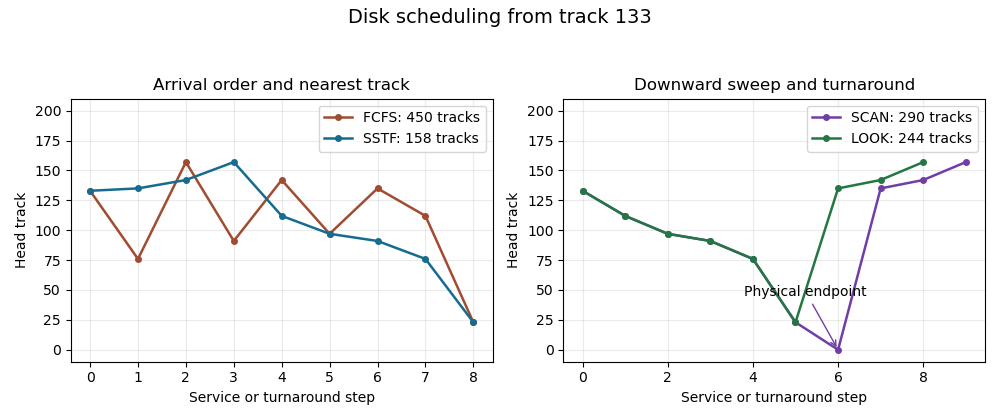
Disk scheduling service paths and the SCAN–LOOK turnaround distinction
. Original paths from the given starting position. The extra zero-track endpoint in SCAN is a movement step rather than a serviced request. Totals measure absolute track displacement. Details.
Articles by others on the same topic
There are currently no matching articles.