Device independence lets an application request input-output through a uniform interface without depending on a particular device's control registers, instruction protocol or geometry. A device driver translates the abstract requests into device-specific operations. Replacing one supported disk model with another can then preserve the application's file-reading interface.
First-come-first-served disk scheduling follows the arrival order:The total seek distance isThe initial position is 133; the earlier completed request at 135 is used to determine direction for the elevator policy, not added again to this total.
133 -> 76 -> 157 -> 91 -> 142 -> 97 -> 135 -> 112 -> 23Shortest-seek-time-first disk scheduling chooses the nearest remaining track after each service:The distances are , giving 158 tracks. There are no distance ties along this service sequence.
133 -> 135 -> 142 -> 157 -> 112 -> 97 -> 91 -> 76 -> 23The previous motion from 135 to 133 fixes the initial direction as downward. Under SCAN disk scheduling, the head continues to the physical endpoint 0 before reversing:Thus SCAN crosses tracks, stopping once the final pending request has been served.
133 -> 112 -> 97 -> 91 -> 76 -> 23 -> 0 -> 135 -> 142 -> 157If “elevator” means LOOK disk scheduling, reversal occurs at the lowest pending request, 23, rather than track 0. Its route omits 0, and the total is tracks. Stating the turnaround convention is necessary to make the numerical answer unambiguous.
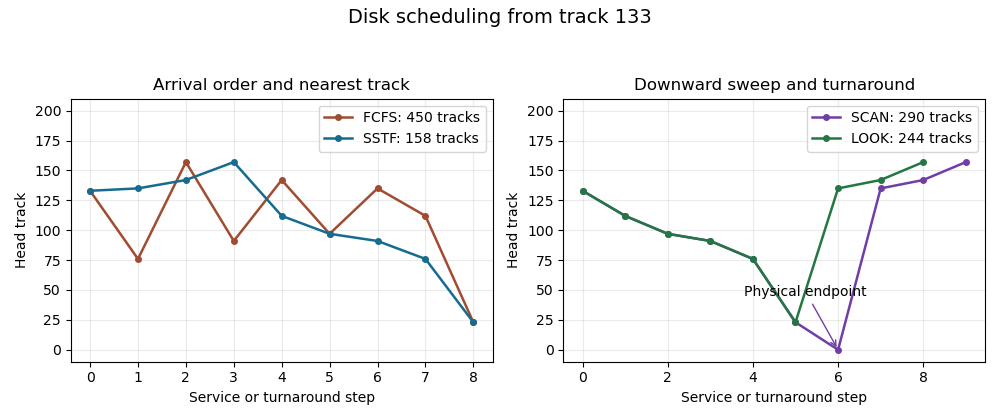
Disk scheduling service paths and the SCAN–LOOK turnaround distinction
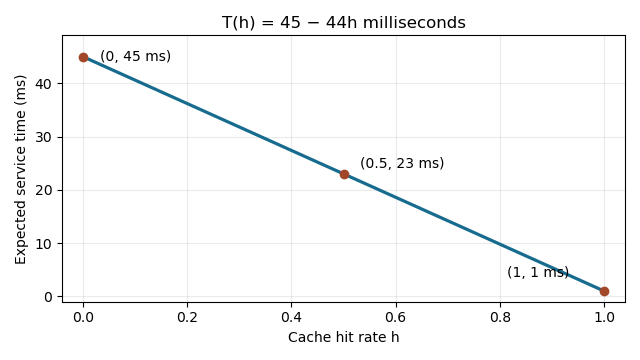
. Original paths from the given starting position. The extra zero-track endpoint in SCAN is a movement step rather than a serviced request. Totals measure absolute track displacement. Details.Conditioning on a cache hit or cache miss, the expected latency isThis is a straight line from to ; at hit rate , the mean is 23 ms. The 45 ms is already the complete miss-service time in the question, so another cache-lookup millisecond is not added to it.


At 6000 revolutions per minute the disk makes 100 revolutions per second, so one turn takes 10 ms and the mean rotational latency is 5 ms. Adding seek time, data transfer time and controller overhead gives, using decimal MB,Using bytes instead gives 19.09765625 ms, with the same rounded answer. The calculation assumes the stated rate applies to the sector transfer and that the seek and overhead are each paid once.
Use binary units bytes and bytes, consistent with the given binary GB convention. Reading one average file takes seek plus rotation plus transfer; moving it requires the same costs again on the write:A half-full 16 GB disk contains used bytes, or average files. Under the stated per-file disk compaction model,A calculation with decimal KB and MB changes the unrounded figures, so the unit convention must be retained consistently. This model charges one seek and rotational delay on each read and each write; it does not assume a single streaming pass over the whole disk.
Articles by others on the same topic
There are currently no matching articles.