Use partial fraction decomposition:Integrating givesThis real antiderivative is valid on each interval avoiding , with its own integration constant. In particular, .
For positive bounds, integration by parts with and givesFor negative bounds, specify the complex logarithm on the negative real axis. With argument , namely the upper-bank boundary value of the principal logarithm, . Substitute in the real part:More generally, a continuous branch taking argument replaces by . The imaginary part depends on that choice. The analytic principal branch excludes the negative axis itself, so the boundary-value convention is part of this interpretation.
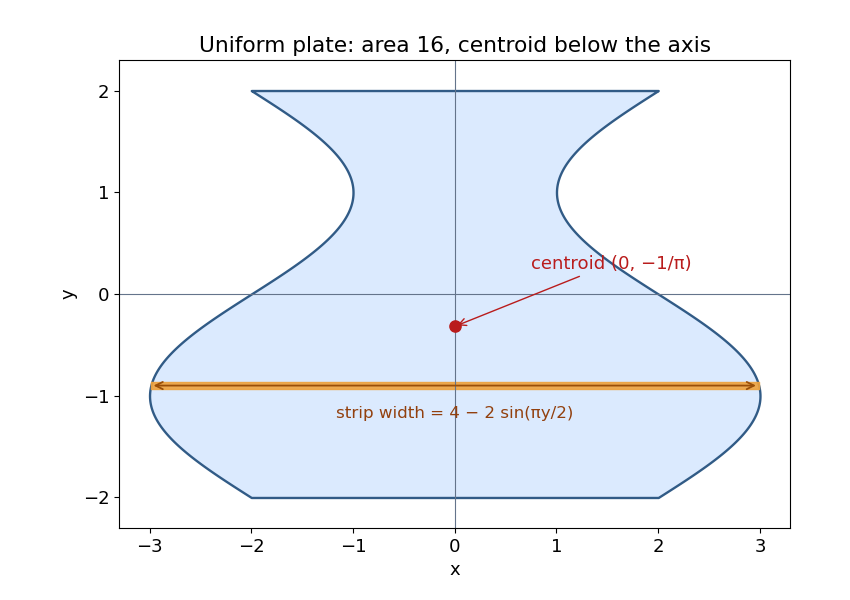
A horizontal strip at height has width . The sine term is odd, so the area isReflection symmetry in the -axis gives . For uniform density, the constant density cancels from the center of mass ratio. Its first moment in the vertical coordinate isConsequentlyThe wider part below the horizontal axis accounts for the negative vertical coordinate.

For , the composite trapezoidal rule isWith this becomesWrite the requested right Riemann sum as . The trapezoidal endpoint correction for a right Riemann sum givesThe integrand is continuous on , so the trapezoidal values converge to its definite integral; the endpoint correction tends to zero. Therefore
Articles by others on the same topic
There are currently no matching articles.