Starting at , the two possible two-step returns are and . They are disjoint events, with probabilities and . ThereforeEach path probability uses the specified Markov property to multiply its successive transition probabilities.
Let . By the law of total probability,There is no return contribution from the absorbing state . Since can be entered only from , for . Substitution yieldsNo independence between successive positions is assumed; the conditional transitions give the recurrence.
The initial values are and . The characteristic polynomial of the linear recurrence iswith roots and . Hence . The initial conditions give , , so , . Therefore
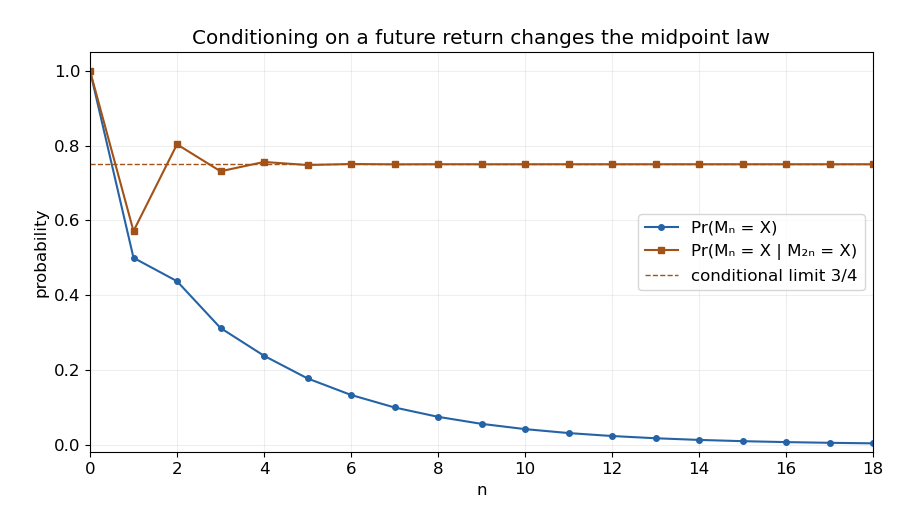
The Markov property and time homogeneity giveSince , conditional probability yields the Markov chain return bridge expressionThe explicit formula gives , soThe conditioning event has positive probability at each finite time even though those return probabilities tend to zero. Taking an undefined conditional on an infinite-time zero-probability event is not needed.

Articles by others on the same topic
There are currently no matching articles.