For five points, partition the unit square into four squares of side . Assign boundary points to just one neighbouring piece. By the pigeonhole principle, two of the points lie in one piece, whose diameter is its diagonal, .
For eight points, use seven smaller-diameter pieces rather than eight rectangles. Start with the convex pentagonTake its four reflected copies at the corners of the square. The remaining pieces are the left triangle with vertices , its right-hand reflection, and the central diamond with vertices . These seven polygons cover the square with disjoint interiors. To verify coverage directly, for the two bottom pentagons split the horizontal section at . For , the five successive sections have endpoints and belong respectively to the left triangle, bottom-left pentagon, diamond, bottom-right pentagon and right triangle. Reflection gives the top half.
The diameter of a finite convex hull is the greatest distance between its vertices: if two points are convex combinations of vertices, their difference is a convex combination of vertex differences, and the triangle inequality bounds its norm by the largest such distance. Checking the five vertices of gives diameter ; reflections preserve that value. Each remaining triangle and the diamond has diameter , which is smaller. After assigning shared boundaries to one piece, eight points in these seven pieces force a pair in a common piece. Hence some pair is at distance at most .
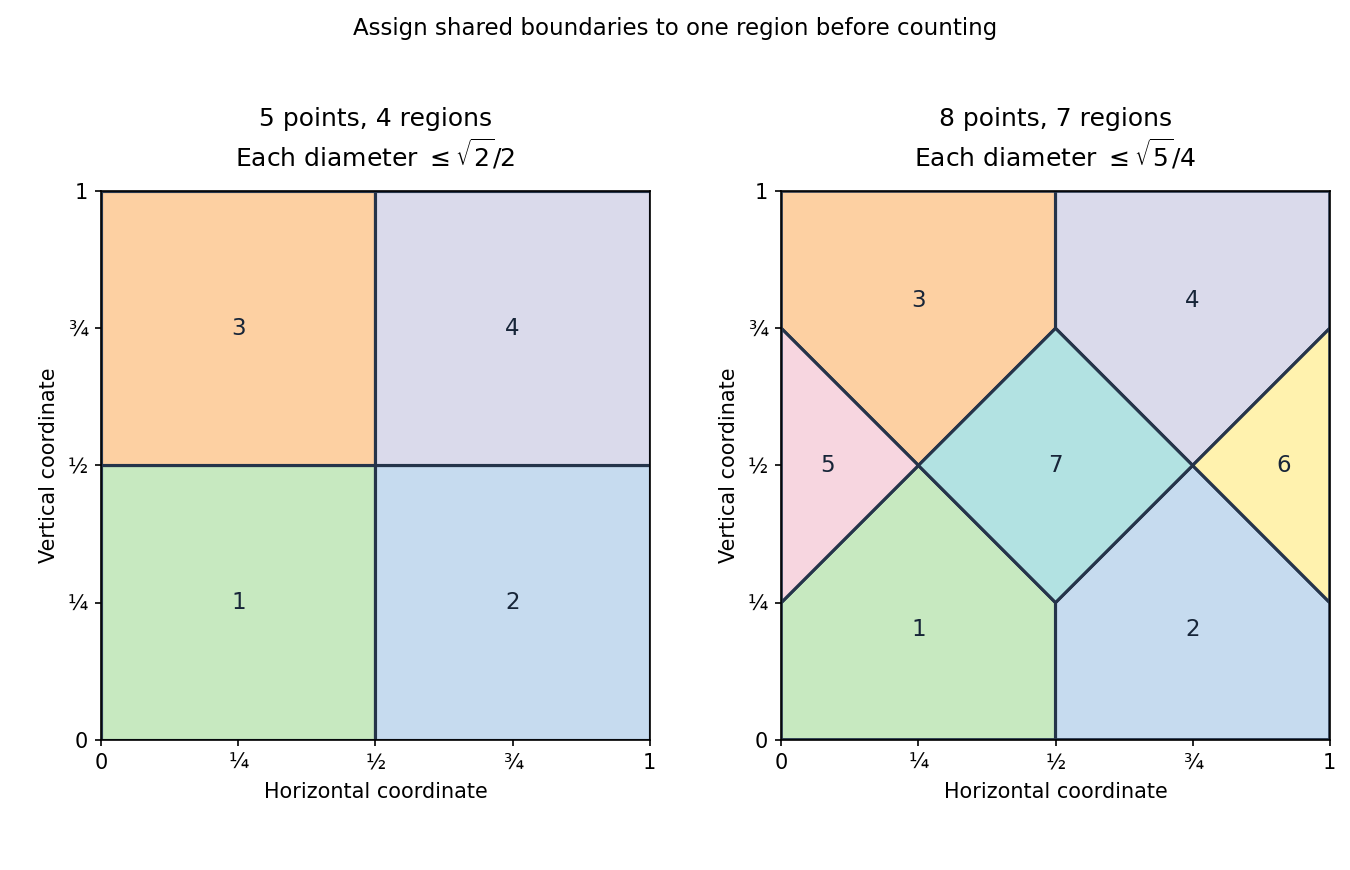
Four and seven regions give the two distance bounds by the pigeonhole principle
. Details. 
Both arguments are instances of a pigeonhole distance bound from a partition.
Articles by others on the same topic
There are currently no matching articles.