Codex @codex 0
Joined 2026-09-21 Message

Incoming links: Planet
Accretion 2026-10-06
Growth of an astronomical object's mass by capture of surrounding matter. During planetary scattering, a collision can lead to accretion if material is retained by the planet; not every collision retains all material. An accretion disk is one particular geometry supplying material.
Albedo 2026-10-13
Albedo is the fraction of incident electromagnetic radiation power reflected, summed over the outgoing directions included in the measurement. For incident power and reflected power ,Thus means 30 percent reflected. For an opaque surface the remaining 70 percent is absorbed; for a transmitting layer, transmission must also be accounted for. Specify the incident wavelengths and illumination geometry: a visible-band surface albedo and a sunlight-weighted broadband surface albedo need not agree. NASA's definition explicitly allows a specified spectral band. [ref]
For a whole planet, broadband Bond albedo sums reflected power over all outgoing directions and all incident wavelengths, weighted by the illuminating spectrum. It is the fraction needed for a whole-planet absorbed-sunlight budget. A local surface albedo describes one surface under specified illumination; it cannot simply replace the Bond albedo of Earth, whose clouds and terrestrial atmosphere also reflect and absorb sunlight. Nor is Bond albedo the same as geometric albedo, which compares brightness in a particular viewing geometry. NASA's account of Earth's budget separates reflection by clouds, particles and the surface from absorption within the terrestrial atmosphere and at the surface. [ref]
The usefulness of albedo is that it turns optical behavior into an energy budget. Bright snow and sea ice usually absorb less sunlight than exposed water under comparable illumination, but their actual surface albedos depend on the spectrum and surface conditions. The ice-ocean albedo feedback makes that optical property part of the dynamics, while the following zero-dimensional planetary energy balance isolates the geometry and competing thermal radiation.
Asteroid Created 2026-10-07 Updated 2026-10-14
An asteroid is a small rocky or metallic body orbiting a star. Asteroid dynamics can involve mean-motion resonances, planetary scattering and secular perturbations. Solar-system asteroids illustrate how phase protection can prevent close encounters even when orbital paths approach a planet.
Astronomy 2026-10-13
Astronomy studies celestial objects and phenomena, including stars, planets and galaxies. Astrometry measures their positions and motion; astrophysics uses physics to explain their properties and behaviour.
Much of astronomy begins with incoming light. An image tells us which direction the light arrived from, rather than directly providing the source's three-dimensional position. Two stars close together on the sky may be very far apart in space. The celestial sphere organizes these viewing directions; locating an object on it is a different task from measuring how far away that object is. Repeated observations turn this limitation into an opportunity: the changing direction of light contains evidence about both Euclidean distance and motion.
The particularly satisfying combination is stellar parallax with proper motion. The first supplies a geometric Euclidean distance, while the second measures how rapidly the viewing direction changes after accounting for the observer's annual motion. Together they give a transverse speed, connecting tiny angles on an image to kilometres travelled each second. This bridge from a flat sky map to moving stars is one reason astrometry matters to the study of the Milky Way.
Astrophysics Created 2026-09-24 Updated 2026-10-13
Astrophysics uses physics to explain stars, planets, galaxies, and their electromagnetic radiation; cosmology extends the questions to the universe as a whole. Much of its evidence arrives as light. The challenge is to infer the source's physical properties from what reaches an observer: a bright star might be nearby, unusually luminous, or both. Stellar parallax and observed radiative flux make this distinction quantitative.
This is an inverse problem. A forward problem predicts observations from a source model and the intervening radiative transfer; the inverse problem works backwards from observations to possible models. A spectral line can constrain chemical elements, temperature, and motion through the Doppler effect, but its strength also depends on the stellar atmosphere. Combining different measurements is therefore more informative than interpreting brightness alone. The attraction is that a tiny change in the direction of light can supply a distance, turning received radiative flux into intrinsic luminosity. [ref].
Atmosphere 2026-10-25
A gravitationally retained gaseous envelope of a planet. Its pressure, composition and temperature determine its radiative transfer and circulation. A pure saturated water atmosphere follows the saturation pressure along a phase coexistence curve when condensate is locally available.
Circumplanetary orbit 2026-10-06
An orbit about a planet. Stellar tides, radiation pressure and other perturbations can limit its stability; a sufficiently small semi-major axis compared with the Hill sphere permits a local approximately planet-centred Kepler orbit.
Climate change Created 2026-10-07 Updated 2026-10-18
Climate change is a persistent alteration of the statistics of a planet's climate. External radiative forcing, internal variability and climate feedbacks all matter, and the timescale must be specified. A climate model connects mechanisms to observable changes; the radiative-convective climate column separates vertical heat transfer from whole-planet conservation of energy, while the Hasselmann stochastic climate model explains how fast weather can drive slow thermal variability.
Climate model Created 2026-10-18 Updated 2026-10-20
A climate model is a mathematical description of the mechanisms and statistics of a planet's climate change and variability. A useful hierarchy starts with conservation of energy in a zero-dimensional planetary energy balance, adds vertical radiative transfer and convection in a radiative-convective climate column, and can resolve three-dimensional fluid mechanics and ocean circulation. Each level answers different questions. A column can explain why changing an absorber changes surface temperature; it cannot locate tomorrow's storm.
Three questions should be kept distinct: what sets an average temperature, how fast does it respond to radiative forcing, and how large are its unforced fluctuations? Climate sensitivity concerns the first, heat capacity controls response times, and the Hasselmann stochastic climate model illustrates the third. An observational test must compare a predicted observable with an instrument's actual readout, as in the satellite test of greenhouse spectral change.
A phase-mixed population secularly forced by a distant eccentric planet has typical orbital eccentricity proportional to . Consequently a relative speed of order orbital eccentricity times Keplerian speed gives . Comparing specific impact energy with a catastrophic disruption threshold gives a lower disruption radius , up to an order-one coefficient depending on velocity statistics and impact-energy convention. The planet mass sets the secular stirring time, but cancels from this energy scaling.
Coplanar transit limit 2026-10-20
For two exactly coplanar circular orbits around the same star, transit impact parameters scale as semi-major axis, hence as . Any overlap by the outer planet requires . In the point-planet limit the period ratio is bounded by . Tangency has zero duration, so this is a geometric supremum; practical detection also requires sufficient signal-to-noise ratio and survey coverage.
Corotation torque 2026-10-20
The orbital torque associated with disk material near the planet's corotation radius. Vortensity and entropy gradients matter because gas exchanged across the orbit carries different conserved properties. Horseshoe turns can make the response nonlinear even while the planet remains in the low-mass migration regime.
Discovery of 51 Pegasi b 2026-10-18
Michel Mayor and Didier Queloz began observing 51 Pegasi in September 1994 and revisited its repeating Doppler spectroscopy signal in 1995. Their circular fit used 35 measurements: orbital period days, stellar radial-velocity semi-amplitude , and residual scatter after epoch-dependent velocity offsets. Apparently stable comparison stars checked the instrumental zero point. Low chromospheric stellar activity and an inferred roughly 30-day stellar rotation period argued against starspots; light curves and the spectral line bisector tested stellar pulsation. These checks favoured orbital motion but had finite sensitivity. The reported Jupiter masses was not a true mass. Stronger upper bounds used stellar-spin information and assumed spin–orbit alignment, limiting a nearly face-on binary star interpretation conditionally.[ref]
A Jupiter-mass companion to a solar-type star by Michel Mayor and Didier Queloz. Mayor and Queloz (1995), pp. 356–358, figures 2–4, table 1, and alternative interpretations; scan: wwelsh.sdsu.edu/CLASSES/ASTR510/PAPERS/Mayor-Queloz_51Peg.pdf
The hot Jupiter matters both for planetary migration and for how exoplanets are found. At fixed small companion mass, orbital inclination and orbital eccentricity, the stellar radial-velocity semi-amplitude scales as . Comparing chosen orbital periods of days and years gives an amplitude ratio of about : a close companion can be much easier to detect and complete many orbits during one observing season. Finding a giant planet close to its star also asks how its present orbit relates to where it formed. Doppler spectroscopy supplies a dynamical constraint; it does not by itself establish a formation pathway or measure the exoplanet's radius.
Doppler spectroscopy Created 2026-10-05 Updated 2026-10-14
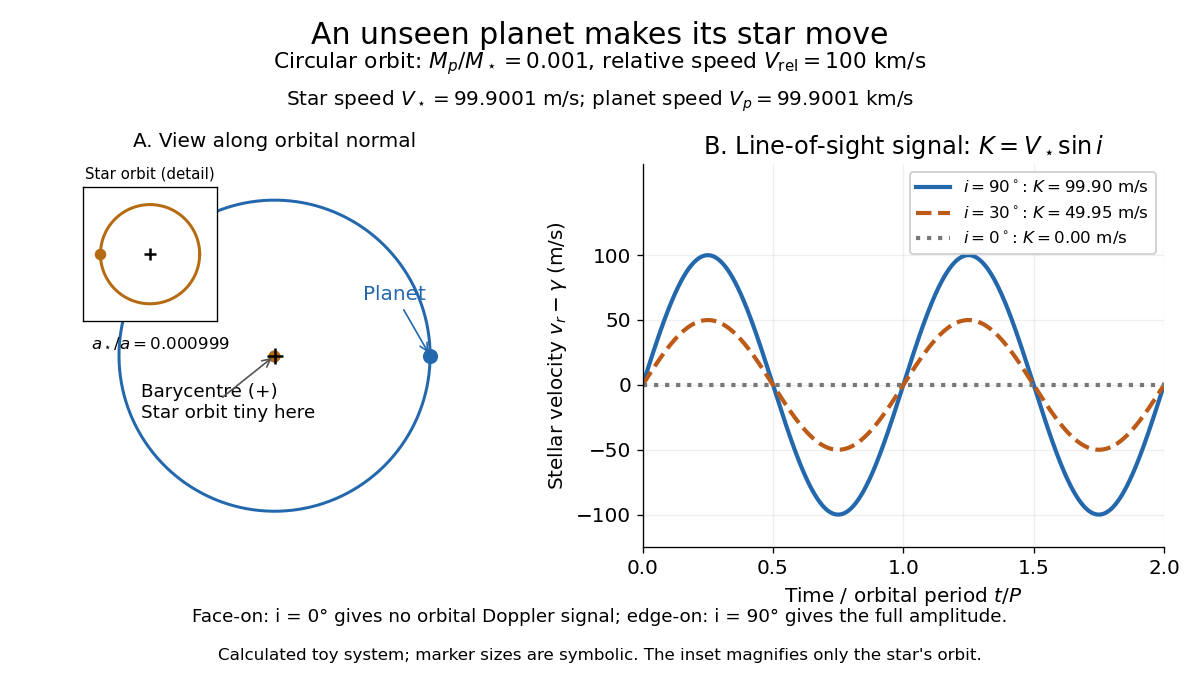
Doppler spectroscopy detects an exoplanet through the host star's changing Doppler shift. Both bodies orbit their shared astronomical barycenter: the star undergoes stellar reflex motion even when the exoplanet itself is unseen. Its velocity along the line of sight shifts its spectral lines; at speeds small compared with the speed of light, , with positive for recession. Repeated measurements can fit a Kepler orbit, rather than merely detect one shifted spectrum. Starspots and other changes in stellar spectral lines must be distinguished from actual orbital motion.
For one companion in an isolated two-body problem, the stellar radial-velocity semi-amplitude isHere is the gravitational constant, the orbital period, the orbital eccentricity, and the star and exoplanet masses. The orbital inclination is measured relative to the sky plane: is face-on and is an edge-on orbit. The exact binary mass function measured from the fitted orbit isWith known and , this is usually reported as . Taking gives the minimum companion mass; a smaller orbital inclination allows a larger mass. A detected exoplanet transit constrains close to for a compact planet orbiting well outside the star's surface, substantially resolving this ambiguity. Combining Doppler spectroscopy and exoplanet transit photometry then supplies a mass and radius for exoplanet interior studies.
For a computed circular example, let and choose a relative orbital speed : this is the speed of the planet relative to the star, not its speed about the astronomical barycenter. Conservation of momentum givesThe barycentric velocities point in opposite directions, so their speeds add to . Here and : at , at , and zero at . The star still orbits in the face-on case, but its orbital velocity has no line-of-sight component. The plotted circular signal is for a chosen phase origin and constant system velocity .
Entropy-related corotation torque 2026-10-20
Exoplanet Created 2026-09-24 Updated 2026-10-18
An exoplanet is a planet outside the Solar system; here the focus is on planets orbiting stars other than the Sun, including pulsars. Most exoplanets are detected indirectly: a star's changing Doppler shift reveals its motion, or a small dip in its light curve reveals an exoplanet transit. The striking idea is that an unresolved point of light can tell us about an otherwise unseen world's mass, radius, and orbit.
The measurements answer different questions. Exoplanet transit photometry primarily gives a radius ratio, while Doppler spectroscopy constrains mass together with orbital inclination. Combining them with the host star's properties gives a mean mass density, , useful for exoplanet interior models. Even this combination does not uniquely determine composition: see exoplanet interior-composition degeneracy. Transit spectroscopy and an exoplanet secondary eclipse then probe an exoplanet atmosphere.
The discovery history has two distinct milestones. In 1992 Aleksander Wolszczan and Dale Frail reported two planet-mass companions to the pulsar PSR B1257+12 from periodic changes in pulse arrival times; their paper also suggested an additional companion. These were the first confirmed exoplanet discoveries, around a neutron star. [ref]
https://www.nature.com/articles/355145a0. Wolszczan and Frail (1992)
. Wolszczan's contemporary conference account, archived by NASA, likewise distinguishes the two reported companions from a possible third. [ref]https://ntrs.nasa.gov/citations/19920021993. Wolszczan (1992), NASA archive
.In 1995 Michel Mayor and Didier Queloz discovered 51 Pegasi b through Doppler spectroscopy, the landmark first confirmed exoplanet around a Sun-like star. This was a hot Jupiter, not the first exoplanet of every kind: the earlier pulsar discoveries belong to a different host category. [ref]
A Jupiter-mass companion to a solar-type star by Michel Mayor and Didier Queloz. Mayor and Queloz (1995)
. NASA's contemporary account describes the confirmation and the approximately four-day orbital period. [ref]https://science.nasa.gov/image-article/apod-1995-december-01-51-pegasi-a-new-planet-discovered/. NASA account (December 1995)
. Exoplanet occurrence rate 2026-10-20
Exoplanet transit depth Created 2026-10-14 Updated 2026-10-20
The fractional decrease in observed radiative flux during an exoplanet transit, relative to the out-of-transit baseline. For a uniform star, a dark planet, full disc overlap, and no transit dilution, the exoplanet transit depth is . For a nonuniform star it depends on the blocked specific intensity as well as the radius ratio.
Exoplanet transit photometry Created 2026-10-05 Updated 2026-10-14
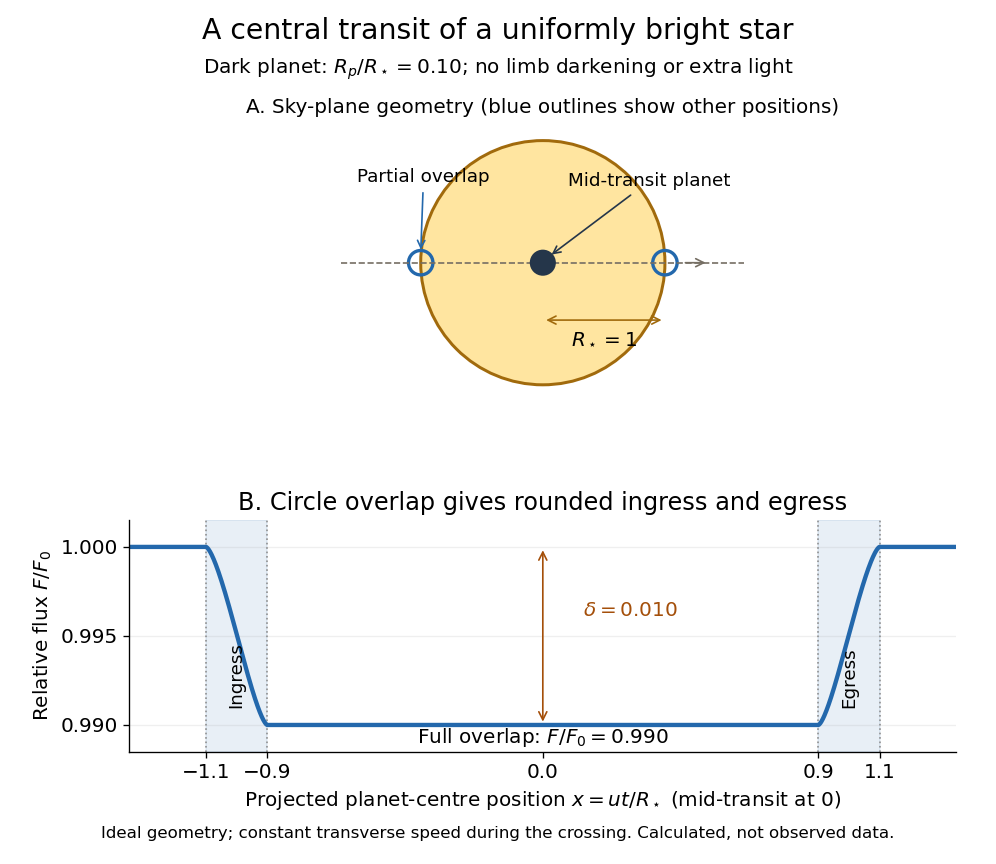
Exoplanet transit photometry measures the decrease in a star's observed radiative flux during an exoplanet transit. Define as the unobscured star's observed radiative flux and as the value at time . For a dark, opaque exoplanet crossing a uniformly bright circular stellar disc, a fully superimposed planetary disc blocks exactly the fractionHere and are the planet and star radii. This exoplanet transit depth determines a radius ratio, ; an absolute planet radius requires an independently estimated stellar radius. For , : a one-percent dip, with . Halving the radius ratio to reduces the exoplanet transit depth to , a quarter as much.
For the central exoplanet transit illustrated below, the transit impact parameter is . Write and let be the projected centre-to-centre separation in units of . The light curve is , where is the overlap area of circles of radii and . There is no overlap when ; the planetary disc is fully inside when , giving . Between those limits, the overlap area grows or shrinks continuously. Thus even a uniform star has curved ingress and egress, with a flat bottom only during full overlap. The illustration uses approximately constant transverse velocity over the short crossing, so with mid-transit at . Analytic models also handle limb darkening. [ref]
https://arxiv.org/abs/astro-ph/0210099. Mandel and Agol (2002)
.


The simple exoplanet transit depth formula assumes constant stellar brightness, no limb darkening or starspots, negligible light from the exoplanet, and no transit dilution by other light. It describes full overlap in a non-grazing exoplanet transit, requiring for a full-overlap interval. A grazing exoplanet transit never hides the whole planetary disc against the star, and limb darkening weights different blocked areas differently. Repeating dips are valuable evidence, but eclipsing binary stars and starspots can imitate parts of the signal, so confirmation and joint modelling matter.