The escape velocity is the least initial speed that permits a freely coasting body to move arbitrarily far from an isolated attracting body. Despite its conventional name, it is a speed, not a unique velocity vector. For a fixed point mass , or outside a body with spherical symmetry, set Newtonian gravitational potential energy zero at infinity. An exterior test particle of constant mass then hasHere is the standard gravitational parameter, and is distance from the centre, not height above the surface. Set for surface escape velocity. Evaluate velocity in the body's rest inertial frame. Neglect drag, later rocket thrust, other bodies' gravity, and relativistic effects.[ref]
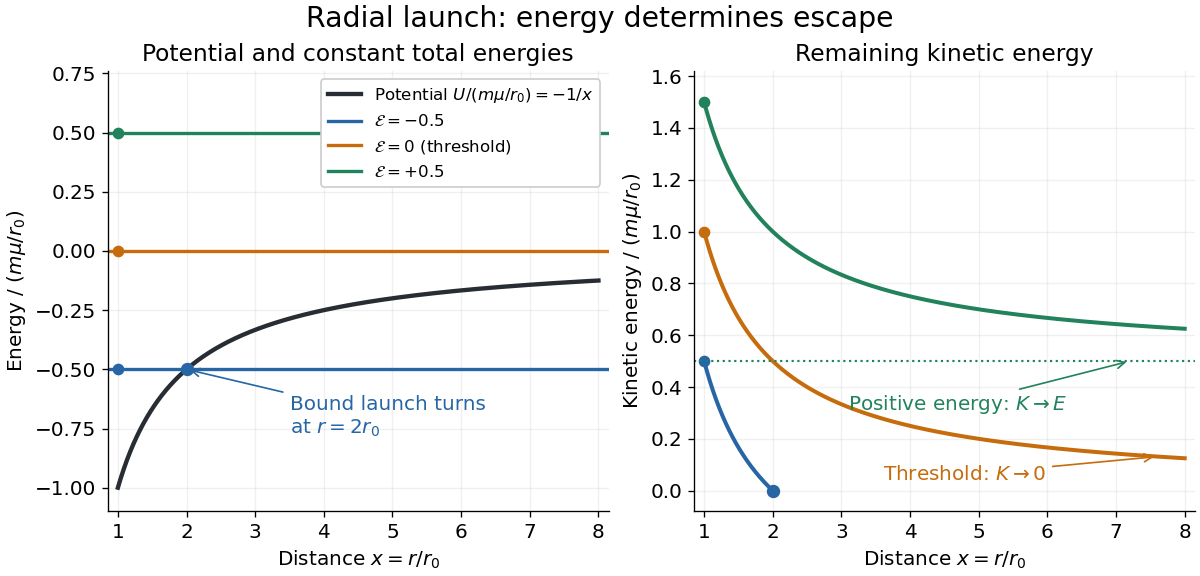
Conservation of energy gives the threshold by requiring : at infinity the potential energy tends to zero and the kinetic energy cannot be negative. If , the outward motion loses speed continuously toward zero. If , the asymptotic speed is . If , infinity is inaccessible. For a radial outward launch, its outer turning point is . For nonradial motion use angular momentum and the escape energy threshold to distinguish zero radial velocity from zero total speed.
Direction still determines the orbit and whether the body hits an obstacle. An initially inward velocity can cause collision even when . For an isolated spherical body, an exterior outward launch, or a tangential launch at or above escape velocity, has an outward escape branch without intersecting the body. A parabolic trajectory is the nonradial threshold path; a hyperbolic Kepler orbit has positive energy. The formula specifies their required local speed, not their orientation.[ref]
13.3 Gravitational Potential Energy and Total Energy. §13.3, “Energy and gravitationally bound objects”: scalar energy and finite-body collisions
For a spherical nonrotating asteroid of the same mean mass density as a reference planet of radius R and surface gravity g, the mass scales as r cubed. Its surface escape speed therefore obeys . A take-off speed permits escape for . If that same take-off speed gives ballistic height H above the reference planet, , and the limiting asteroid radius is . A chosen H is an explicit performance estimate, not a universal human constant.
Equating the molecular root-mean-square speed to the surface escape velocity gives , or . This compares speed scales; the high-speed tail can escape below that temperature, and molecular dissociation can invalidate the assumed species at high temperature.
Use the synthetic standard gravitational parameter and launch distance . Then escape speed is . Three outward radial launches give exact comparisons: has specific orbital energy and stops outward at ; has zero specific orbital energy; has specific orbital energy and asymptotic speed . The second case has speed at . Doubling divides escape speed by , whereas doubling at fixed multiplies it by . Changing the test particle's mass changes but cancels from the escape speed.
The same initial distance can lead to strikingly different orbits. Let and launch tangentially in one orbital plane. Then periapsis is the launch point, specific angular momentum is , andwhere is true anomaly. These follow by combining the initial specific orbital energy with the orbital eccentricity relation and the Kepler orbit equation. With and , the initial speeds , , , and give : a circular orbit, an elliptic orbit with apoapsis distance , a parabolic trajectory, and a hyperbolic Kepler orbit. The two open paths have asymptotic speeds zero and respectively. Their different directions at large distance are part of the Kepler orbit, not an extra scalar escape threshold.
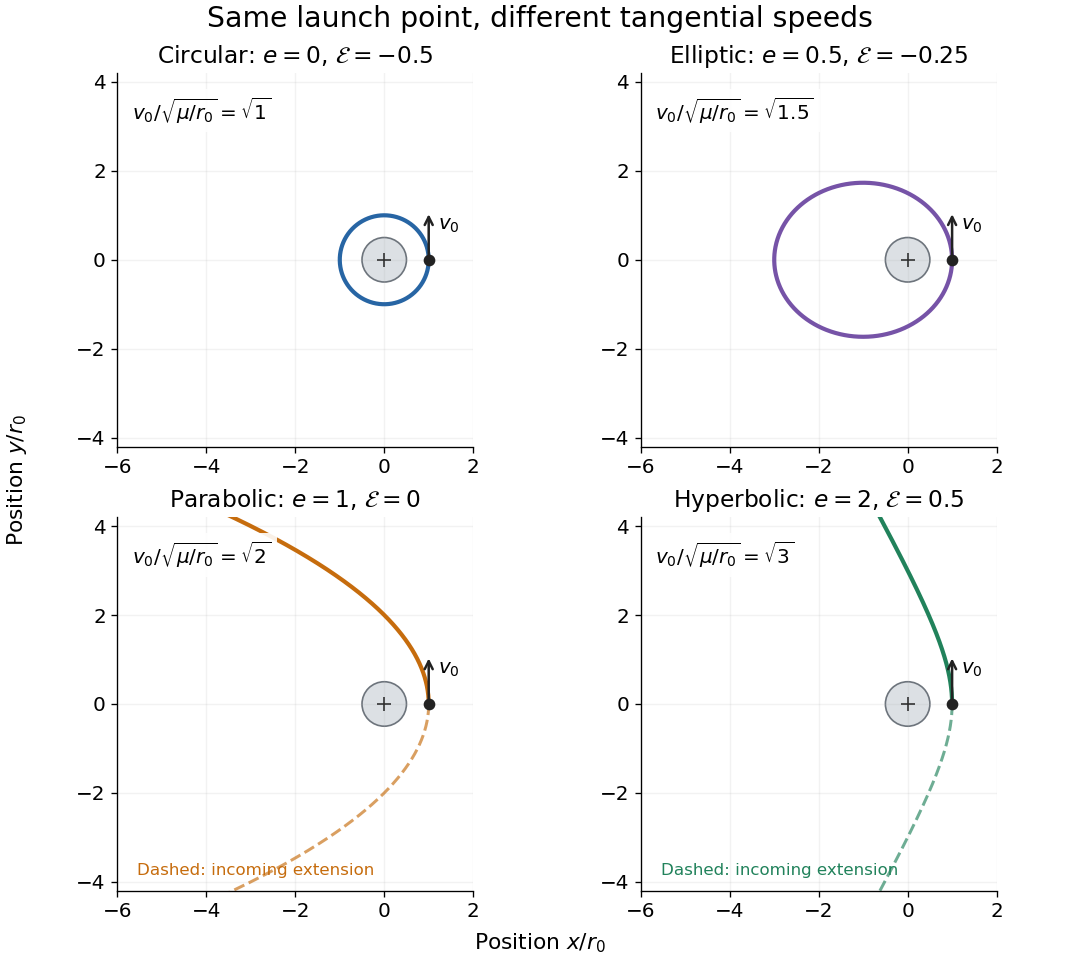
Tangential launches give circular, elliptic, parabolic, and hyperbolic Kepler orbits
. All panels use equal spatial scales, a fixed attracting centre at the origin, a launch point , and an initially upward velocity. The gray body's radius is stipulated as , so all displayed paths remain exterior. Colored solid curves follow motion after launch; dashed curves on the open orbits are their incoming extensions, not an additional part of the launch. Open curves continue beyond the viewing window. The normalized launch speeds and specific orbital energies are computed from the stated isolated model. Details.“Arrives at infinity with zero speed” is an asymptotic statement. For outward radial motion at zero specific orbital energy,Every finite distance takes finite time, but as . There is no instant of rest at an infinitely distant destination. Differentiating the displayed solution gives , independently checking Newton's second law. In the synthetic example, reaching takes exactly . For nonzero specific angular momentum, the Barker equation gives the corresponding infinite-time limit along a parabolic trajectory. Positive-energy escape also takes infinite time to reach infinity; it retains nonzero asymptotic speed.
For a circular orbit, gravity supplies centripetal acceleration, giving . ThusA body in a circular orbit is bound despite its continuous free fall. At the same , escape needs twice its kinetic energy per unit mass. An instantaneous forward tangential velocity increment from the circular orbit requires , rather than the full escape speed from rest. In the synthetic example this is exactly .[ref]
13.4 Satellite Orbits and Energy. §13.4, “Circular Orbits” and “Energy in Circular Orbits”: centripetal balance and negative total energy
Escape speed is a coasting threshold, not a required continuously maintained speed or a measure of rocket propellant. A powered vehicle can start at rest and acquire energy gradually. The rocket equation relates an ideal velocity increment to rocket exhaust speed and rocket mass ratio; rocket thrust, drag, and the timing and direction of propulsion affect a real ascent. Rotation also changes the relation between surface-relative velocity and the inertial frame used in the calculation.
Reaching another body is a finite-destination spacecraft trajectory problem. In the synthetic radial example, a launch at reaches while remaining bound. A spacecraft can similarly encounter the Moon on a bound geocentric transfer; actual planning must include the Moon's gravity, target motion, arrival velocity, and any propulsion needed for capture. Escaping Earth alone does not imply escaping the Sun, because the relevant reference frame and attracting mass have changed. The isolated formula describes one gravitational well; a full mission requires more than its scalar threshold.
Operational evidence comes from reconstructing a spacecraft's motion. A ground antenna transmits a coded signal; the spacecraft returns it. Corrected round-trip time constrains distance, while the Doppler effect of a coherent carrier constrains the line-of-sight relative velocity. NASA's navigation account describes calibration of onboard turnaround delays before launch, calibration of ground delays before use, and corrections for the terrestrial atmosphere. Measurements over multiple stations and epochs constrain the orbit; range and Doppler effect alone do not directly give all transverse motion. Navigators compare a fitted spacecraft trajectory with later tracking and remeasure after propulsion to assess the maneuver. The account identifies radiation pressure and imperfect propulsion as disturbances. This provides practical checks of a dynamical model and its corrections, rather than a laboratory measurement of a universal escape speed. The simple inverse-square potential predicts an unpowered exterior arc; accurate navigation includes additional forces and measurement delays.[ref]
A spacecraft trajectory is the path traced by a spacecraft's position over time. An unpowered exterior arc can approximate a Kepler orbit; other bodies' gravity, radiation pressure, and propulsion can change it.
Orbit determination infers a body's position and velocity from observations and an equation of motion. It is an inverse problem; a residual of an inverse problem compares an observed readout with its modeled prediction.
For a sphere of radius and uniform mass density , with no surrounding mass and gravitational potential zero at infinity, the spherical shell theorem gives inside. Matching to the exterior point-mass potential gives . Since , the displayed relation follows for . Exterior shells leave the interior circular speed unchanged but deepen the potential and change the escape velocity; a uniform core alone is insufficient to determine escape.
Articles by others on the same topic



Escape velocity is the minimum speed needed for an object to break free from the gravitational attraction of a celestial body, such as a planet or moon, without any further propulsion. This concept is essential in physics and planetary science, especially when discussing spacecraft launches and orbital mechanics. The escape velocity depends on the mass of the celestial body and the distance from its center of mass.