Plateau airway pressure, , is the airway pressure assessed during an end-inspiratory interval with no flow and sufficiently stable conditions. An end-inspiratory hold can allow the airway and communicating alveolar gas pressures to equilibrate when the respiratory system is passive and the circuit is not leaking.[ref]
Measured values for Ppeak and Pplateau by Hamilton Medical. Definition of airway pressures; Principles of measuring plateau pressures
[ref]The distinction from peak airway pressure follows a simple single-compartment model:During the modeled hold, , leavingHere is respiratory-system compliance, is airway resistance, and total positive end-expiratory pressure supplies the starting reference. The measured difference is the corresponding respiratory driving pressure.
In an original example, total PEEP 8 cm HO, tidal volume 0.40 L and compliance 0.04 L/cm HO give cm HO. If flow immediately beforehand is 0.5 L/s and resistance is 12 cm HO·s/L, the model's airway pressure during that flow is 24 cm HO. The 6 cm HO difference is the modeled resistive contribution, not an extra static distending pressure.
A plateau does not directly measure pleural pressure or isolate the lung from the chest wall. For the same stipulated alveolar pressure 18 cm HO, pleural pressures of 12 and 2 cm HO imply transpulmonary pressures of 6 and 16 cm HO. The airway value alone cannot distinguish those states.
Finally, a stable displayed number is not automatically the same operation as an actual hold. The manufacturer distinguishes measured holds, rapid occlusion and calculated monitoring estimates.[ref]
Measured values for Ppeak and Pplateau by Hamilton Medical. Principles of measuring plateau pressures; Monitoring parameter Pplateau
Reporting the method and its conditions connects plateau airway pressure to the mechanical question it can answer.An end-inspiratory hold is a pause after inflation during which the airway is occluded and external flow is interrupted. Under passive, leak-free conditions, the resulting pressure trace helps distinguish flow-related airway resistance from the pressure remaining at approximately fixed lung volume. A stable endpoint provides a plateau airway pressure for interpreting respiratory-system compliance.[ref]
How to measure driving pressure by Hamilton Medical. End-inspiratory hold; passive and leak-free measurement conditions
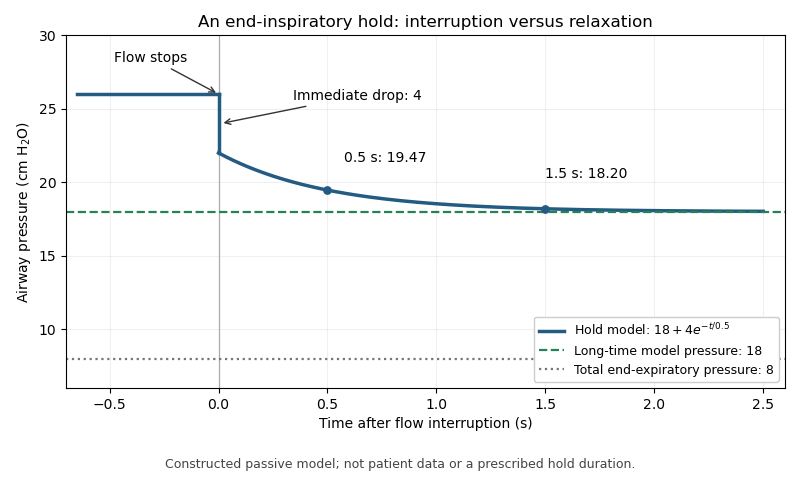
Stopping flow does not imply that every compartment instantaneously reaches a common pressure. Stress relaxation, redistribution between lung regions and the apparatus response can produce a continuing pressure change after the rapid resistive drop. The measured value should therefore identify the observation interval, rather than treating the first post-interruption sample as universally equilibrated.
For an original illustrative trace, suppose flowing peak pressure is 26 cm HO and stopping flow immediately removes 4 cm HO. Let the subsequent relaxation beThe initial hold value is 22 cm HO, about 19.47 remains after 0.5 s, and about 18.20 after 1.5 s. The model's long-time value is 18. The change from 26 to 22 and the later change from 22 toward 18 represent different mechanisms in this constructed example.
With total end-expiratory pressure 8 cm HO, using the initial hold value gives a nominal respiratory driving pressure of 14, whereas using the asymptotic value gives 10 cm HO. The difference demonstrates the importance of time and model assumptions; it does not prescribe a hold duration. Continued muscle activity, leakage or airway closure can invalidate the simple static interpretation. The experimental pilot study compares static and dynamic measurement methods rather than assuming all displayed pressure estimates are interchangeable.[ref]
Static and Dynamic Measurements of Compliance and Driving Pressure: A Pilot Study by Pierre Tawfik and others. Figure 1 and Study Procedures

Articles by others on the same topic
There are currently no matching articles.