
FRET dipole orientation factor 2026-10-14
The FRET dipole orientation factor describes the geometry of the two transition electric dipoles relative to their separation. Let , and be their unit vectors. ThenFor a separation along , parallel electric dipoles along give , parallel ones along give , and one along with the other along gives . Thus rotating a pair can change FRET efficiency without changing its separation.
The familiar value requires suitable rapid, independent orientation averaging during the FRET donor lifetime. Random orientations across a population of slowly rotating fluorescent proteins do not establish that dynamic condition. [ref]
FRET donor lifetime 2026-10-14
The FRET donor lifetime is the mean time spent in the excited state. For the constant-rate model of FRET efficiency,After a sufficiently brief excitation pulse, the FRET donor's fluorescence follows exponential decay, . With the illustrative values nanoseconds and nanoseconds, the inferred FRET efficiency is . Multiplying changes brightness without changing this decay time.
The lifetime comparison requires the same nontransfer decay rates in the reference and paired samples. Changes in the FRET donor's environment or a different nonradiative loss can also shorten the FRET donor lifetime. Heterogeneous FRET efficiencies or slowly varying FRET dipole orientation factors need an appropriate decay model; substituting any fitted average lifetime into the single-pair formula can mislead. [ref]
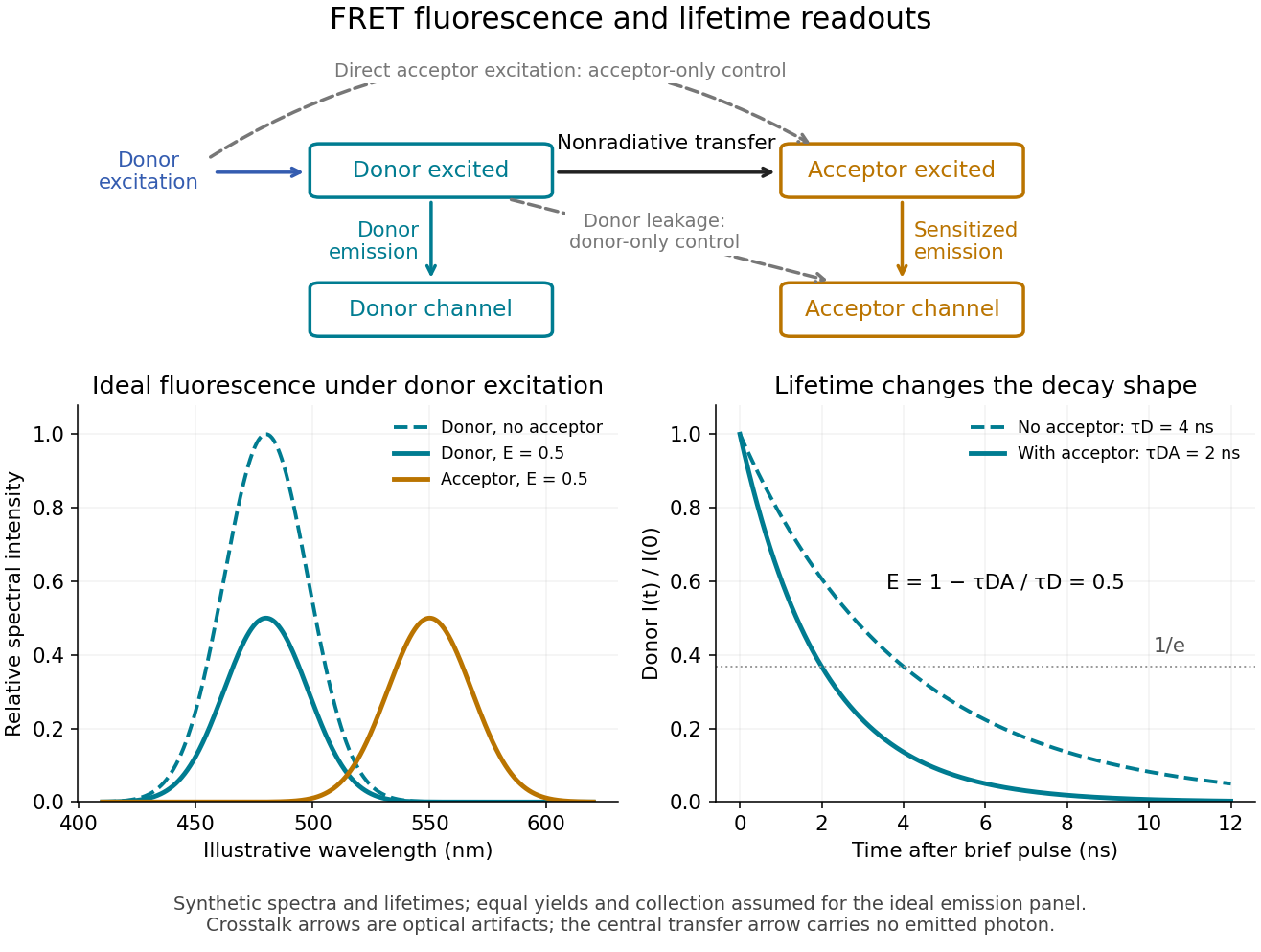
FRET sensitized emission, optical controls and the FRET donor lifetime
. Original schematic and synthetic curves. The spectral panel assumes equal fluorescence yields and collection efficiencies for the two labels; its amplitudes are illustrative, not a calibration or measured cyan/yellow spectra. The lifetime panel uses and nanoseconds. Dashed optical paths require FRET optical crosstalk controls; they do not represent the nonradiative transfer mechanism. Details.