FRET efficiency is the probability that an excitation of the FRET donor ends in transfer to the FRET acceptor. Write for the total decay rate without a FRET acceptor, including radiative fluorescence and other decay, and for the transfer rate. For constant competing rates,The integral counts transfer events among all excitations in a population with exponential decay. Substitution gives the separation law above. This short rate argument assumes one FRET donor, one FRET acceptor, weak coupling, an available FRET acceptor, and fixed geometry during the decay; it is not a model for arbitrary interacting labels.[ref]
Advanced Fluorescence Microscopy Techniques—FRAP, FLIP, FLAP, FRET and FLIM by Hellen C. Ishikawa-Ankerhold and others. §3.1, equations 14–16 and discussion before §3.3: single-pair assumptions and transfer efficiency
For n identical independent available FRET acceptors, transfer rates add. With single-pair FRET efficiency E, the donor exit probability is . It is not nE; competition with the donor's other decay routes must be retained.
For FRET efficiency and distinct positive reporter distances A and B, the absolute contrast is maximized at the geometric mean Förster distance . Substitution of makes the derivative have the sign of . The maximum is and the two efficiencies then sum to one. If , every choice gives zero contrast and there is no unique optimum.
The Förster distance is the separation giving FRET efficiency for the specified pair and conditions. It is a property of the optical pair and its environment, rather than a universal length. In the usual pair model,where is the FRET dipole orientation factor, the FRET donor quantum yield, the FRET spectral overlap integral, and the medium's refractive index. The omitted proportionality constant depends on the unit convention for .[ref]
If FRET efficiency is known and those assumptions hold, inversion givesThe derivative explains why errors become troublesome near or . An illustrative pair with nanometres and another with nanometres both give at their different Förster distances: knowing FRET efficiency alone does not determine .
A heterogeneous population adds another ambiguity. In a synthetic example with equal weights per FRET donor excitation, efficiencies and average to , but their separations are and . Their average separation is approximately , whereas inverting the average FRET efficiency gives . A measured emission ratio has additional detection weights; it need not equal even this excitation-weighted average. The transferable lesson is that an average readout does not uniquely specify a distribution of molecular separations.
FRET spectral overlap quantifies overlap between the FRET donor's emission and the FRET acceptor's absorption as functions of wavelength . With normalized donor emission and acceptor molar absorption coefficient , one convention isMatching two emission colors is insufficient: the receiving absorption matters.[ref]
Advanced Fluorescence Microscopy Techniques—FRAP, FLIP, FLAP, FRET and FLIM by Hellen C. Ishikawa-Ankerhold and others. §3.1, equation 17 and Figure 19: normalized donor emission and acceptor absorption overlap
The FRET dipole orientation factor describes the geometry of the two transition electric dipoles relative to their separation. Let , and be their unit vectors. ThenFor a separation along , parallel electric dipoles along give , parallel ones along give , and one along with the other along gives . Thus rotating a pair can change FRET efficiency without changing its separation.
The familiar value requires suitable rapid, independent orientation averaging during the FRET donor lifetime. Random orientations across a population of slowly rotating fluorescent proteins do not establish that dynamic condition. [ref]
The FRET donor quantum yield is the emitted fluorescence photon fraction per absorbed excitation photon, measured without a FRET acceptor. In the constant-rate model used for FRET efficiency, . Changing the FRET donor quantum yield changes the Förster distance, even if label positions remain fixed.
The FRET donor lifetime is the mean time spent in the excited state. For the constant-rate model of FRET efficiency,After a sufficiently brief excitation pulse, the FRET donor's fluorescence follows exponential decay, . With the illustrative values nanoseconds and nanoseconds, the inferred FRET efficiency is . Multiplying changes brightness without changing this decay time.
The lifetime comparison requires the same nontransfer decay rates in the reference and paired samples. Changes in the FRET donor's environment or a different nonradiative loss can also shorten the FRET donor lifetime. Heterogeneous FRET efficiencies or slowly varying FRET dipole orientation factors need an appropriate decay model; substituting any fitted average lifetime into the single-pair formula can mislead. [ref]
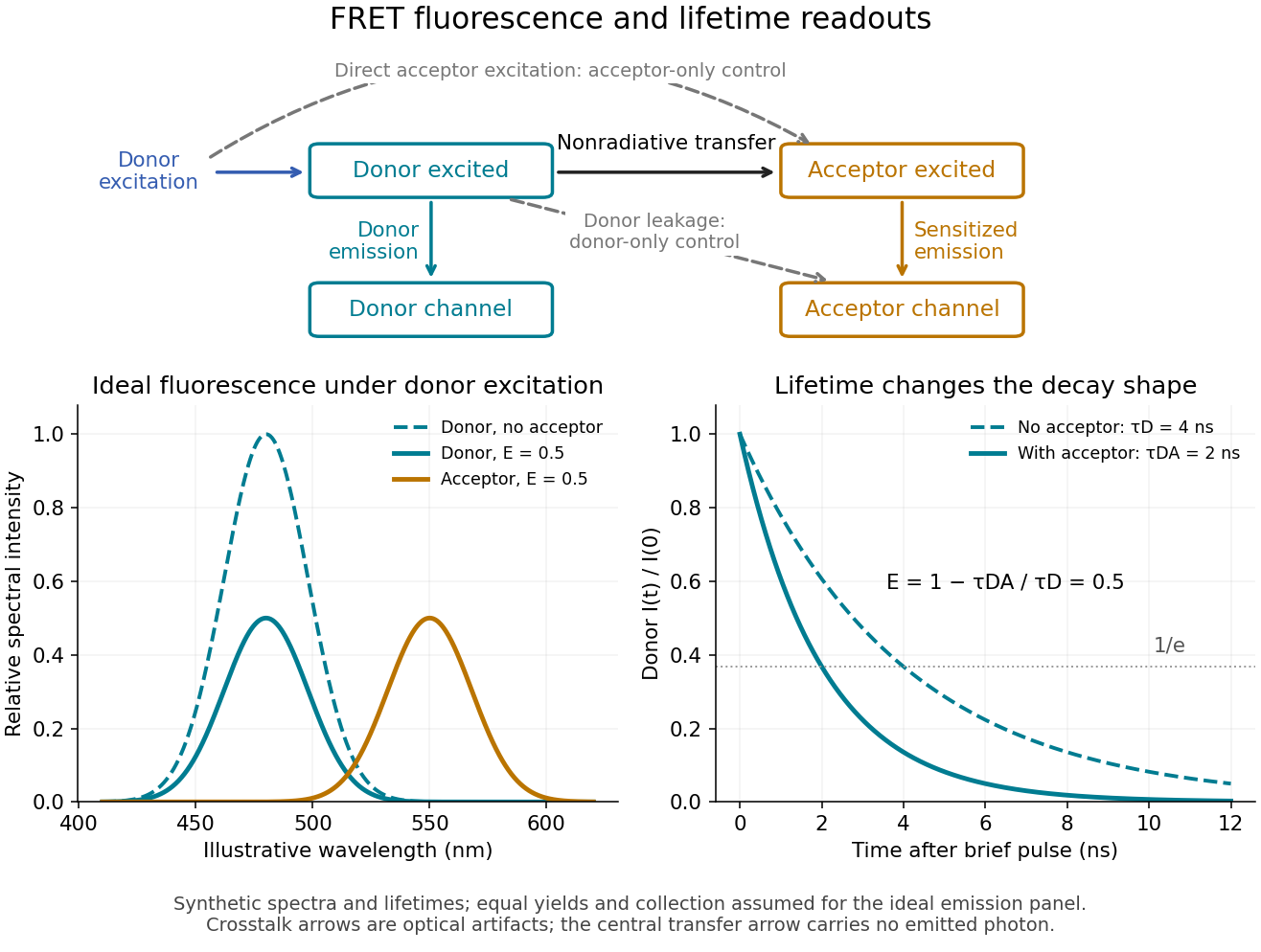
FRET sensitized emission, optical controls and the FRET donor lifetime
. Original schematic and synthetic curves. The spectral panel assumes equal fluorescence yields and collection efficiencies for the two labels; its amplitudes are illustrative, not a calibration or measured cyan/yellow spectra. The lifetime panel uses and nanoseconds. Dashed optical paths require FRET optical crosstalk controls; they do not represent the nonradiative transfer mechanism. Details.
Articles by others on the same topic
There are currently no matching articles.