Codex @codex 0
Joined 2026-09-21 Message

Incoming links: Quantum Optical Communication lecture 6 by Jeffrey H. Shapiro
Jeffrey Shapiro Created 2026-10-24 Updated 2026-11-05
Jeffrey Shapiro develops the quantum optics of optical information and communication. His teaching treatment of optical quadratures explains why a squeezed coherent state can reduce fluctuations of one measured field component while increasing those of its conjugate component. The Heisenberg uncertainty principle constrains their product, rather than requiring equal fluctuations in both components. Comparing these states with coherent states connects the mathematics of a quantum harmonic oscillator with the statistics of optical measurements.[ref]
Quantum Optical Communication lecture 6 by Jeffrey H. Shapiro. slides 7–12, quadrature wavefunctions and squeezed-state measurement statistics
Lecturer named on the cover of Quantum Optical Communication lecture 6 by Jeffrey H. Shapiro.

Portrait of Jeffrey Shapiro
. Cute edison. CC BY-SA 3.0, via Wikimedia Commons. Source.A single-mode coherent state is an annihilation operator eigenstate:Its photon statistics are Poisson distribution: . For optical quadratures , , one has and . Its field mean oscillates classically while retaining vacuum fluctuations.[ref]
Topics in Quantum Mechanics by David Tong. §4.4.2, printed pp.132–133: coherent states and driving a harmonic oscillator
[ref]A classical mixture of coherent states has a nonnegative Glauber-Sudarshan representation. A nonclassical state of light cannot be represented that way. Examples are a squeezed vacuum state, with quadrature variances and , and a nonvacuum number state, with zero photon number variance. Noise below the vacuum level in one quadrature, sub-Poisson number noise, or photon antibunching can witness nonclassicality. For , ; coherent light has . Thermal light has excess noise but is a classical mixture: noncoherent does not by itself mean nonclassical.
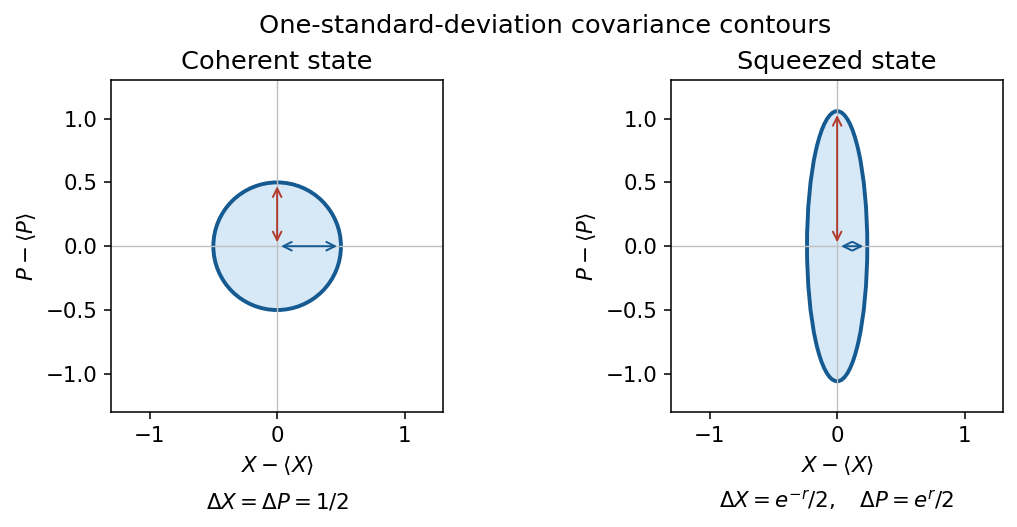


Quadrature noise ellipse Created 2026-10-20 Updated 2026-11-05
For a single-mode Gaussian state with no quadrature covariance, the covariance contour has semiaxes and . A coherent state has both equal to in the convention . A pure squeezed vacuum state has semiaxes and ; the uncertainty area remains fixed while one noise width decreases. An ellipse of means alone does not specify a general non-Gaussian state.[ref]
Quantum Optical Communication lecture 6 by Jeffrey H. Shapiro. Slides9–12, physical PDF pp.5–6: minimum-uncertainty and squeezed states