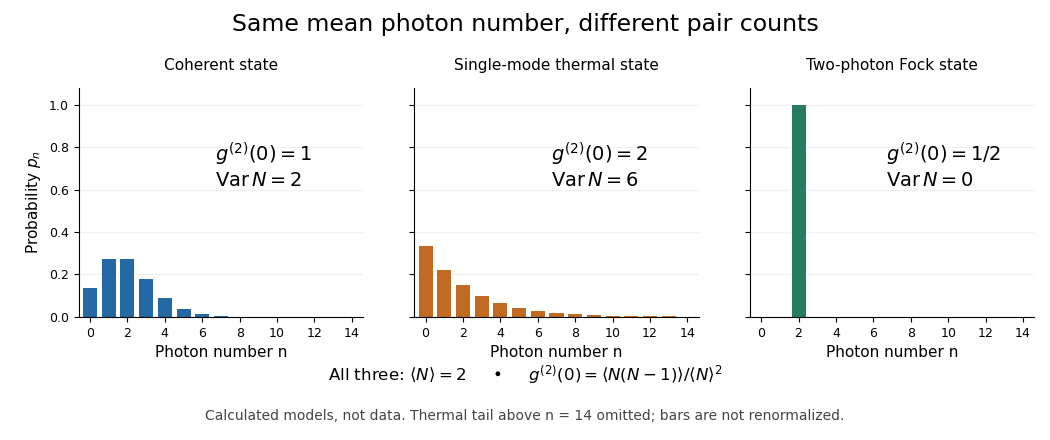
For a single mode in thermal equilibrium, its quantum harmonic oscillator energy ladder gives a geometric distributionIts probability generating function is . Differentiating twice gives , hence . At the chosen mean , , , , , and . Rare high occupations increase the pair count even though the mean matches the other preparations. The geometric weights also arise from a Gaussian mixture of coherent states.[ref]
One Hundred Years of Light Quanta by Roy Jay Glauber. 2005 individual Nobel lecture, pp. 91–92, equations (31)–(38)

Articles by others on the same topic
There are currently no matching articles.