Photon statistics is the probability distribution of the number operator in specified field modes, or the distribution of registered counts in a specified gate. Those distributions agree only for an appropriate ideal measurement. Mode selection, losses, and detector dead time matter. For a one-mode density matrix, andThese two sums already distinguish preparations with the same expected value.
For a coherent state, write and in number states. The annihilation operator gives , so . Normalization yields . Thus photon statistics follows a Poisson distribution with , and the normal ordering of every moment gives . This factorization is the defining virtue of coherent states for optical calculations.[ref]
Coherent and Incoherent States of the Radiation Field by Roy Jay Glauber. 1963, §III, equations (3.1)–(3.7): coherent-state expansion; Universidade Estadual de Campinas mirror
As an original comparison, choose . Then , , , and . A two-photon Fock state also has mean two but has and pair moment two. ConsequentlyIn particular, cannot supply a pair. Nevertheless, photon statistics alone does not determine a quantum state: averaging over a uniform quantum phase removes its off-diagonal entries while retaining exactly the same and these equal-time moments.
For a single mode in thermal equilibrium, its quantum harmonic oscillator energy ladder gives a geometric distributionIts probability generating function is . Differentiating twice gives , hence . At the chosen mean , , , , , and . Rare high occupations increase the pair count even though the mean matches the other preparations. The geometric weights also arise from a Gaussian mixture of coherent states.[ref]
One Hundred Years of Light Quanta by Roy Jay Glauber. 2005 individual Nobel lecture, pp. 91–92, equations (31)–(38)
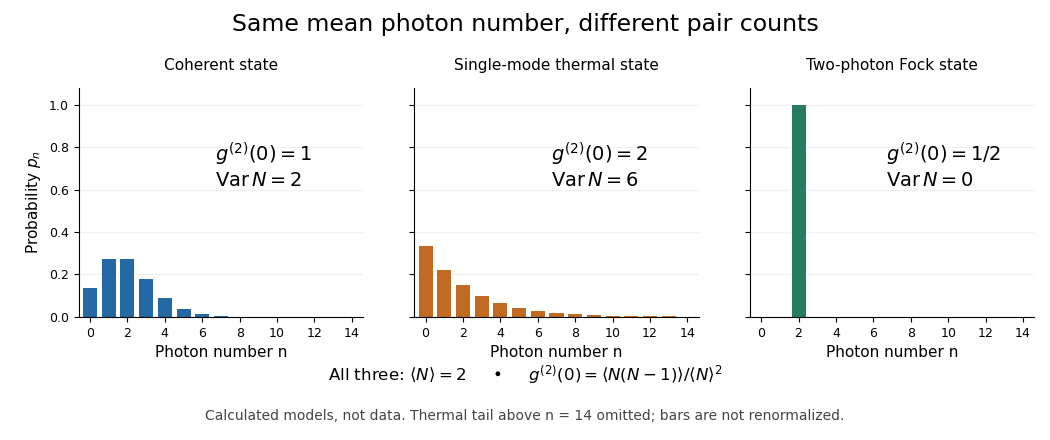

Single-mode selection is essential to this factor of two. If independent equally populated thermal modes are collected together, let with . Adding their variances gives , hence . Averaging over many unresolved modes can make thermal pair counts approach the independent-count reference.
Photon bunching is enhanced near-coincident detection relative to an appropriate independent-count reference. It need not require nonclassical light. In a classical intensity model with nonnegative instantaneous light intensity , ideal detection with a conditional Poisson distribution givesA fluctuating intensity therefore bunches counts. For a stationary classical intensity with finite second moment, the Cauchy-Schwarz inequality further gives . A zero-delay correlation smaller than one at a later delay cannot be explained by this model.
Photon antibunching means suppression of close pairs compared with pairs at some later delay: for some . If correlations decay to the independent-count reference, is a sufficient signature. It violates the classical intensity bounds in photon bunching. For the specified single-mode number measurement, second-order optical coherence also shows that is equivalent to . This variance criterion concerns that mode or gate; it must not be applied unchanged to arbitrarily long integrated counting intervals.
Articles by others on the same topic
There are currently no matching articles.