For , let contain the first terms, with . The remainder after those terms isThis is the exact absolute error. A convenient bound replaces the denominator by , giving through the triangle inequality. The exact denominator is preferable when the sign or complex phase of is known.
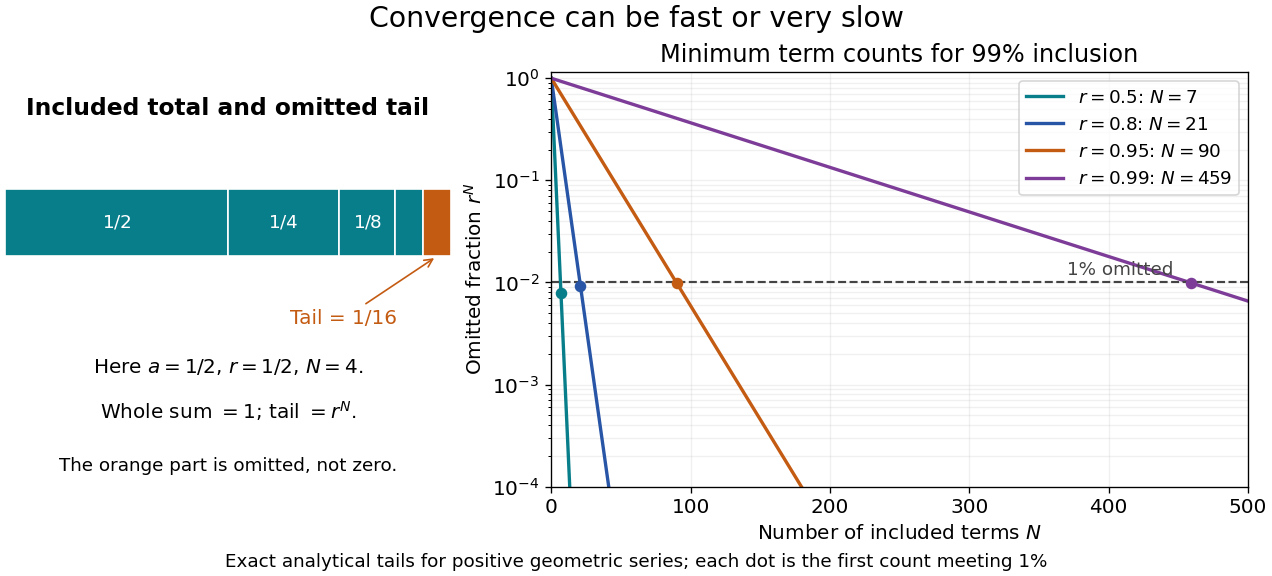

For and , the omitted fraction of the entire sum is . Capturing at least percent therefore means . Taking logarithms and applying the ceiling function gives the smallest integer :This gives and terms for and , respectively. The difference is a concrete reason to care about the common ratio, even when all four series converge.
An absolute target has a different scale. For , , and required absolute error at most , the total sum is andThe first acceptable term count is : the remainder is approximately , while at it is approximately . Counting terms and checking the tail avoids an ambiguous instruction to stop when a term merely looks small.
Articles by others on the same topic
There are currently no matching articles.