A shadow price measures the marginal improvement from relaxing an inequality optimization constraint. Use for in a minimization problem. With strong duality and a differentiable optimal value function, .[ref]
Convex Optimization by Stephen Boyd and Lieven Vandenberghe. §5.6.3, printed pp. 251–252, equation (5.58): local sensitivity
In the quadratic minimization with a moving upper bound, direct differentiation givesThe derivative at is zero from both sides, although has different one-sided derivatives there. The value of additional room has faded continuously to zero just as the active constraint stops restricting the optimizer.
At , , and . Raising the bound to lowers the value to : the first-order prediction is a change of , while the exact change is . At , the same relaxation leaves and . At , tightening by costs , a second-order effect despite the zero Lagrange multiplier.
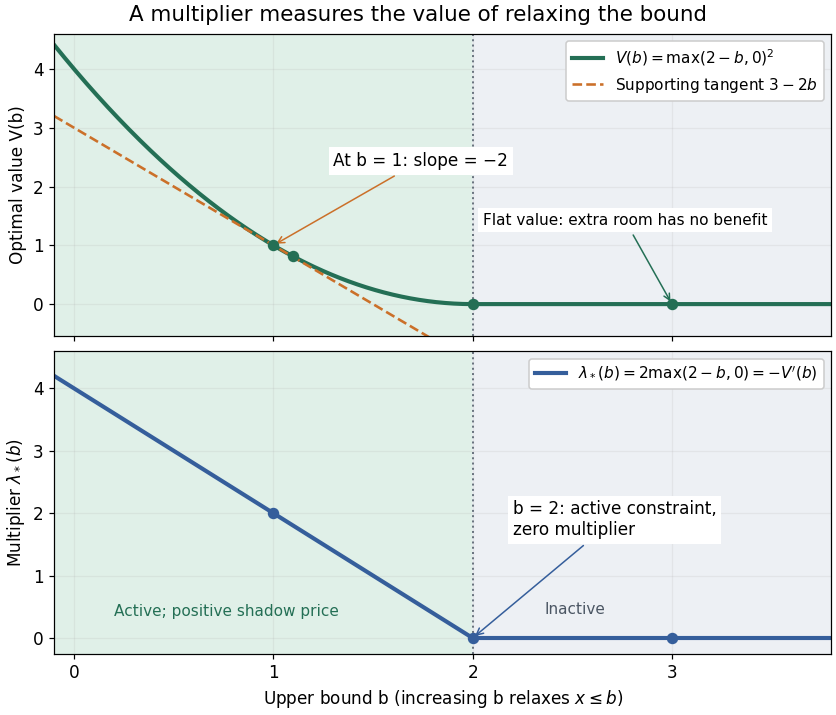
The derivative of the optimal value is the negative inequality multiplier
. Details. 
There is also a global statement in this example. Keeping the Lagrange multiplier at the value associated with , the Lagrange dual function changes by . Weak duality therefore givesAt this is , the supporting tangent shown in the diagram. This bound remains valid for large changes, whereas the derivative predicts only the first-order effect. If the value function is not differentiable, an optimal Lagrange multiplier can instead supply a supporting subgradient, rather than a unique marginal rate. This is the same idea used in sensitivity analysis in convex perturbation duality.
Articles by others on the same topic
There are currently no matching articles.