Shared bias in an interlaboratory consensus occurs when a common systematic error shifts several laboratories' results together. Their interlaboratory consensus value can then be highly reproducible while displaced from an independent reference. Shared calibration standards, a common correction or the same inadequately modeled measurement step can create such dependence. The GUM explicitly warns that using the same instrument, standard or reference datum can correlate input quantities.[ref]
Guide to the expression of uncertainty in measurement by JCGM. §5.2.4 and AnnexF.1.2.3, common references and correlated inputs
A simple original model iswhere θ is the target quantity value, b a common fixed offset and εi a laboratory-specific deviation. The arithmetic mean is xˉ=θ+b+εˉ. Increasing the number of independent laboratories reduces the fluctuations in εˉ but leaves b in place.
xi=θ+b+εi,
The obstacle is also one of identification. For any constant c, replacing (θ,b) with (θ+c,b−c) leaves all predicted results unchanged. Pairwise differences xi−xj cancel both terms. Thus the comparison's internal agreement cannot determine the absolute common offset without additional information.
To represent residual common-reference uncertainty, use an uncertain zero-centered quantity B with standard uncertainty uB, independent of mutually independent laboratory errors of variance σ2. ThenThis is a stated uncertainty model, distinct from asserting that an unknown fixed bias has been observed to vary randomly. The common contribution is counted once in the mean's uncertainty; it is not divided by the number of laboratories.
cov(xi,xj)=uB2(i=j),u2(xˉ)=uB2+nσ2.
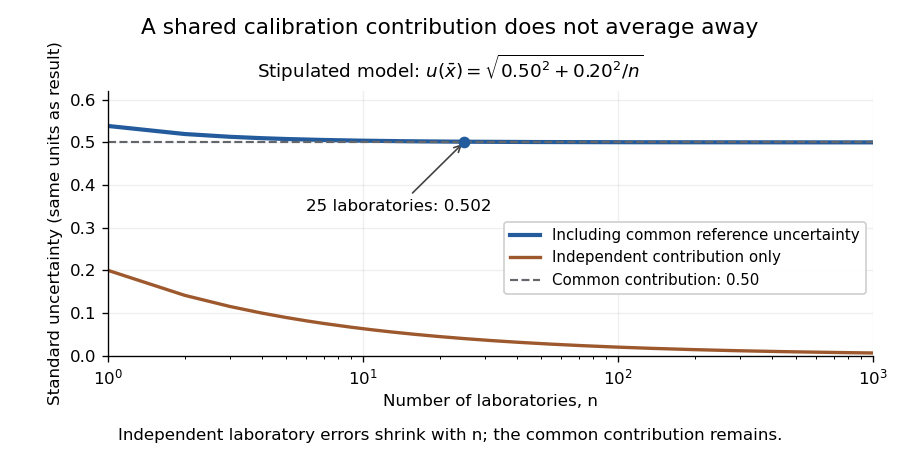
An original interlaboratory uncertainty model: a common calibration contribution remains as independent laboratory variation averages down
. Details. 
For stipulated uB=0.50, σ=0.20 and n=25, treating everything as independent would retain only 0.20/5=0.04. The stated correlated model instead gives u(xˉ)=0.25+0.0016≈0.502, in the same units as the measurement. The appropriate covariance terms prevent the implausible conclusion that enough copies of a shared reference can remove its uncertainty.[ref]
Guide to the expression of uncertainty in measurement by JCGM. §5.2.2 and §5.2.2 note1, covariance combination and shared-resistor example
An independently characterized certified reference material, a different measurement principle or an independently calibrated reference can help test the suspected common shift. Independence must itself be checked: a nominally separate reference derived from the same calibration chain may retain the same dependency. Recognized biases should be corrected where appropriate, with the correction's uncertainty retained.
Ancestors (5)
Incoming links (6)
Discussion (0) New discussion
There are no discussions about this article yet.
Articles by others on the same topic (0)
There are currently no matching articles.