An interlaboratory consensus value is a value derived from results supplied by a specified group of laboratories to represent their common location for a stated measurand. It can serve as an assigned value in proficiency testing, but consensus and independent reference assignment are different ways of establishing that benchmark. The procedure must specify the participating results, estimator and associated measurement uncertainty.[ref]
Selection, Use and Interpretation of Proficiency Testing (PT) Schemes by Brian Brookman and Ian Mann. §7.2.2 and Annex D.2, expert-laboratory and participant-consensus assignment
For an original example, three laboratories report , and in the same units. Their arithmetic mean is and their sample standard deviation is . Under a model of independent, equally distributed, unbiased laboratory errors, the estimated standard uncertainty of this mean is . This calculation does not include an unrecognized systematic error common to all three laboratories.
Choosing a location estimator is a substantive decision. For stipulated results , , and , the arithmetic mean is , whereas the median is . Robust statistics can reduce the influence of an isolated extreme result, but cannot decide from these four numbers whether that result is erroneous or represents a different measurement method or material condition. The guide discusses robust approaches while distinguishing consensus assessment from fitness-for-purpose criteria.[ref]
Selection, Use and Interpretation of Proficiency Testing (PT) Schemes by Brian Brookman and Ian Mann. §7.1, printed p. 15, robust statistics; §7.2.3 and AnnexD, consensus versus assessment criteria
When laboratories supply valid, mutually uncorrelated standard uncertainties for unbiased estimates of the same quantity, an inverse-variance weighted mean usesThe last equality belongs to that model. Shared references, method-specific effects or underestimated can invalidate its interpretation. A laboratory reporting a small uncertainty should not receive overwhelming influence merely because that number was submitted.
An interlaboratory consensus value therefore summarizes a specified collection of evidence. It is not automatically the true value, a certified reference material value, or an independent test of those same laboratories. Shared bias in an interlaboratory consensus and the influence of participants on their own benchmark must be considered before interpreting a small deviation as evidence of accuracy.
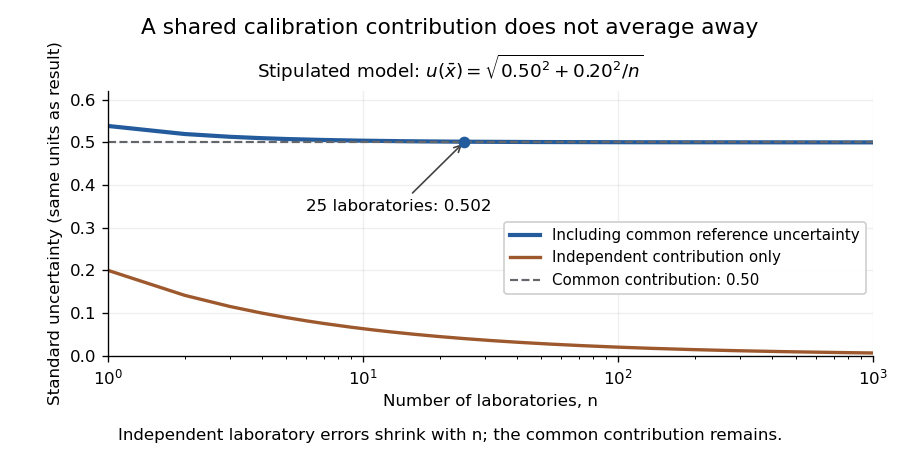
An original interlaboratory uncertainty model: a common calibration contribution remains as independent laboratory variation averages down
. Details. 
Articles by others on the same topic
There are currently no matching articles.