The sieve of Eratosthenes finds all prime numbers at most an integer . Start with the integers marked as candidates. For each surviving candidate in increasing order, mark the multiples up to as composite numbers. Stop processing candidates once : the surviving candidates are exactly the prime numbers. Starting at saves work because any smaller proper multiple of already has a smaller prime factor. [ref]
https://web.stanford.edu/class/cs106aj/res/handouts/36-Section-6.pdf. Jerry Cain, Stanford CS106AJ, Section Handout 6, Problem 4: the sieve of Eratosthenes
.For a complete run with , the only prime numbers at most are , since . Exclude one before starting; it is not a prime number. The four marking passes are:
- : mark , removing 29 candidates.
- : mark . The nine newly removed candidates are ; the even integers were already marked.
- : mark . Only are newly removed.
- : mark . Only is newly removed.
There are surviving prime numbers:The next surviving candidate is , and , so no further marking pass is necessary. A prime number used for marking remains a candidate: starting at never marks itself.
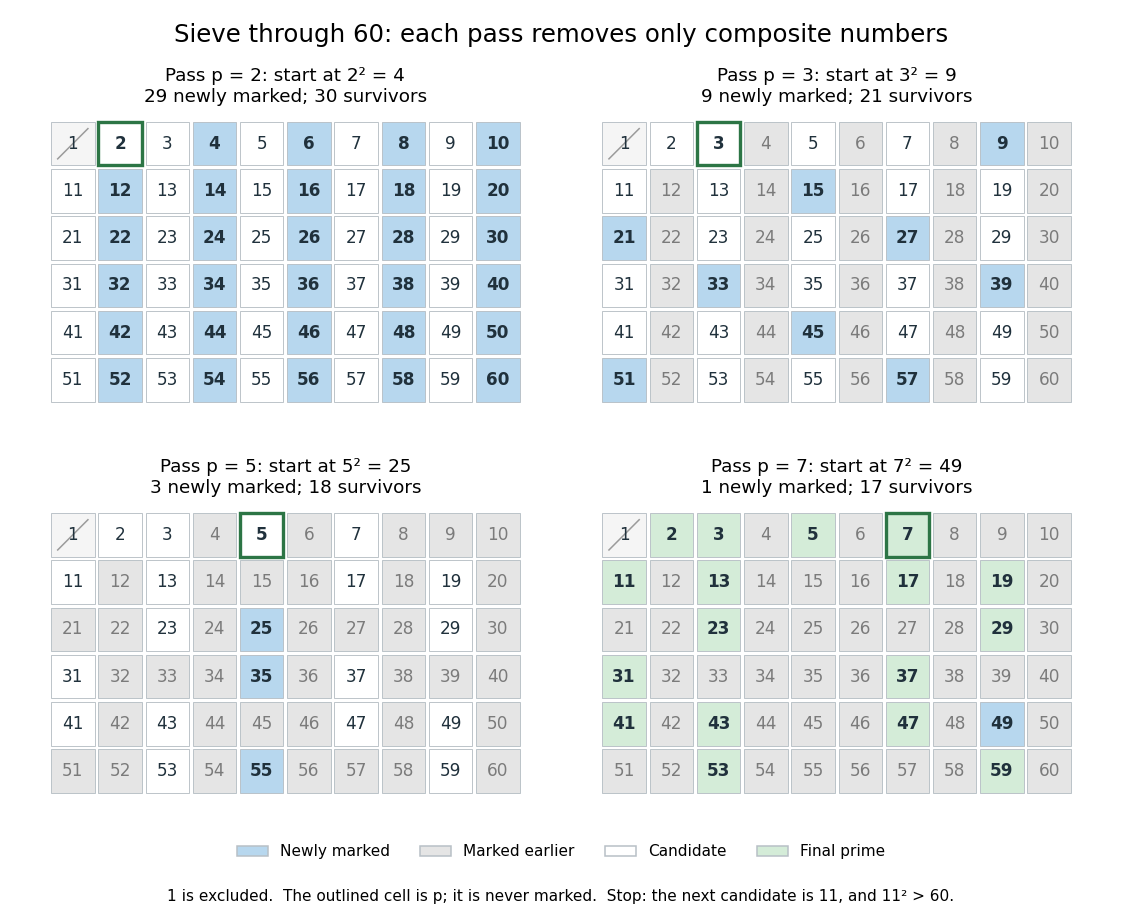
Four passes of the sieve of Eratosthenes through 60 leave seventeen prime numbers
. Blue cells are newly marked composite numbers; gray cells were removed earlier. White cells are candidates in the first three panels, and green cells are the final prime numbers. The outlined cell identifies the prime number used for that pass. One is excluded throughout. Details.The saving from starting at is justified by the smaller multiplier: if with , then has a prime factor , so has already marked . For , the earlier multiples have already been marked using or . The first new possibility is .
For , only the prime numbers need marking passes. They remove all the composite numbers, leaving 25 prime numbers. The diagram colors each composite number by its smallest prime factor, so it shows which marking pass removes it first. The excluded integer one is shown separately.
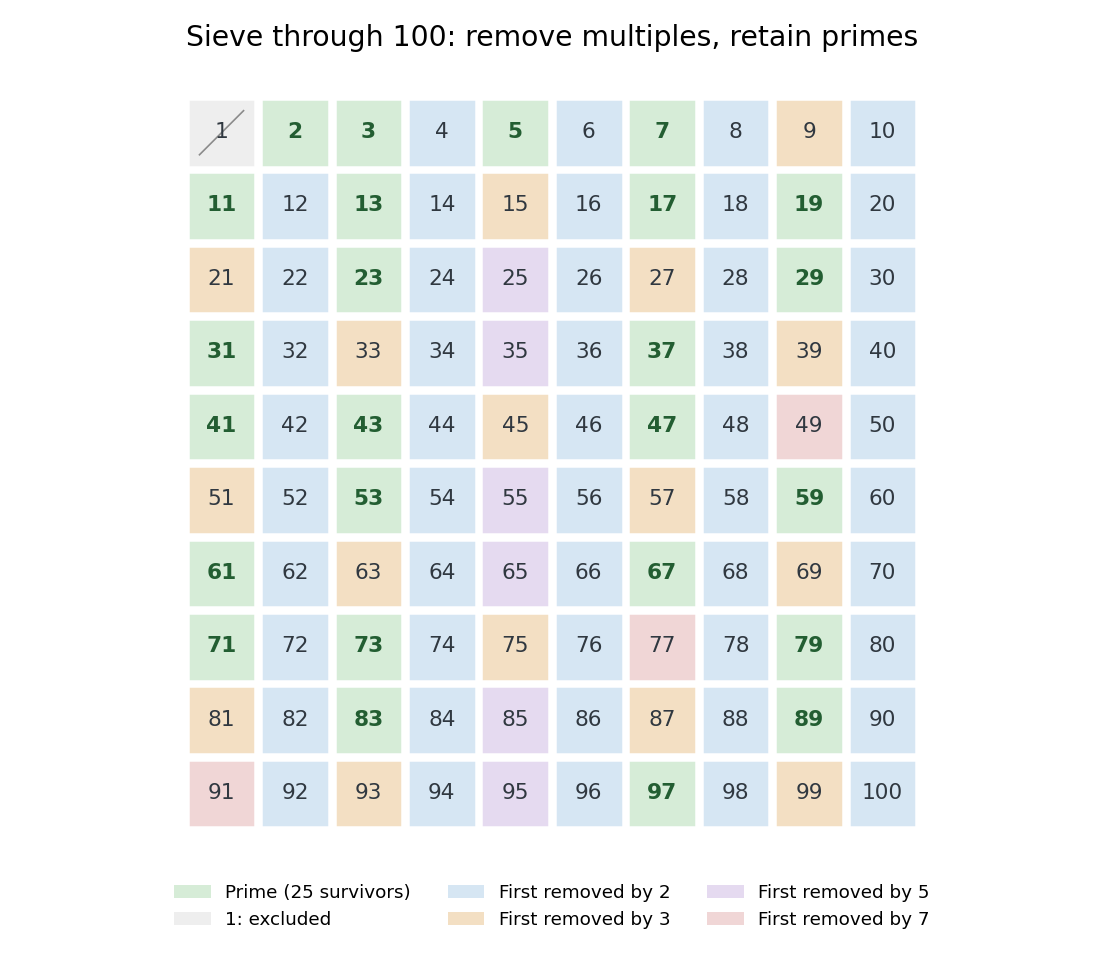
Why does the algorithm work? A surviving candidate cannot be a composite number, since its smaller prime factor would already have removed it. Conversely, marking proper multiples never removes a prime number. Every composite number at most has a prime factor at most , so no later pass is needed. The sieve of Eratosthenes is useful when an entire bounded list is wanted; primality testing of one large integer is a different computational task.
The historical name is supported by a surviving primary account: Nicomachus, in Book I, chapter 13 of Introduction to Arithmetic, names Eratosthenes and describes separating prime numbers from composite numbers by marking multiples among the odd integers beginning with three. That passage documents the sieve tradition; the bounded algorithm above and its starting rule are the formulation explained here, rather than instructions quoted from Euclid's Elements. [ref]
https://stoicheiamath.com/wp-content/uploads/2025/09/Nicomachus-Introduction-to-Arithmetic-Student-Edition.pdf#page=28. Nicomachus, Introduction to Arithmetic I.13.2–8, Martin Luther D'Ooge translation (1926), revised classroom edition by Nathanael Hahn (2025), pp. 24–25
Articles by others on the same topic



The Sieve of Eratosthenes is an ancient algorithm used to find all prime numbers up to a specified integer. It is efficient and straightforward, making it one of the most popular methods for generating a list of primes. Here's how it works: 1. **Initialization**: Start with a list of consecutive integers from 2 to a specified number \( n \) (the upper limit).