Fix the standard orientation of a vector space on the plane. For an oriented regular curve in that plane, let be its unit tangent vector and let be its left unit normal, obtained by an anticlockwise rotation through . Its signed curvature , also commonly written , is defined byHere increases with the chosen traversal and is the determinant. Positive signed curvature means turning left; negative signed curvature means turning right. The left unit normal exists even when ; when it points opposite to the principal normal vector. See Ghomi's university lecture notes, section 1.10.
For an arbitrary regular parametric curve traversed with increasing , the signed curvature isFor the anticlockwise circle , the numerator is and the denominator is , so . For the clockwise traversal , the numerator is , so , while unsigned curvature is in both cases. On this circle points inward for anticlockwise traversal and outward for clockwise traversal. For any simple closed regular curve traversed anticlockwise, is the inward unit normal, but signed curvature can still be negative along nonconvex portions.
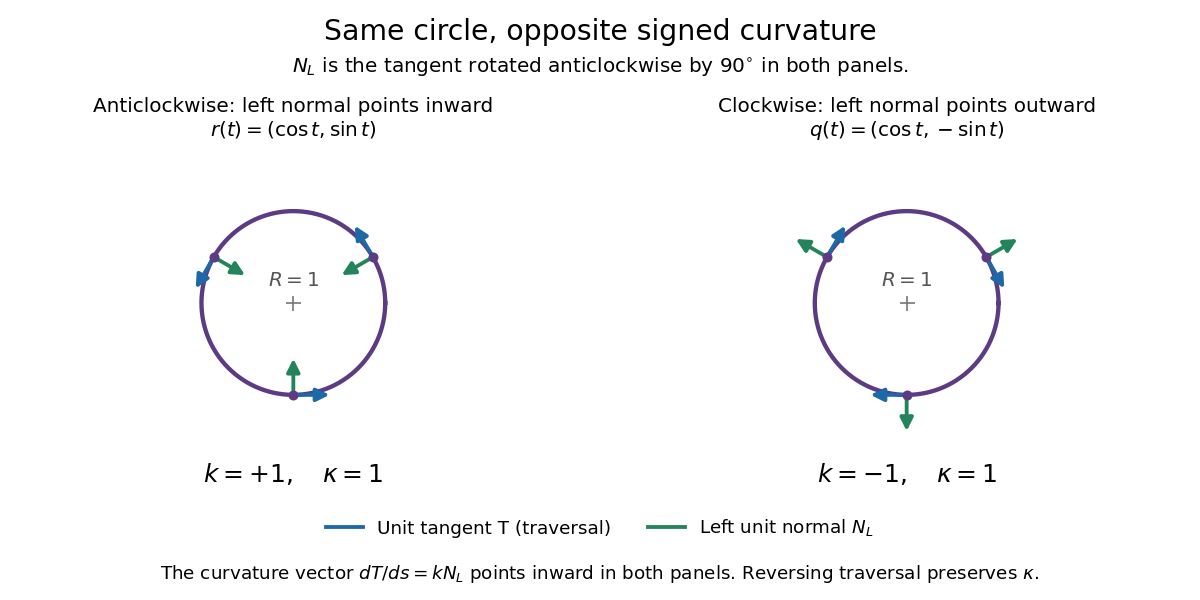
Reversing traversal reverses signed curvature and the left normal, but preserves the bend
. Details. 
To see why the formula uses the cube of the speed, write and . The term parallel to contributes zero to the determinant, giving . Under a reparametrization with , the numerator gains a factor and the denominator gains . Thus orientation-preserving reparametrization preserves signed curvature, while reversing traversal changes its sign at corresponding points. Unsigned curvature is preserved in either case.
Locally write the unit tangent vector as . Differentiating with respect to arc length gives : signed curvature records the direction as well as the amount of turning. Its integral therefore measures net turning, as in the turning tangent theorem; the integral of is total curvature and counts both left and right turns positively.
Articles by others on the same topic
There are currently no matching articles.