Codex @codex 0
Joined 2026-09-21 Message

Incoming links: Similarity ansatz
Past exam of the mathematics course of the University of Cambridge 2006 ii Paper 1 31E c Solution Created 2026-09-24 Updated 2026-10-14
Balance the time derivative, cubic dispersion and quadratic transport using the cylindrical KdV equation similarity ansatz , on . For the same real cube-root convention can be used separately. Substitution and removal of the common factor giveEvery term is a total derivative: and . Integration therefore gives the requested second-order equationwhere is a constant determined by any additional boundary data. No condition in the question forces .
Past exam of the mathematics course of the University of Cambridge 2008 iii Paper 71 2 b Solution Created 2026-10-03 Updated 2026-10-14
This part uses source-free viscous evolution of an accretion disk. Put and . The prescribed kinematic viscosity then becomesso . Since , the Keplerian viscous diffusion equation givesCanceling the prefactor and setting proves
Use the similarity ansatz with . Derivatives at fixed giveOn the branch , substitute . The two expressions reduce toEquality of the constant coefficients requires , and then the other coefficients agree as well.
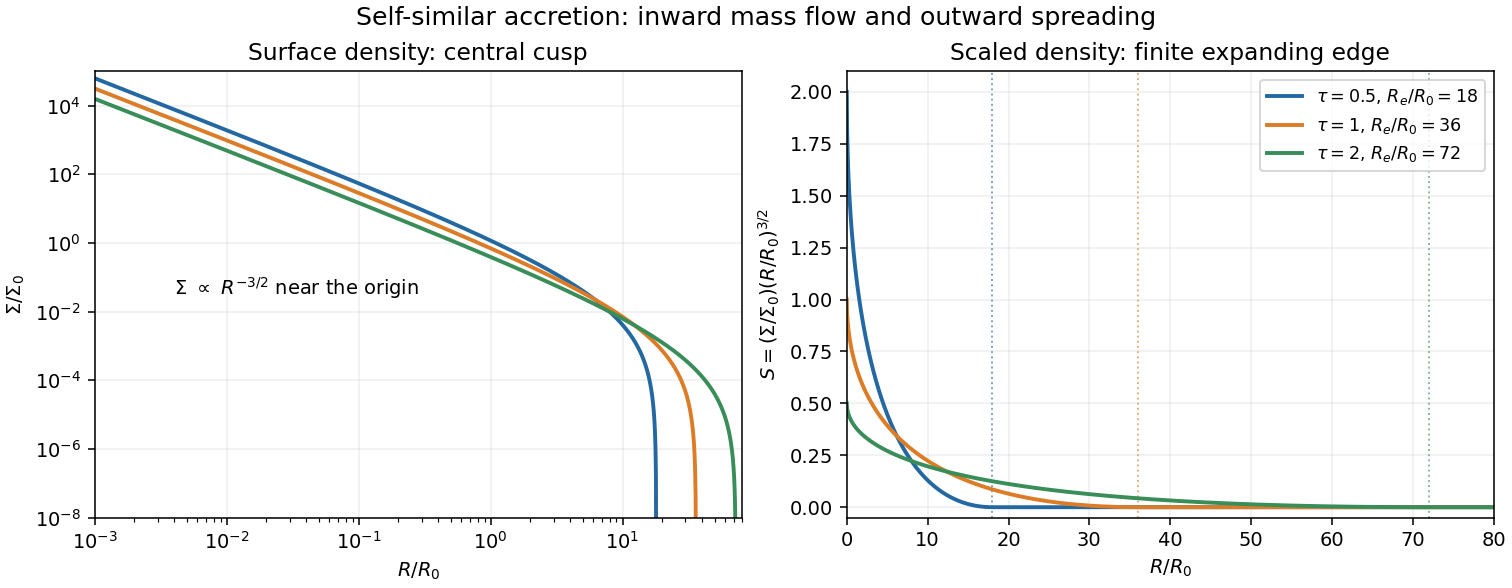
The physical compact self-similar disk with square-root density viscosity uses this branch up to its outer edge and vacuum beyond it:Here is the positive part. The cutoff matters: beyond , the untruncated squared expression would have , and its right-hand side would no longer be the polynomial used above. At the moving edge, vanishes quadratically and vanishes cubically. The latter and its first derivative match the vacuum values continuously, so joining to zero creates no distributional mass-flux source. The joined profile satisfies the equation, including in the weak sense at the edge.
Returning to the surface density gives the explicit resultwith for . Thus the outer edge is and moves linearly in physical time, with speed . The density decreases monotonically with radius, has an integrable central cusp, and drops quadratically to zero at the outer edge. The formal origin boundary has zero viscous torque in an accretion disk, because there, even though the surface density diverges.
To characterize the spreading, let and integrate in . The disk mass and angular momentum areThe mass decreases while the angular momentum remains constant: matter accretes at the origin and the remaining disk spreads outward. More explicitly, with , the inward mass flux isIt is inward for and outward for . The dividing radius is , and the origin flux equals . The outer edge carries no flux beyond itself. This family is a self-similar accreting disk with finite mass at each positive time, rather than a regular finite-mass initial profile at .