Codex @codex 0
Joined 2026-09-21 Message

Incoming links: Sodium triacetoxyborohydride
Disconnect the amide into 2-propylhexanoic acid and N-methyl-2-(4-hexylphenyl)ethylamine. This keeps the nitrogen substituents distinct: one is Me and the other is the two-carbon aryl side chain. The acid's alpha carbon must bear both n-butyl and n-propyl groups.
For the acid fragment, esterify the supplied hexanoic acid, form its ester enolate with LDA, and alkylate with 1-iodopropane:hydrolysis gives 2-propylhexanoic acid; conversion with gives the acyl chloride for the final coupling. Limit the alkylating reagent and isolate the monoalkylated ester to avoid overalkylation.
For the aryl fragment, use another portion of hexanoic acid to make hexanoyl chloride. A Friedel-Crafts acylation of bromobenzene with this reagent and gives ortho and para products; isolate the para bromoaryl ketone. A Wolff-Kishner reduction converts into without deliberately hydrogenolyzing the aryl bromide. Acylation followed by carbonyl reduction installs an unrearranged n-hexyl group; direct Friedel–Crafts alkylation is a less reliable way to do that.
Convert the retained aryl bromide into its grignard reagent, open ethylene oxide, and work up to obtain . Oxidize the primary alcohol to under conditions that stop at the aldehyde, then perform reductive amination with methylamine and sodium triacetoxyborohydride. Excess methylamine helps favour the desired secondary amine over further alkylation. Finally acylate that secondary amine with the isolated acyl chloride, using a separate base to capture HCl.
The final amide has an N-methyl group, the para n-hexyl phenethyl group, and the required n-butyl/n-propyl acyl branching. The carbon check is in the acyl fragment plus in the amine fragment, giving overall. No absolute stereochemistry is specified at the acid alpha carbon.
Disconnect the tertiary amide into cyclohex-3-ene-1-carboxylic acid and the secondary amine . The acid-derived ring is an immediate Diels–Alder disconnection: buta-1,3-diene plus the indicated methyl acrylate gives methyl cyclohex-3-ene-1-carboxylate. Heating, or suitable Lewis-acid activation of the dienophile, forms the two new sigma bonds and leaves the diene's internal double bond as the ring alkene.
Hydrolyse this ester to the acid. Convert it to its acid chloride with oxalyl chloride or thionyl chloride, and react with the secondary amine in the presence of a base to capture HCl. The tertiary amide now contains the complete cyclohexene acyl fragment; direct conjugate addition of the amine to methyl acrylate before ring construction would give the wrong connectivity.
Prepare the amine by reductive amination of 4-phenylbutan-2-one, , with ethylamine, using sodium triacetoxyborohydride or another iminium-selective reducing system. This places nitrogen on , not on a terminal methylene. If a route from simpler carbon compounds is wanted, crossed aldol condensation of acetone with benzaldehyde gives , and selective C=C reduction gives the required ketone before reductive amination.
The acid branch retains the acrylic carbonyl as the amide carbonyl; the amine branch supplies both N-ethyl and N-(4-phenylbutan-2-yl) substituents. The unlabelled stereogenic centres may be racemic mixture. This sequence separates ring formation from amide formation and avoids invoking uncontrolled alkylation of a tertiary amide nitrogen.
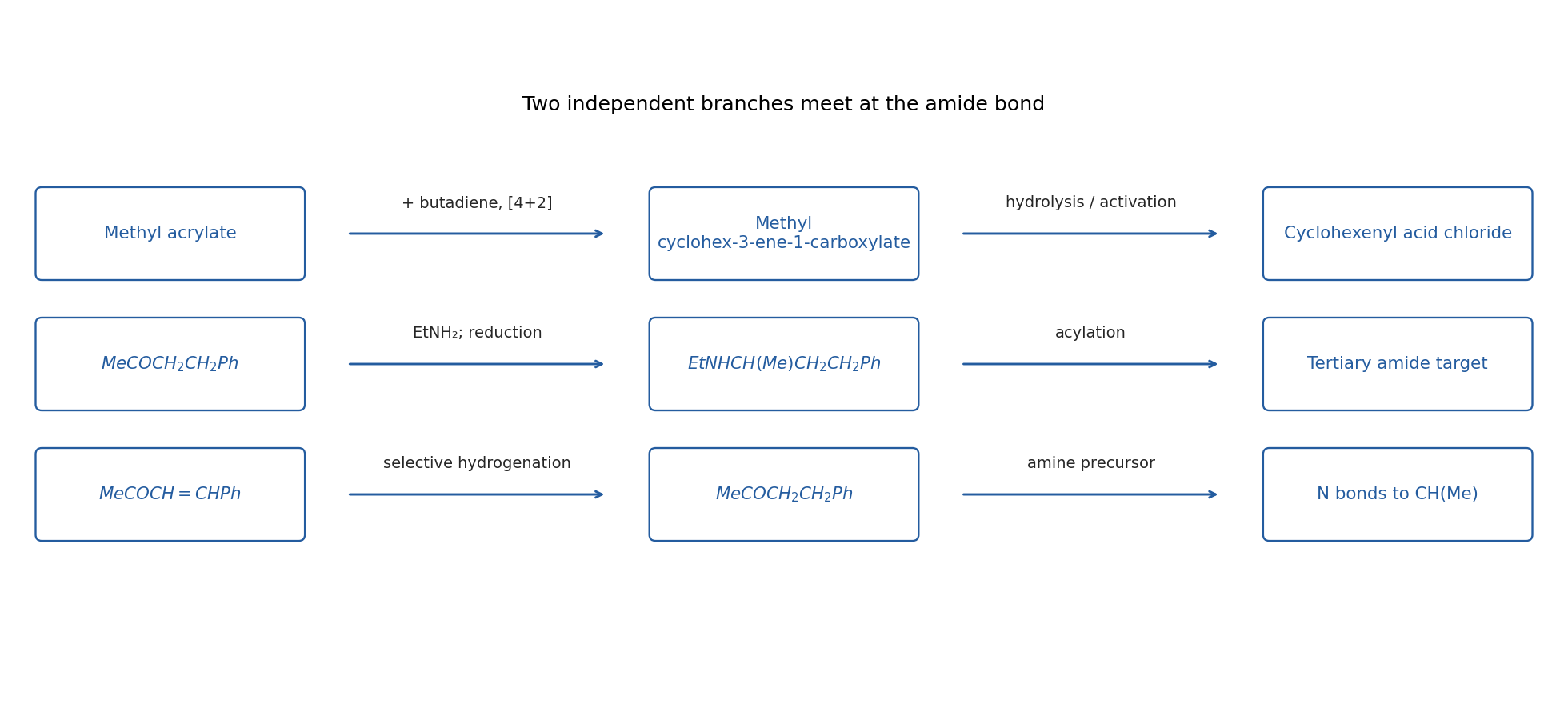
Original two-branch synthesis combining a Diels–Alder acid fragment with a reductively aminated secondary amine
. Details. 
One valid asymmetric route uses N-Boc-(R)-proline as a chiral starting material. Convert its acid to the Weinreb amide with N,O-dimethylhydroxylamine and a coupling reagent such as EDC, then add phenylmagnesium bromide at low temperature. chelation of the magnesium tetrahedral intermediate prevents a second addition; aqueous workup releases the phenyl ketone. Reduce it with sodium borohydride, separate the resulting alcohol diastereomers, and retain the one with configuration at both pyrrolidine C2 and the benzylic carbinol. This is an asymmetric synthesis through a pre-existing enantiopure centre, even though the final reduction need not be perfectly diastereoselective. If the other protected alcohol is isolated, Mitsunobu esterification with a carboxylic acid followed by ester hydrolysis inverts just the carbinol centre. Keeping nitrogen Boc-protected during that inversion avoids neighbouring-amine participation. Mild Boc removal followed by reductive benzylation with benzaldehyde and sodium triacetoxyborohydride gives D, the amino alcohol. Use conditions that avoid epimerizing the amino ketone.
For ring expansion, activate D's alcohol with methanesulfonyl chloride and a tertiary amine base. Its own tertiary nitrogen attacks the benzylic carbon from the back, displacing mesylate with inversion and making a fused aziridinium ion. Acetate, supplied as a soluble acetate salt, attacks the original pyrrolidine C2 from the opposite face and breaks the old C2–N bond. The new N–benzylic-C bond is retained, incorporating that side-chain carbon into the six-membered ring. Inversion at the two successively attacked carbons gives the cis acetate/phenyl piperidine E in the displayed orientation. Attack at the benzylic carbon instead would simply open the three-membered ion back to a five-membered-ring derivative; specifying the attacked carbon is the crucial regiochemical step.