Stereochemistry studies the spatial arrangement of chemical atoms in molecules. A Fischer projection records this information at successive stereocenters, whereas a molecular formula only counts chemical atoms. See McMurry: representing carbohydrate stereochemistry.
Preferential formation of one stereoisomer over another.
Chirality associated with the arrangement of substituents relative to a plane, as in an unsymmetrically substituted coordinated cyclopentadienyl ring. Two planar-chiral coordination ligands can give a meso arrangement and a pair of enantiomeric arrangements.
Bond-making or bond-breaking at the same face of the interacting orbital array in a pericyclic reaction. It is a local stereochemical relation, not a statement that all substituents end on one molecular face or a specification of an absolute clockwise rotation.
Selective conversion of interconverting substrate stereoisomers to an enriched product. Unlike a simple kinetic resolution, rapid substrate interconversion can in principle allow more than 50% yield of one stereoisomer.
A chiral catalyst preferentially forms one stereoisomer from an achiral or stereochemically labile substrate. Product stereochemistry depends on competing transition-state free energies, rather than a catalyst simply transferring its own R or S label.
Interconversion of the two spatial orientations of a three-coordinate pyramidal centre through a flatter geometry. Quaternary ammonium nitrogen has no lone pair and cannot follow the ordinary three-coordinate amine pathway.
A dependence of reactivity or stability on the spatial alignment of donor and acceptor orbitals. Antiperiplanar lone-pair donation into a breaking bond can accelerate a suitable cleavage.
Epimerization interconverts diastereomers differing at one stereocenter. It can change a product ratio after the initial bond-forming chemical reaction.
Two sites are enantiotopic if separately replacing one or the other by the same distinguishing group gives enantiomers. Achiral conditions do not distinguish them by chirality alone.
Two sites are diastereotopic if replacing one or the other with the same test group gives diastereomers. In an achiral solvent they can have different chemical shifts, unlike a simple pair of symmetry-related sites. A rigid chiral metal chelate can make the two hydrogens of a linker methylene diastereotopic.
Steric hindrance is the restriction of access to a reactive site or molecular arrangement by the spatial demands of surrounding groups. It can affect both relative stability and reaction barriers; these are distinct effects.
Energetic destabilization associated with unfavourably close nonbonded contacts or deformation needed to avoid those contacts.
A 1,3-Diaxial interaction is the close nonbonded contact between axial groups separated by one ring atom in a chair. Replacing a carbon-bearing axial hydrogen by an oxygen changes this contact, so cyclohexane substituent preferences cannot be transferred unchanged to dioxanes.
An equimolar mixture of two enantiomers.
An anomeric effect can favour an axial electronegative substituent at a cyclic acetal carbon. Donation from an endocyclic oxygen lone pair into an antiperiplanar exocyclic C–O antibonding orbital is one important contribution. Steric, electrostatic and solvent effects also influence the observed preference.
An oxygen adjacent to a carbonyl can coordinate the same metal as the carbonyl oxygen, constraining conformation. Nucleophilic attack on the less hindered face of the chelate can differ from an open Felkin–Anh prediction.
The Fürst-Plattner rule describes a preference for trans-diaxial opening of suitable bridged intermediates on six-membered rings. A chair-like pathway generally avoids the unfavorable geometry of a competing twist/boat pathway; substrate fusion and substitution determine which route is accessible.
The Felkin-Anh model predicts facial preference in nucleophilic addition beside a stereogenic centre under suitable open, non-chelating conditions. Orient the large alpha substituent approximately perpendicular to C=O, then favour approach opposite it and past the small substituent. It is a predictive model rather than a universal guarantee.
The Cahn-Ingold-Prelog priority rules rank substituent paths to assign stereochemical descriptors. Compare the next shell only after a tie; multiple bonds and aromatic paths require the prescribed duplicate-atom treatment. Spatial orientation and priority ranking are separate steps.
A Newman projection views a molecule along a chosen bond, showing substituents on the front atom and rear atom. It makes relative torsions visible without assuming that the two centres lie in the plane of a skeletal drawing.
Sugar puckering describes the nonplanar conformation of a sugar ring. In nucleic acids, C2′-endo and C3′-endo conformations alter backbone geometry and help distinguish B-DNA from A-DNA.
A trans configuration places the specified substituents on opposite sides of a restricted structural element. For comparable fatty-acyl chains, trans unsaturation usually permits closer packing than cis unsaturation.
A cis configuration places the specified substituents on the same side of a restricted structural element. A cis double bond in a fatty-acyl chain commonly disrupts close chain packing relative to the comparable trans arrangement.
Chirality means that a molecule cannot be superposed on its mirror image. A carbon attached to four different groups is a common source of chirality; the definition concerns the whole molecule, rather than requiring this particular structural feature.
The test is spatial: apply a translation and a rotation to the entire molecule until corresponding chemical atoms coincide, keeping their identities and chemical bonds. A mirror operation is a reflection; physically turning a model is a rotation. They are different operations. If no such superposition exists, the two forms are enantiomers; if one succeeds, the molecule is achiral. A different-looking flat drawing alone establishes neither conclusion.
For a simple molecule with exactly one tetrahedral stereocenter and four constitutionally different substituents, the mirror forms cannot superpose. Compare entire attached groups, including paths around a ring, rather than just the first chemical atom. Several tetrahedral stereocenters require a whole-molecule check: a meso compound can be achiral. Conversely, axial chirality needs no tetrahedral stereocenter.[ref]
5.2 The Reason for Handedness in Molecules: Chirality. McMurry, Organic Chemistry, §5.2: whole-molecule chirality, four different groups and equivalent ring paths
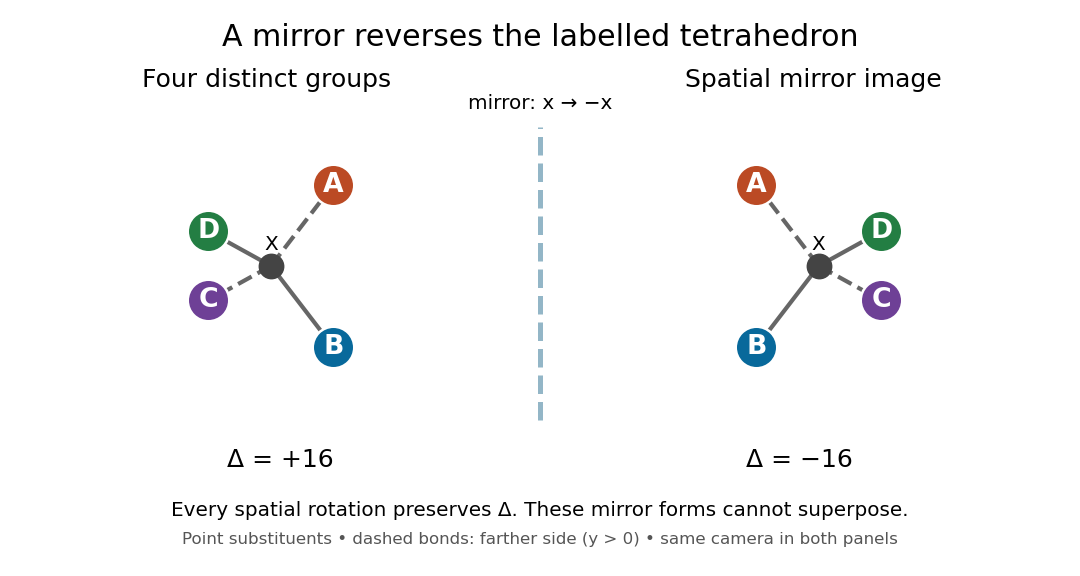
Why care about this distinction? Two enantiomers can fit differently into an already chiral molecule, just as two opposite hands fit differently into one glove. Thus a protein's spatial arrangement can distinguish a mirror pair even when an achiral measurement cannot. Polarimetry provides a different kind of test: it measures a sample's net optical rotation, which depends on the populations of its enantiomers.
Enantiomers are a pair of nonsuperposable mirror-image molecules. The D and L configurations of alanine are an example; glycine has no such pair because its amino acid alpha carbon carries two identical hydrogen chemical atoms. [ref]
Organic Chemistry by John McMurry. §26.1, discussion of glycine and Fischer projections after Table 26.1
The word names a relation between two stereoisomers. Merely finding two different spatial arrangements does not make them enantiomers: arrangements that are different but not mirror partners are diastereomers.
A racemate contains the same amount of substance of each member of an enantiomer pair. Their equal and opposite contributions cancel in ordinary solution polarimetry under identical conditions. Zero net optical rotation therefore does not establish achirality of the individual molecules.[ref]
5.8 Racemic Mixtures and the Resolution of Enantiomers. McMurry, Organic Chemistry, §5.8: equal enantiomer populations and cancelling optical rotations
Achirality means that a molecule is superposable on its mirror image. A reflection plane that leaves the complete labelled spatial structure unchanged establishes achirality. Absence of such a plane alone is not a complete test: other orientation-reversing spatial symmetries can also make a rigid structure achiral.
Take a central chemical atom at the origin and four substituents at the vertices of an ideal regular tetrahedron:These dimensionless coordinates describe shape, not measured bond lengths. For distinct labels A, B, C and D, define a signed determinantIt is six times the oriented volume of the labelled tetrahedron. A translation cancels from the differences. A rotation has and preserves , whereas the mirror matrix has and changes it to . Consequently no rotation can place every distinct label on its mirror partner. This argument uses three-dimensional coordinates, not clockwise order on a page.
Now let C and D both be the same substituent H. Swapping these identical groups is allowed. For this model the half-turnabout the axis maps the reflected A and B to their original positions and exchanges the two H positions. The models superpose. With distinct C and D, the same half-turn fails precisely at those two labels; the determinant argument rules out every other rotation as well. This is the local reason two identical hydrogen chemical atoms prevent glycine's amino acid alpha carbon from being a tetrahedral stereocenter.
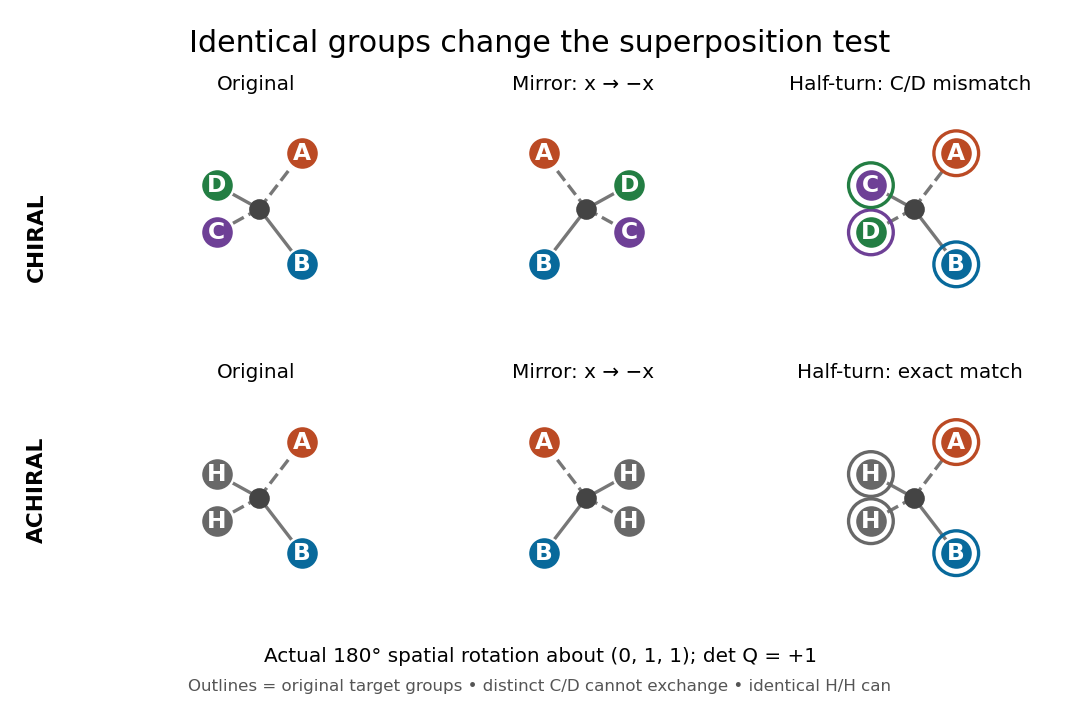
The same spatial half-turn succeeds only when the exchanged groups are identical
. Original model, mirror model and rotated mirror model. Top: the distinct C and D remain mismatched, so the A/B/C/D model is chiral. Bottom: the identical H groups may exchange, so the A/B/H/H model is achiral. The operation is an actual three-dimensional rotation about , with determinant . Details.For a flexible molecule, also distinguish conformational isomerism from a persistent enantiomer pair. A particular frozen shape may be chiral while ordinary internal motions interconvert mirror shapes. Turning the entire model is always allowed in a spatial comparison; an internal motion must be considered with its actual accessibility and timescale.
A meso compound is an achiral molecule despite having stereocenters. Tartaric acid, , has two tetrahedral carbon stereocenters. Its and forms are enantiomers, but and name the same meso form after equivalent ends are identified. A symmetric spatial arrangement has a mirror plane exchanging its two halves. Thus there are three stereoisomers, not four.[ref]
5.7 Meso Compounds. McMurry, Organic Chemistry, §5.7, Figure 5.12: meso-tartaric acid and its symmetry plane
Opposite R and S configurations alone do not guarantee a meso compound: the rest of the molecule must permit mirror superposition. Likewise, a meso compound is one achiral chemical compound, whereas a racemate is a mixture of two chiral molecule populations. Both can give zero optical rotation for different reasons.
An allene has a unit whose terminal substituents lie in perpendicular planes. In , with and , the two terminal pairs can define enantiomers without any tetrahedral carbon stereocenter. The groups need be different within each end pair, not all four mutually different. This is axial chirality.[ref]
Axial Chirality. Basic Terminology of Stereochemistry, entry Axial Chirality: nonplanar pairs about an axis, including allenes
chirality produced by distinguishable terminal substituents arranged about the constrained axis of a spiro framework.
Axial stereoisomerism in suitably substituted alkylidenecyclohexanes, where the constrained ring and alkene distinguish two handed arrangements.
Stereoisomerism arising from restricted rotation about a bond. A hindered biaryl can make otherwise similar methylene hydrogens diastereotopic on the NMR timescale.
Optical activity is the ability to rotate the direction of linear polarization of transmitted light. In an achiral solvent, the two members of an enantiomer pair have equal and opposite optical rotations at the same wavelength, temperature and concentration. The measured angle concerns a bulk sample; it is not a geometric rotation of the molecules.[ref]
The rotating object in this description is the direction along which the electric field oscillates. At each position the transmitted light can still have linear polarization: its electric field moves back and forth along a line, while the orientation of that line changes along the sample. Nothing requires the molecules to turn bodily through the observed angle. This makes polarimetry a bridge from molecular chirality to a visible bulk measurement, and, with a suitable calibration, a way to follow concentration or the balance of enantiomers.
In a transparent, isotropic chemical solution, natural optical rotation can be understood as circular birefringence: the two opposite circular polarizations accumulate different wave phases, and their equal-amplitude sum remains linearly polarized along a rotated direction. Circular dichroism instead means unequal absorption of those components and can produce elliptical polarization. These are related responses, not interchangeable measurements. General birefringence need not produce this simple rotation of linear polarization.[ref]
Optical Activity and Molecular Dissymmetry in Coordination Chemistry by Stephen F. Mason. Optical Activity and Molecular Dissymmetry in Coordination Chemistry, introduction, printed pp. 335–336: refractive-index difference and absorption counterpart
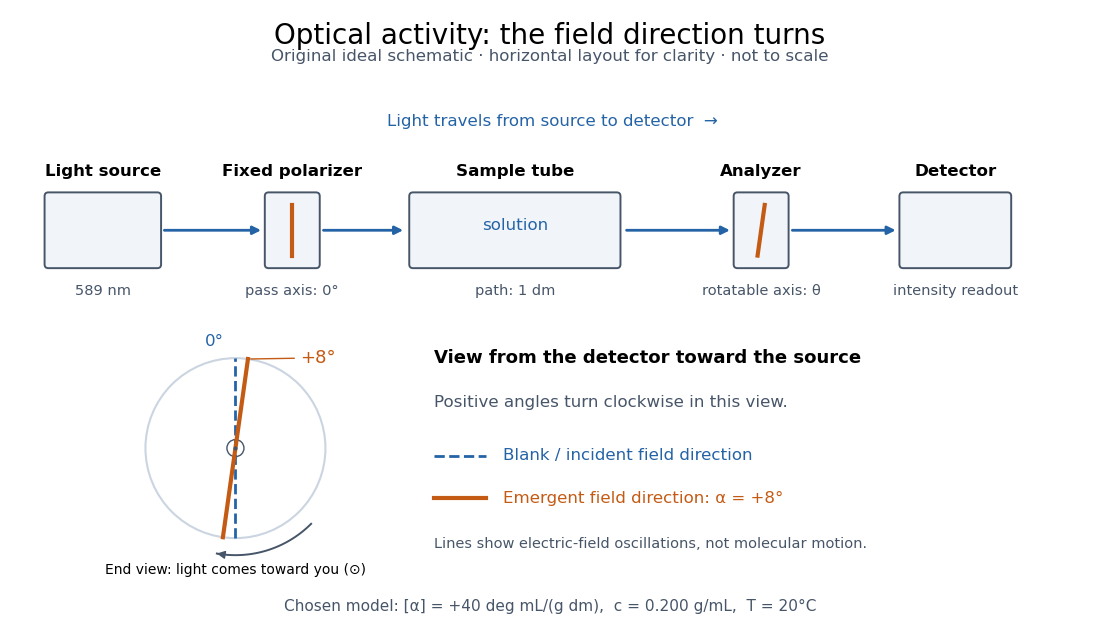
Optical rotation is the signed angle measured in polarimetry. Positive rotation is clockwise for an observer facing the incoming light; negative rotation is counterclockwise. State the viewing convention, wavelength, temperature, solvent, concentration and path length when comparing measurements. R and S configuration specifies spatial arrangement, and does not predict the sign of optical rotation.[ref]
5.5 Sequence Rules for Specifying Configuration. McMurry, Organic Chemistry, §5.5, discussion after Figure 5.10: no simple relation between R/S and rotation sign
Here the observer stands beyond the sample, on the detector side, looking back toward the source. Measure both the polarimeter analyzer angle and the optical rotation clockwise from the blank's polarization direction. Looking from the source end reverses the apparent sense. A line has no distinguished arrowhead, so an intensity scan alone determines its orientation only modulo ; continuity or additional information must choose the appropriate rotation branch.
For a chemical solution in a validated linear regime,where is path length in and is solute mass per final solution volume in . These conventions give specific rotation units . Specify solvent, temperature and wavelength : specific rotation is conditional on the sample environment.[ref]
5.3 Optical Activity. McMurry, Organic Chemistry, §5.3: observed rotation divided by path length and mass concentration
For an original model, stipulate an unnamed enantiomer pair in the same achiral solvent at and wavelength . Assign the positive member specific rotation , assumed constant over the modeled concentrations. With and ,These are chosen model parameters, not measured properties of a named material. Doubling only or only doubles within this stipulated linear model; doubling both multiplies it by four. A real chemical solution must be checked for concentration dependence rather than assuming that is dilute enough.
For an additive mixture containing only this enantiomer pair as solutes, put and write for their mass concentrations. ThenBecause enantiomers have the same molar mass, their relative mole fractions within the pair also equal their relative mass fractions: , . Thus , which connects optical rotation to enantiomeric excess.
The enantiomeric excess of an enantiomer pair is the magnitude of the difference between their relative mole fractions, , often reported as a percentage. Here counts the pair only, excluding solvent; the signs label optical rotation under the specified conditions, not R and S configuration.
In the model above, and give . Keep the same total pair concentration , path length, solvent, temperature and wavelength. The two contributions areThe pure-member reference therefore gives . This ratio measures signed population imbalance only for a pure pair with additive linear responses under matching conditions. Adding unrelated solutes, changing total concentration, or changing chemical equilibrium can invalidate that inference. For , the racemate gives zero net optical rotation by cancellation; each molecule remains chiral. A zero reading alone proves neither a racemate nor molecular achirality.
Polarimetry measures optical rotation with a polarimeter. The vertical Vernier Go Direct instrument uses a light-emitting diode source, fixed polarizer, sample cell, motor-driven polarimeter analyzer, photodetector and optical rotary encoder. Calibrate using the same solvent at fill height; rinse with sample, fill to , and read the meniscus to . The readout plots illumination against analyzer angle; a maximum near zero or a cosine-squared fit locates .[ref]
Go Direct Polarimeter User Manual by Vernier. Using the Product steps 2–4; Specifications; How the Sensor Works
An actual teaching experiment in the Truman State University-hosted Optical Activity Laboratory handout, revised July 2013, uses sucrose chemical solutions. Weigh the sucrose, dissolve completely without heating, and measure final solution volume for concentration. Use one polarimeter throughout; measure the water blank's extinction reading, then each sample's extinction reading and actual liquid path length near . Subtract the blank and plot corrected optical rotation against concentration. The attached apparatus description specifies a vertical light path, an incandescent or tungsten source with yellow filter, sheet polarizers and a rotating eyepiece polarimeter analyzer. Its coarse demonstration permits temperature control to the nearest , path length to the nearest millimeter and approximately angular precision. These are design tolerances, not measured results.[ref]
Optical Activity Laboratory, Truman State University. Optical Activity Laboratory, revised July 2013, pp. 1–2 Experiment 1; p. 3 The Design and General Use of Simple Polarimeters
For a quantitative comparison, equilibrate blank, reference and sample at the same recorded temperature; use a thermostatted cell when needed. This is a recommended control, not a claim that the teaching instruments provide a thermostat. A yellow filter also passes a band of wavelengths, so its result need not match a narrow-source reference exactly. The laboratory's concentration series tests the linear model rather than establishing it in advance; a second series varying only path length tests the other factor.
For our original ideal model, Malus's law giveswhere is light intensity immediately before the ideal polarimeter analyzer, after sample transmission. It is not the intensity of the original unpolarized source. The angle difference is evaluated in consistent units; the plotted degree values are converted to radians before computing the cosine. Assume transmitted light retains linear polarization, with negligible scattering and no polarization-dependent absorption. The pure positive model, mixture and racemate shift the maxima to , and , respectively. Minima shift by the same amount, to , and . Thus an extinction measurement and a maximum measurement recover the same shift after their respective blanks are subtracted.
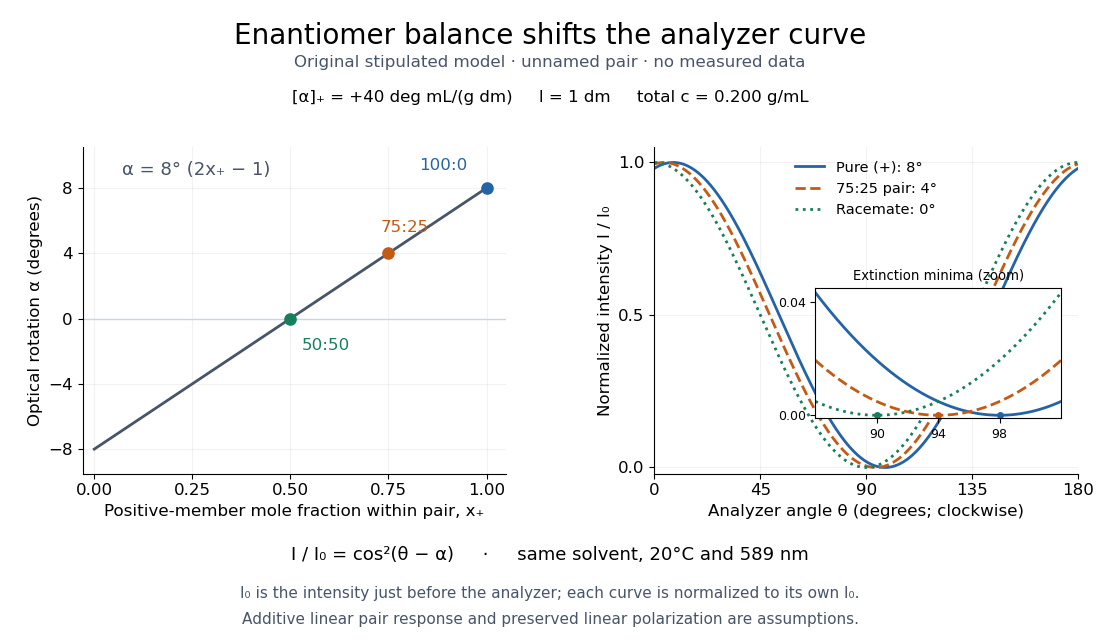
Repeat blanks and use a reference to check drift and scale. Bubbles, particles, stressed windows and sample absorption can spoil the ideal curve. Vernier specifies accuracy; the manual's fit reproducibility does not establish that accuracy. It warns against interpreting its illumination readout quantitatively and requires a transparent homogeneous sample.[ref]
Go Direct Polarimeter User Manual by Vernier. Using the Product, cosine-squared fit; Specifications; Troubleshooting, illumination and sample limits
Neither a zero reading nor a matching specific rotation uniquely identifies a molecule.A polarimeter uses polarizers to compare the direction of linear polarization before and after light passes through a sample; polarimetry explains the apparatus, readout and controls.
An angular polarimeter associated with Jean-Baptiste Biot, measuring the rotation produced by a sugar solution of known optical path length. The original form used a black-glass polarizing mirror and a calcite analyser; it should not be conflated with a later quartz-wedge compensating instrument.[ref]
A Handbook of Sugar Analysis by Charles Albert Browne Jr.. pp.84–85, Biot polariscope; chapter VI, compensating saccharimeters
A polarimeter analyzer is the rotatable final polarizer. Comparing its transmission maximum or extinction minimum with the corresponding blank reading measures the sample's optical rotation.
Circular dichroism is unequal absorption of opposite circular polarizations. It can produce elliptical polarization; it is the absorptive response related to optical rotation, rather than the same measured quantity.
Stereoisomers have the same chemical bond connectivity but different spatial arrangements. A mirror pair of distinct stereoisomers comprises enantiomers; diastereomers have no mirror-pair relation.
Different spatial arrangements of a fixed ligand connectivity, including cis and trans arrangements in square-planar or octahedral complexes.
For ideal with equivalent ends of each chelate, the monodentate donors can be trans or cis. The cis form has two mirror-related configurations; the trans form is achiral when the chelate backbones introduce no additional stereochemistry.
A stereoisomer distinguished by the spatial arrangement of connected groups, such as cis versus trans ligands.
Geometric isomers share connectivity but differ in spatial relationships such as cis/trans or facial/meridional coordination. A reflected chiral facial complex instead gives an enantiomer.
In an octahedral meridional isomer, three selected like donors lie in a plane through the metal and include one trans pair. For three unsymmetrical bidentate ligands, this changes both steric contacts and the identity of opposite donor pairs.
In an octahedral facial isomer, three selected like donors occupy one triangular face and are pairwise cis. Unsymmetrical bidentate ligands can give facial and meridional isomers, each with distinct optical configurations.
Diastereomers are different stereoisomers that are not enantiomers. The meso compound form of tartaric acid is a diastereomer of either member of its enantiomer pair.
The anomeric carbon is the former carbonyl group carbon that becomes a stereocenter on ring closure: C1 of glucose. It is an existing chemical atom, not an added one.
Absolute configuration records a spatial arrangement without leaving its handedness relative to its mirror unspecified. R and S configuration is one naming convention; optical rotation is a measured response.
For a tetrahedral stereocenter, rank its four substituents using stereochemical sequence rules. With lowest-priority group pointing away, a clockwise sequence is and a counterclockwise sequence is . Looking from the other side reverses the apparent sequence, so the viewing condition is essential. The geometric letters A/B/C/D in the tetrahedral mirror-image test carry no assigned priority. Neither nor determines positive or negative optical rotation.[ref]
5.5 Sequence Rules for Specifying Configuration. McMurry, Organic Chemistry, §5.5, Figure 5.8 and discussion after Figure 5.10
Stereochemical sequence rules rank substituents for R and S configuration. Compare the directly attached chemical atoms by atomic number first, then resolve ties by comparing successive shells at the first difference. Isotopes and multiple chemical bonds require additional rules. This ranking convention does not involve optical rotation.[ref]
Conformational isomerism concerns spatial arrangements interconverted by internal motion, such as turning about a single chemical bond. Moving the entire molecule or applying a rotation changes its position or viewing direction, not its internal arrangement.
A conformational form distinguished by rotation about a specified bond. Interconversion can be slow when resonance gives that bond partial multiple-bond character.
Antiperiplanar geometry places two specified bonds at a torsion near . It often enables favorable orbital alignment in E2 elimination and supports large vicinal proton couplings in an appropriate calibrated Karplus relation.
A gauche interaction concerns groups separated by an approximately torsion about a bond. Its energetic effect depends on the groups and electronic environment; not every gauche geometry is unfavorable.
Ring inversion interconverts ring conformations while preserving covalent connectivity and configurational stereochemistry. In a cyclohexane chair flip, axial and equatorial labels exchange, while the up/down face of a given substituent is retained.
A substituent is an attached chemical atom or group considered relative to a chosen molecular framework. Testing whether two substituents are identical may require comparing their full chemical bond connectivity and stereochemistry.
A substituent that increases electron density in a specified molecular region through induction or chemical resonance. Donation into an arene can affect an attached metal and its other coordination ligands.
A substituent that reduces electron density in a specified molecular region by induction or chemical resonance. The sign and size of its effect depend on connectivity and the measured property.
At a stereocenter, exchanging two attached groups produces a different spatial configuration. The open-chain ribose and glucose examples have carbon stereocenters bearing four different groups; C2 of deoxyribose has two identical hydrogen substituents and is not a stereocenter. See Moss, Basic Terminology of Stereochemistry, IUPAC Recommendations 1996: stereogenic units.
A phosphorus centre with an appropriate set of four distinguishable substituent directions can be stereogenic. A phosphate triester with three different alkoxy groups illustrates phosphorus chirality.
A nitrogen bonded to four distinct substituents is stereogenic. It cannot undergo ordinary three-coordinate amine inversion without a bond-breaking process.
In a Fischer projection, each cross represents a carbon position: horizontal chemical bonds point toward the viewer and vertical chemical bonds point away. For the open-chain aldehyde sugars illustrated here, place at the top and at the bottom. This is a convention for stereochemistry, not a measured molecular shape. See Moss, IUPAC Recommendations 1996: Fischer projection.
In these Fischer projections, D specifies that the hydroxy group at the lowest stereocenter lies on the right: C4 for ribose and deoxyribose, C5 for glucose. D does not specify every other stereocenter, and it does not specify the direction of rotation of polarized light. See McMurry: the meaning of D and L.
A Haworth projection depicts cyclic monosaccharide connectivity and substituents above or below a reference ring plane; it does not assert a physically flat ring.
Articles by others on the same topic

Stereochemistry is a branch of chemistry that focuses on the spatial arrangement of atoms within molecules and how this arrangement affects their physical and chemical properties. It primarily deals with isomerism, which is the phenomenon where compounds can have the same molecular formula but different structures or arrangements of atoms. There are several key concepts in stereochemistry: 1. **Isomers**: Molecules with the same molecular formula but different structural arrangements.



