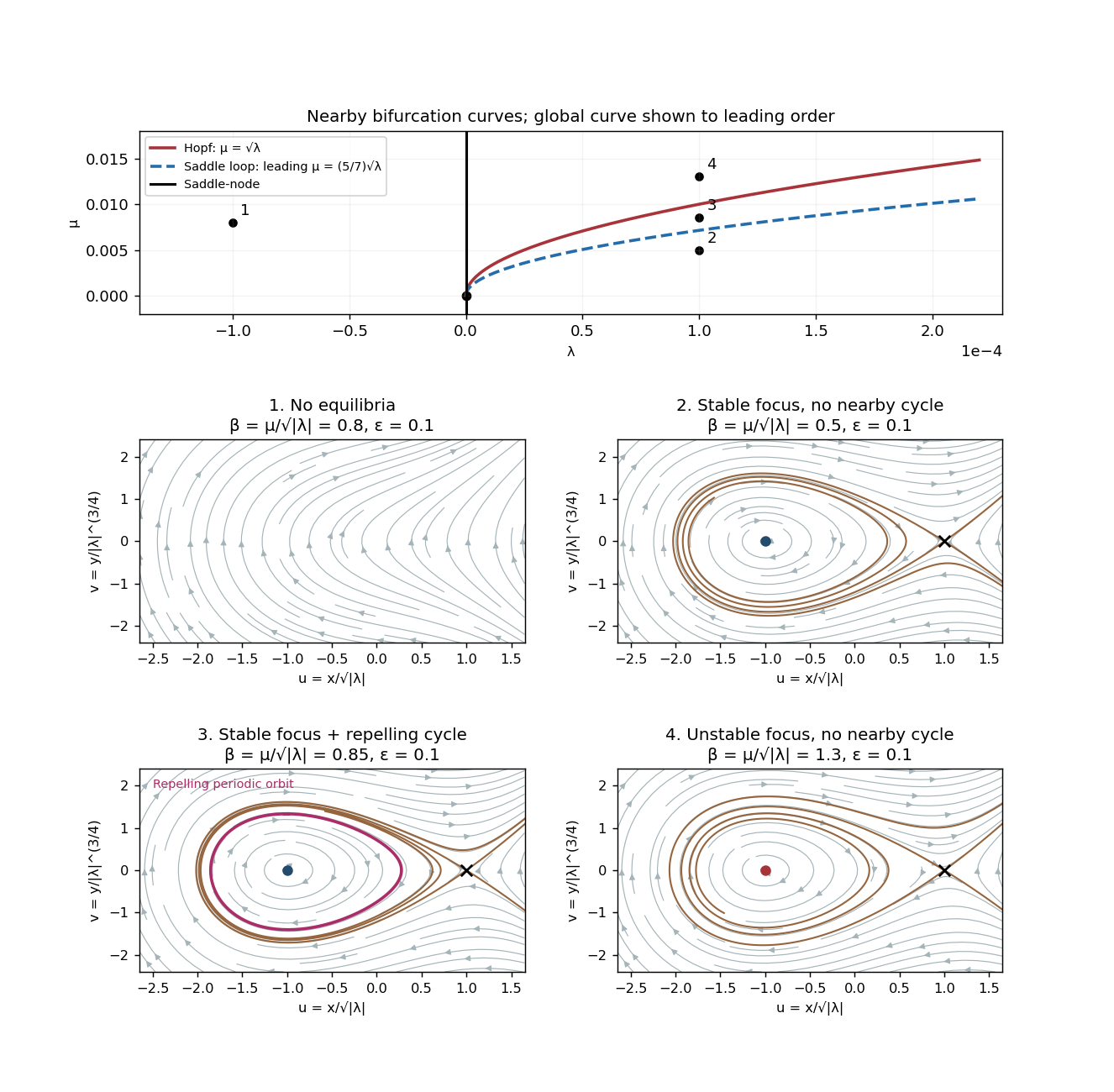
Along a perturbed saddle loop the incoming and outgoing endpoints have the same Hamiltonian value. Integrating H′=ε(β+u)v2 and evaluating the leading integral on the conservative homoclinic orbit gives
This is an asymptotic curve near the double-zero point, not an exact finite-parameter identity. More precisely, time reversal (τ,v,ε)↦(−τ,−v,−ε) preserves the loop condition. The smooth curve selected by its simple splitting zero is even in ε, giving β=5α/7+O(ε2) and hence μ=5λ/7+O(λ) for fixed scaled α>0.
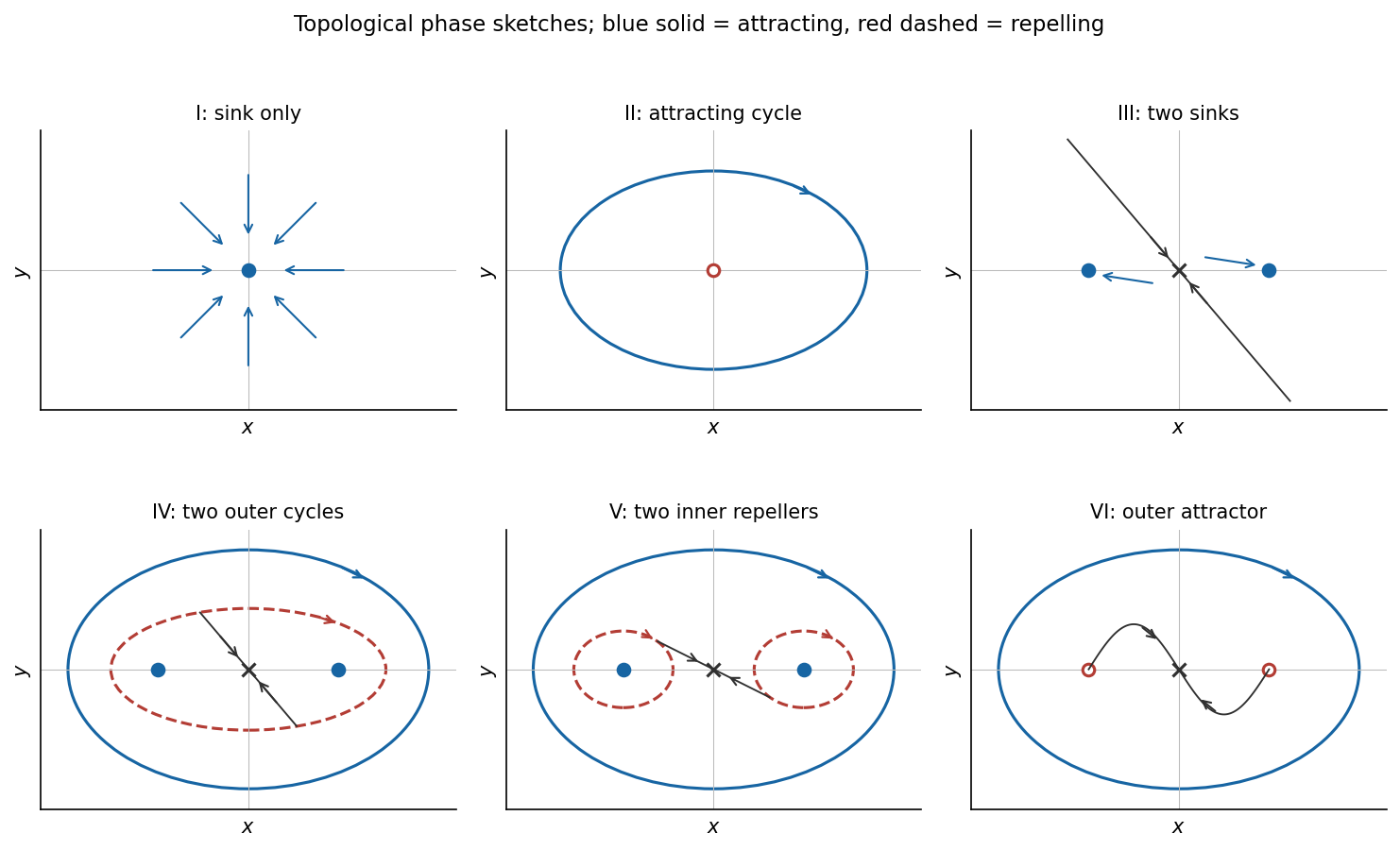
Between the saddle-loop curve and μ=λ, a stable focus is surrounded by the repelling periodic orbit created at the subcritical Hopf bifurcation. As μ decreases, this orbit grows until it reaches the saddle. Below the saddle-loop curve there is a stable focus and a saddle, but no nearby cycle. Above the Hopf curve there is an unstable focus and a saddle, with no nearby cycle. At the global curve the saddle separatrices form the repelling loop. Under the stipulated absence of further bifurcations, these are the distinct nearby regions in the earlier sketch; no extra remote phase structure is being inferred from the leading-order calculation.
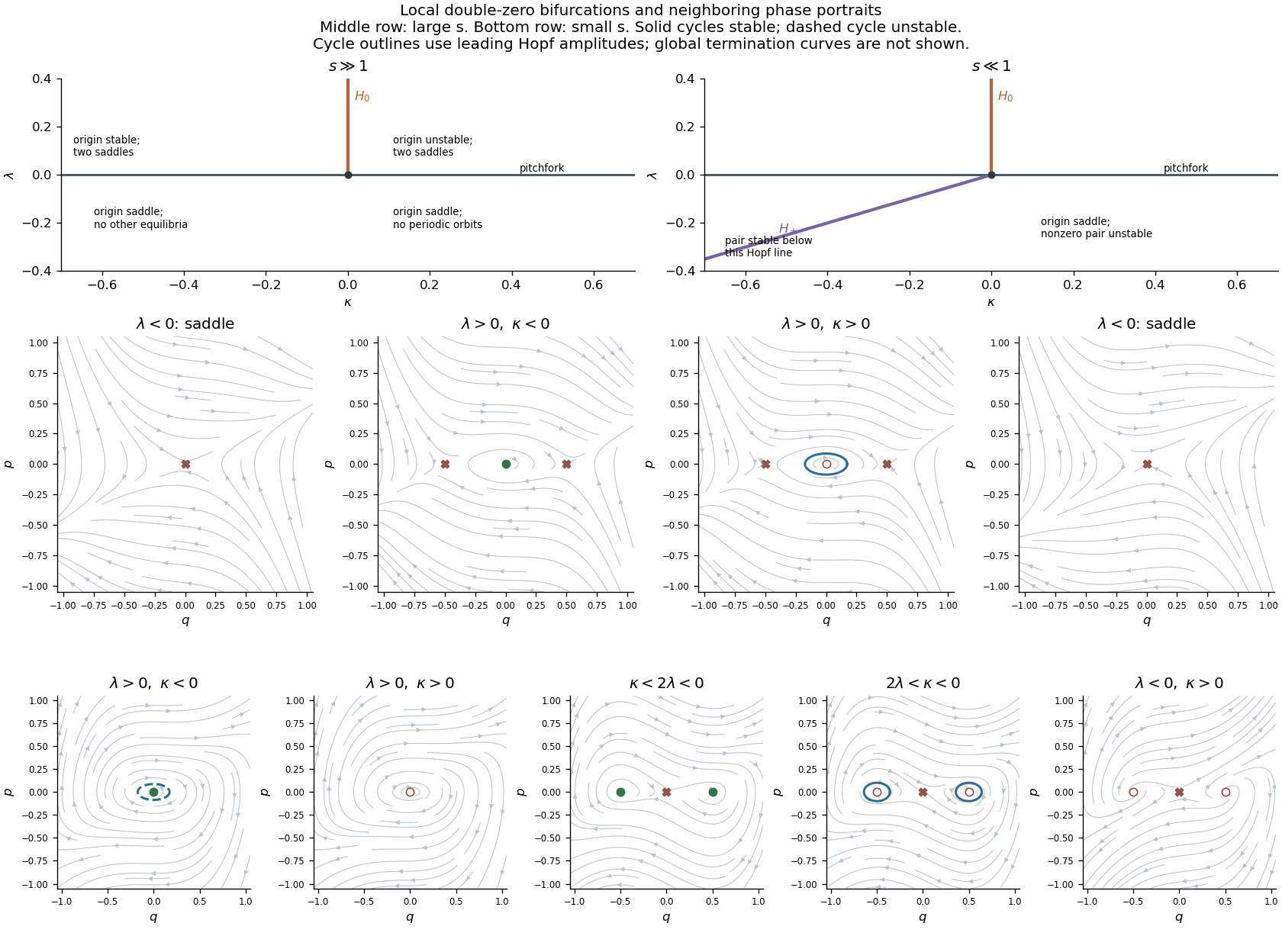
It is invariant under (q,p)↦(−q,−p). Thus the large-s case has σ=1 and the small-s case σ=−1. At the origin the Jacobian matrix has determinant λ and trace κ: it is a saddle for λ<0, stable for λ>0,κ<0, and unstable for λ>0,κ>0. In the latter two cases the discriminant κ2−4λ distinguishes nodes from foci; its zero is not an equilibrium-creation bifurcation.
The nonzero equilibria satisfy p=0, q2=λ/σ. At either of them the determinant is −2λ and the trace is κ−2λ. Therefore for s≫1, apair of saddles exists when λ>0, while for s≪1, apair of attracting equilibria exists when λ<0,κ<2λ, and a repelling pair when λ<0,κ>2λ. The repelling or attracting points may be nodes or foci. Their origin collision occurs on the pitchfork bifurcation line λ=0, away from κ=0. For fixed κ=0, the scalar centre equation there begins
For κ<0, the large-s case is a subcritical pitchfork and the small-s case a supercritical pitchfork. For κ>0, the scalar criticality reverses, but there is already an unstable transverse eigenvalue, so the full-plane branches have the stability just listed.
These are respectively a supercritical Hopf bifurcation and a subcritical Hopf bifurcation, with λ>0 fixed and the cycle sufficiently small. The portraits change from a stable focus to an unstable focus surrounded by a stable cycle in the first case; in the second, a stable focus is surrounded by an unstable cycle before the focus becomes unstable and that cycle disappears.
For an oscillator x¨=−ωH2x+A2x2+B2xx˙+C3x3+D3x2x˙, the cubic radial coefficient is D3/8+A2B2/(8ωH2). Here it is 2/8+(−3a)(4a)/(8⋅2a2)=−1/2. Thus both nonzero Hopf bifurcations are supercritical: for small δ>0, each newly unstable well equilibrium is surrounded by a stable small cycle with r2∼δ.
For σ=1,κ≤0, the divergence has one strictsign except on a line, and the Bendixson-Dulac criterion excludes every nonconstant periodic orbit. For σ=−1,κ≥0, the same reasoning excludes every periodic orbit. When the divergence changes sign, this criterion makes no such exclusion; the Hopf cycles above are consistent with that restriction. In the large-s case a periodic orbit also requires λ>0: if λ≤0, a positive maximum of q would have q¨=−λq+q3>0, or a negative minimum would have negative acceleration, both impossible. For λ>0 the same extremum argument confines a cycle to ∣q∣<λ, between the two saddle locations. The local bifurcation lines and representative portraits on both sides are summarized below; their global completion requires part (c).