Fix a real angle fraction , and repeatedly multiply by in the circle group. The generated cyclic subgroup is . Equivalently, the angle fractions are the fractional parts of , with one full turn identified with zero.
If is a rational number in lowest terms, with and coprime, then and no smaller positive power is . Hence is a finite cyclic group of order , consisting of equally spaced points. For , the successive angle fractions, starting at , areThe subgroup is finite, so it is a closed subgroup of the circle group; it is also a discrete subgroup. It is not an open subgroup, since every ambient neighbourhood of any of its points contains an arc, rather than only these seven points.
If is an irrational number, no nonzero integer satisfies , so the powers never repeat. The stronger statement is that is a dense set in the circle group: every nonempty open arc contains a power . Thus its closure is all of , while itself is a countable proper subgroup and is not a closed subgroup or a discrete subgroup. See irrational rotation and everywhere interval frequency under an irrational rotation for the corresponding motion and its long-term frequencies.
For , direct computation of the fractional parts of gives, to six decimal places,For example, and . These calculations specify exactly which points the diagram displays.
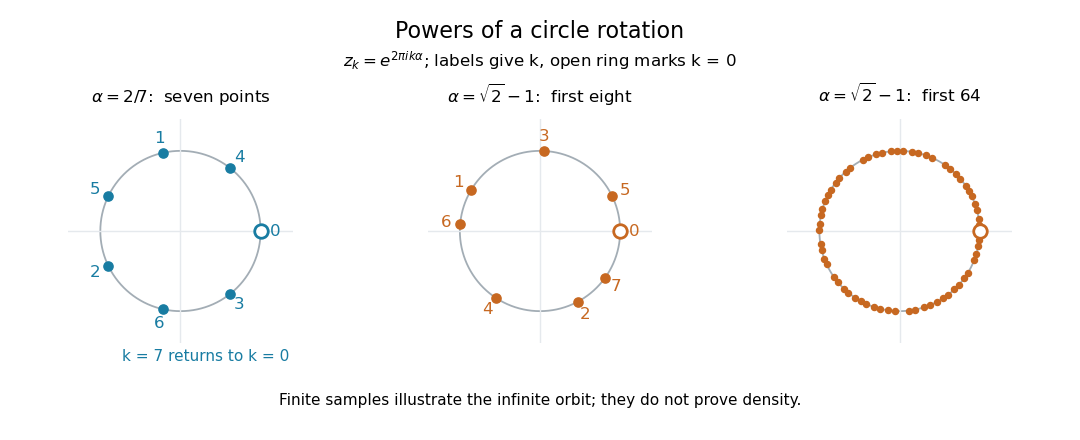
Seven repeating rational-rotation points and the first eight and sixty-four irrational-rotation points
. Labels give the power index ; the points are . The first panel uses , and the other two use . Each finite sample is only an illustration: a finite plot cannot establish that the infinite subgroup is a dense set. Reproduce the diagram with rational-versus-irrational-rotations.py. Details.
This example shows why algebraic generation and closure must be distinguished: one irrational rotation generates a countable cyclic subgroup, yet its closure is the whole uncountable compact group.
Articles by others on the same topic
There are currently no matching articles.