A finite cyclic group of order is isomorphic to the additive group . The group isomorphism sends the congruence class of to , where is a chosen generator of a group. For , the identity element is , modulo six, and the inverse element of is .
One finite cyclic group can have several choices of generator of a group. Adding visits all six elements before returning to zero; adding also visits all six, in the reverse order. Adding reaches only from zero, and adding reaches only . The following permutations of the six elements show what each repeated step can reach.
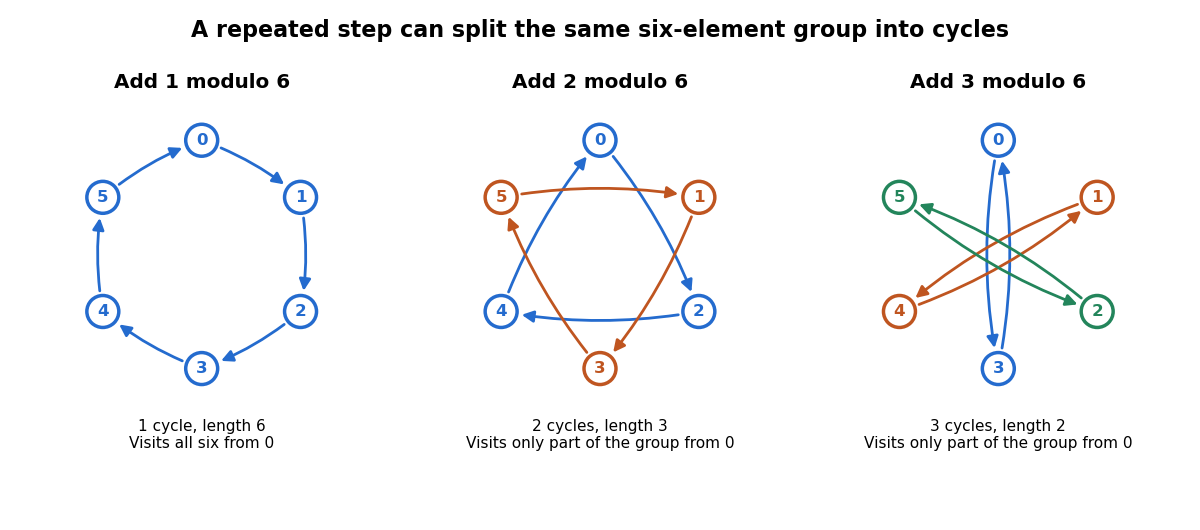

This gives a precise version of a familiar scheduling question: does a fixed step visit every position, or repeatedly miss some? The generators of a finite cyclic group are exactly the steps coprime to the total number of positions. Changing the step changes the orbit through the same underlying group; the diagram does not replace its group operation with a different one.
For a positive integer and a congruence class in the additive finite cyclic group , the order of a group element isIndeed, write , and . Returning to zero after steps means , equivalently . Since and are coprime, this holds exactly when ; the least positive such is . This argument also covers , since .
For , the orders of are respectively . The translation in a group has the same period from every starting element. Consequently its cycles each have length and there are of them. They are exactly the cosets of the cyclic subgroup generated by , which explains both the lengths and the number of components in the picture.
For any group , evaluation at a chosen generator of a group of gives a bijection between group homomorphisms and elements satisfying . A group homomorphism must send to . Conversely, this formula is well-defined because exponents differing by a multiple of give equal powers, and it respects multiplication. The displayed correspondence is a bijection of sets; it is not claimed to be a group isomorphism for a nonabelian target. In a symmetric group, the order of a group element is the least common multiple of its disjoint cycle lengths, making this correspondence easy to enumerate.
Articles by others on the same topic
There are currently no matching articles.