A compact group is a topological group whose underlying topological space is a compact Hausdorff space. The circle group is a compact group: the unit circle is a closed bounded subset of the complex plane, so the Heine-Borel theorem gives compactness. The additive group is a locally compact group and a Hausdorff space, but is not a compact group: the open cover has no finite subcover. A finite group with the discrete topology is another compact group; compactness does not require a smooth manifold structure.
The great advantage of a compact group is that one can average over every element without choosing a preferred origin. Precisely, every locally compact group that is a Hausdorff space admits a nonzero left Haar measure , a regular Borel measure finite on compact sets, unique up to a positive scalar. Left invariance means for every Borel set and every . There is also a right Haar measure; in general left and right Haar measures can differ. On a compact group, , and normalizing to gives a unique regular Borel probability measure invariant under both left and right translation. See Tornier, Haar Measures, Theorem 2.2 for existence and uniqueness, and Ram's notes on left and right Haar measure for the distinction.
For a finite group , normalized Haar measure assigns each element mass , so integration is simply . For the circle group, the corresponding integral is uniform angle averaging, computed below. On , Lebesgue measure is a Haar measure, but its total mass is infinite: no positive scalar multiple makes it a probability measure. Thus the existence of Haar measure does not make every topological group a compact group.
Historically, Alfréd Haar introduced the general invariant-measure construction in Der Massbegriff in der Theorie der kontinuierlichen Gruppen, Annals of Mathematics 34 (1933), pp. 147-169. This bibliographic identification is also recorded in André Weil's archived seminar notes, Mesure de Haar, reference Haa33. The conceptual step is to let group symmetry itself determine the weights used in integration, rather than relying on coordinates in an ambient Euclidean space.
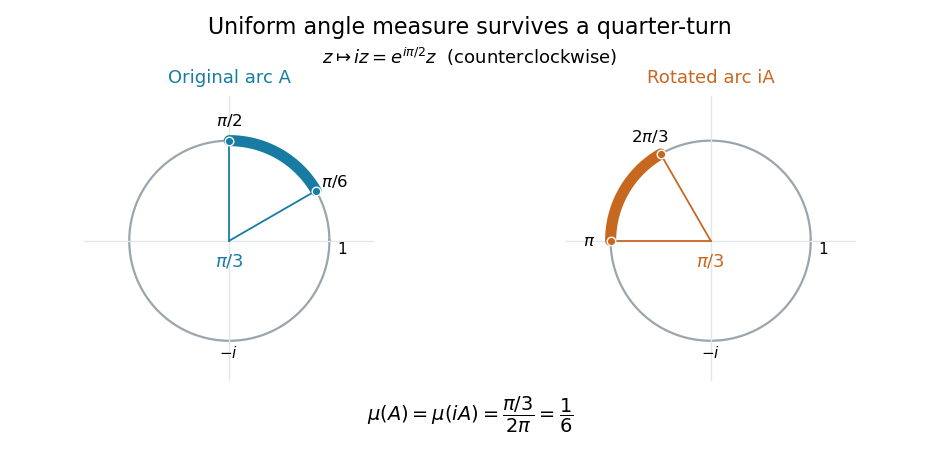
On the circle group , normalized Haar measure is the pushforward measure of uniform angle on . For a continuous function , defineThe factor makes the integral of the constant function equal to . For , a change of angle givesThe last equality uses the -periodic function . Since the circle group is an abelian group, this also verifies right invariance. An arc of angular length has normalized Haar measure . In particular, the arc and its quarter-turn both have measure .
The continuous unitary characters , indexed by integers, give a fully computed family of integrals:Here must be an integer, so is well defined and . Every nonconstant mode cancels exactly over a full turn. For example, the integral of is , and the integral of is . More generally,This is the orthogonality of complex exponentials underlying the Fourier basis and Fourier series: invariant averaging separates distinct frequencies and retains the constant component.
Fix a real angle fraction , and repeatedly multiply by in the circle group. The generated cyclic subgroup is . Equivalently, the angle fractions are the fractional parts of , with one full turn identified with zero.
If is a rational number in lowest terms, with and coprime, then and no smaller positive power is . Hence is a finite cyclic group of order , consisting of equally spaced points. For , the successive angle fractions, starting at , areThe subgroup is finite, so it is a closed subgroup of the circle group; it is also a discrete subgroup. It is not an open subgroup, since every ambient neighbourhood of any of its points contains an arc, rather than only these seven points.
If is an irrational number, no nonzero integer satisfies , so the powers never repeat. The stronger statement is that is a dense set in the circle group: every nonempty open arc contains a power . Thus its closure is all of , while itself is a countable proper subgroup and is not a closed subgroup or a discrete subgroup. See irrational rotation and everywhere interval frequency under an irrational rotation for the corresponding motion and its long-term frequencies.
For , direct computation of the fractional parts of gives, to six decimal places,For example, and . These calculations specify exactly which points the diagram displays.
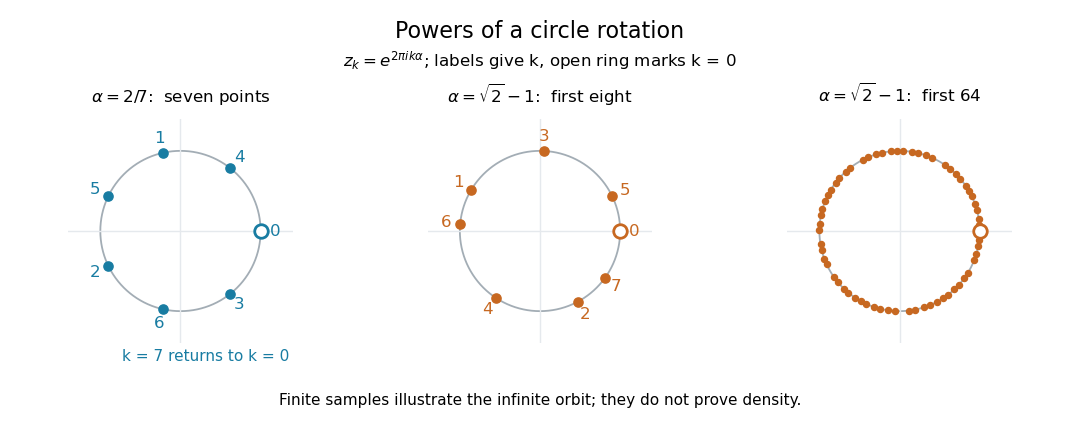
Seven repeating rational-rotation points and the first eight and sixty-four irrational-rotation points
. Labels give the power index ; the points are . The first panel uses , and the other two use . Each finite sample is only an illustration: a finite plot cannot establish that the infinite subgroup is a dense set. Reproduce the diagram with rational-versus-irrational-rotations.py. Details.This example shows why algebraic generation and closure must be distinguished: one irrational rotation generates a countable cyclic subgroup, yet its closure is the whole uncountable compact group.
The Peter-Weyl theorem makes finite-dimensional unitary representations separate elements of a compact group. Intersecting their closed kernels gives the identity subgroup. If the descending chain condition holds for closed subgroups, choose finitely many representations whose kernel intersection is already trivial: otherwise repeatedly exclude a surviving nonidentity element to obtain an infinite strict chain. Their direct sum is a faithful representation into a finite-dimensional unitary group. Compactness makes its image closed, and the closed-subgroup theorem gives the original group a compatible Lie group structure.
A nonempty closed subsemigroup of a compact group is a subgroup. For and a neighbourhood of the identity, choose with and cover the compact group by finitely many translates of . Two of sufficiently many powers lie in the same translate, so some positive power of belongs to . Hence the identity is a limit of positive powers and lies in . The preceding powers converge to , which also lies in . Applied to the closure of a positive-word monoid, this proves that it equals the closed subgroup generated by its generators, without assuming they already include their inverses.
Articles by others on the same topic



In the context of mathematics, specifically in the field of topology and group theory, a **compact group** is a group that is both compact as a topological space and a group in the sense of group operations. ### Definitions 1. **Topological Group**: A topological group is a set equipped with a group structure that is also a topological space, such that the group operations (multiplication and taking inverses) are continuous with respect to the topology of the space.